

2 On the Foundational Principles of Statistical Mechanics
87
(δE)
2
≡ ≡(E − −E)
2
= =E
2
− −E
2
=
1
Z
∂
2 Z
∂β 2
N ,V
−
1
Z
∂Z
∂β
N ,V
2
=
∂
2 log Z
∂β 2
N ,V
= −
∂U
∂β
N ,V
.
(2.7)
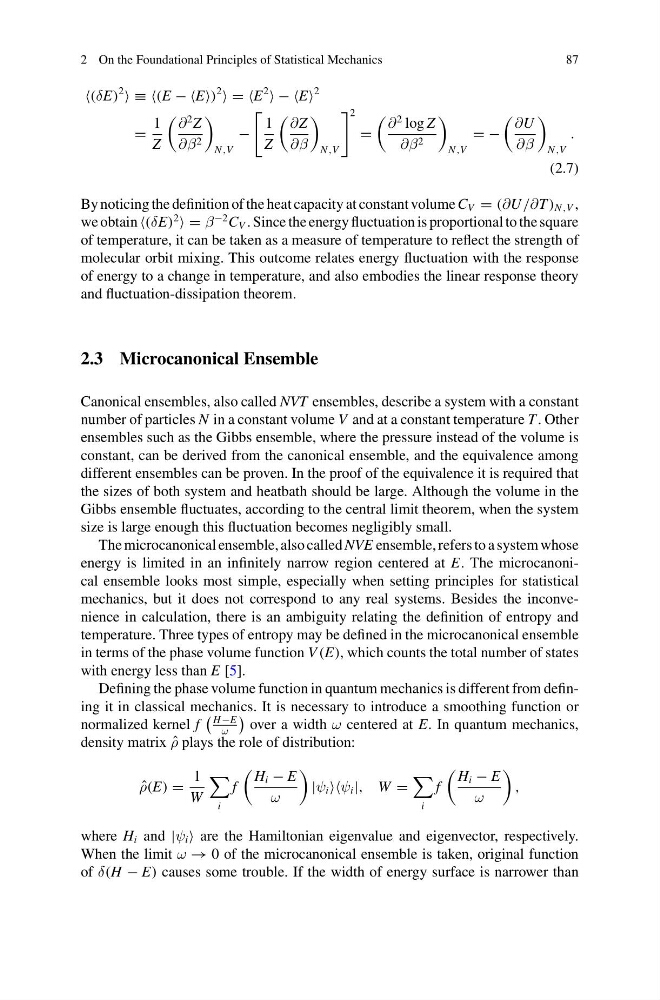
By noticing the definition of the heat capacity at constant volume C V = (∂U /∂T ) N ,V ,
we obtain (δE)
2
= β
−2 C V . Since the energy fluctuation is proportional to the square
of temperature, it can be taken as a measure of temperature to reflect the strength of
molecular orbit mixing. This outcome relates energy fluctuation with the response
of energy to a change in temperature, and also embodies the linear response theory
and fluctuation-dissipation theorem.
2.3 Microcanonical Ensemble
Canonical ensembles, also called NVT ensembles, describe a system with a constant
number of particles N in a constant volume V and at a constant temperature T . Other
ensembles such as the Gibbs ensemble, where the pressure instead of the volume is
constant, can be derived from the canonical ensemble, and the equivalence among
different ensembles can be proven. In the proof of the equivalence it is required that
the sizes of both system and heatbath should be large. Although the volume in the
Gibbs ensemble fluctuates, according to the central limit theorem, when the system
size is large enough this fluctuation becomes negligibly small.
The microcanonical ensemble, also called NVE ensemble, refers to a system whose
energy is limited in an infinitely narrow region centered at E. The microcanonical ensemble looks most simple, especially when setting principles for statistical
mechanics, but it does not correspond to any real systems. Besides the inconvenience in calculation, there is an ambiguity relating the definition of entropy and
temperature. Three types of entropy may be defined in the microcanonical ensemble
in terms of the phase volume function V (E), which counts the total number of states
with energy less than E [5].
Defining the phase volume function in quantum mechanics is different from defining it in classical mechanics. It is necessary to introduce a smoothing function or
normalized kernel f
H −E
ω
over a width ω centered at E. In quantum mechanics,
density matrix ˆ
ρ plays the role of distribution:
ˆ
ρ(E) =
1
W
i
f
H i − E
ω
|ψ i ψ i |, W =
i
f
H i − E
ω
,
where H i and |ψ i are the Hamiltonian eigenvalue and eigenvector, respectively.
When the limit ω → 0 of the microcanonical ensemble is taken, original function
of δ(H − E) causes some trouble. If the width of energy surface is narrower than
87
(δE)
2
≡ ≡(E − −E)
2
= =E
2
− −E
2
=
1
Z
∂
2 Z
∂β 2
N ,V
−
1
Z
∂Z
∂β
N ,V
2
=
∂
2 log Z
∂β 2
N ,V
= −
∂U
∂β
N ,V
.
(2.7)
By noticing the definition of the heat capacity at constant volume C V = (∂U /∂T ) N ,V ,
we obtain (δE)
2
= β
−2 C V . Since the energy fluctuation is proportional to the square
of temperature, it can be taken as a measure of temperature to reflect the strength of
molecular orbit mixing. This outcome relates energy fluctuation with the response
of energy to a change in temperature, and also embodies the linear response theory
and fluctuation-dissipation theorem.
2.3 Microcanonical Ensemble
Canonical ensembles, also called NVT ensembles, describe a system with a constant
number of particles N in a constant volume V and at a constant temperature T . Other
ensembles such as the Gibbs ensemble, where the pressure instead of the volume is
constant, can be derived from the canonical ensemble, and the equivalence among
different ensembles can be proven. In the proof of the equivalence it is required that
the sizes of both system and heatbath should be large. Although the volume in the
Gibbs ensemble fluctuates, according to the central limit theorem, when the system
size is large enough this fluctuation becomes negligibly small.
The microcanonical ensemble, also called NVE ensemble, refers to a system whose
energy is limited in an infinitely narrow region centered at E. The microcanonical ensemble looks most simple, especially when setting principles for statistical
mechanics, but it does not correspond to any real systems. Besides the inconvenience in calculation, there is an ambiguity relating the definition of entropy and
temperature. Three types of entropy may be defined in the microcanonical ensemble
in terms of the phase volume function V (E), which counts the total number of states
with energy less than E [5].
Defining the phase volume function in quantum mechanics is different from defining it in classical mechanics. It is necessary to introduce a smoothing function or
normalized kernel f
H −E
ω
over a width ω centered at E. In quantum mechanics,
density matrix ˆ
ρ plays the role of distribution:
ˆ
ρ(E) =
1
W
i
f
H i − E
ω
|ψ i ψ i |, W =
i
f
H i − E
ω
,
where H i and |ψ i are the Hamiltonian eigenvalue and eigenvector, respectively.
When the limit ω → 0 of the microcanonical ensemble is taken, original function
of δ(H − E) causes some trouble. If the width of energy surface is narrower than