

86
W.-M. Zheng
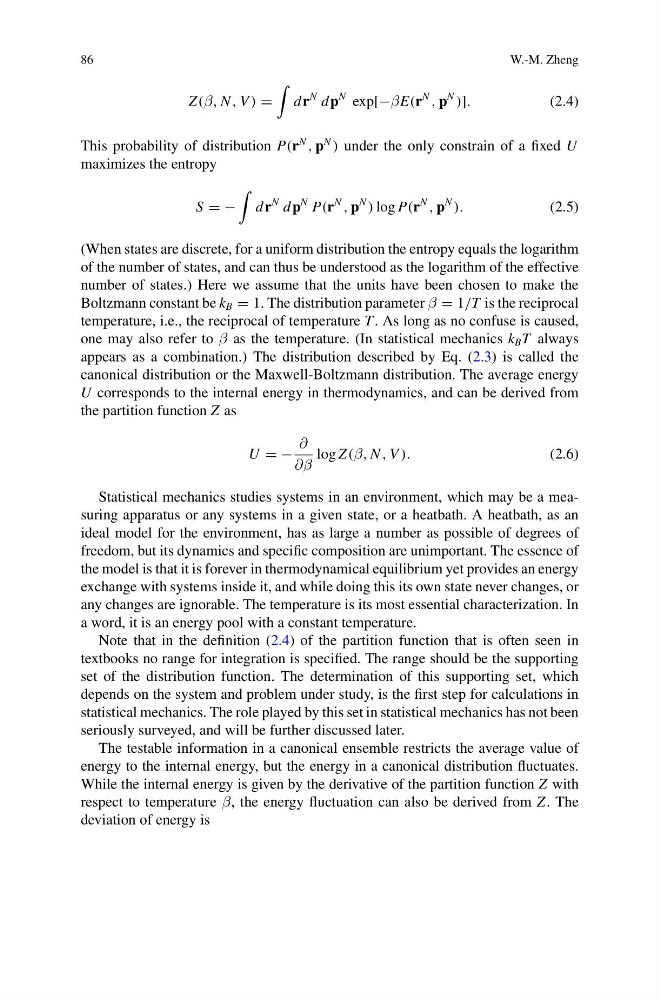
Z(β, N , V ) =
d r
N d p
N exp[−βE(r
N
, p
N
)].
(2.4)
This probability of distribution P(r
N
, p
N
) under the only constrain of a fixed U
maximizes the entropy
S = −
d r
N d p
N P(r
N
, p
N
) log P(r
N
, p
N
).
(2.5)
(When states are discrete, for a uniform distribution the entropy equals the logarithm
of the number of states, and can thus be understood as the logarithm of the effective
number of states.) Here we assume that the units have been chosen to make the
Boltzmann constant be k B = 1. The distribution parameter β = 1/T is the reciprocal
temperature, i.e., the reciprocal of temperature T . As long as no confuse is caused,
one may also refer to β as the temperature. (In statistical mechanics k B T always
appears as a combination.) The distribution described by Eq. (2.3) is called the
canonical distribution or the Maxwell-Boltzmann distribution. The average energy
U corresponds to the internal energy in thermodynamics, and can be derived from
the partition function Z as
U = −
∂
∂β
log Z(β, N , V ).
(2.6)
Statistical mechanics studies systems in an environment, which may be a measuring apparatus or any systems in a given state, or a heatbath. A heatbath, as an
ideal model for the environment, has as large a number as possible of degrees of
freedom, but its dynamics and specific composition are unimportant. The essence of
the model is that it is forever in thermodynamical equilibrium yet provides an energy
exchange with systems inside it, and while doing this its own state never changes, or
any changes are ignorable. The temperature is its most essential characterization. In
a word, it is an energy pool with a constant temperature.
Note that in the definition (2.4) of the partition function that is often seen in
textbooks no range for integration is specified. The range should be the supporting
set of the distribution function. The determination of this supporting set, which
depends on the system and problem under study, is the first step for calculations in
statistical mechanics. The role played by this set in statistical mechanics has not been
seriously surveyed, and will be further discussed later.
The testable information in a canonical ensemble restricts the average value of
energy to the internal energy, but the energy in a canonical distribution fluctuates.
While the internal energy is given by the derivative of the partition function Z with
respect to temperature β, the energy fluctuation can also be derived from Z. The
deviation of energy is
W.-M. Zheng
Z(β, N , V ) =
d r
N d p
N exp[−βE(r
N
, p
N
)].
(2.4)
This probability of distribution P(r
N
, p
N
) under the only constrain of a fixed U
maximizes the entropy
S = −
d r
N d p
N P(r
N
, p
N
) log P(r
N
, p
N
).
(2.5)
(When states are discrete, for a uniform distribution the entropy equals the logarithm
of the number of states, and can thus be understood as the logarithm of the effective
number of states.) Here we assume that the units have been chosen to make the
Boltzmann constant be k B = 1. The distribution parameter β = 1/T is the reciprocal
temperature, i.e., the reciprocal of temperature T . As long as no confuse is caused,
one may also refer to β as the temperature. (In statistical mechanics k B T always
appears as a combination.) The distribution described by Eq. (2.3) is called the
canonical distribution or the Maxwell-Boltzmann distribution. The average energy
U corresponds to the internal energy in thermodynamics, and can be derived from
the partition function Z as
U = −
∂
∂β
log Z(β, N , V ).
(2.6)
Statistical mechanics studies systems in an environment, which may be a measuring apparatus or any systems in a given state, or a heatbath. A heatbath, as an
ideal model for the environment, has as large a number as possible of degrees of
freedom, but its dynamics and specific composition are unimportant. The essence of
the model is that it is forever in thermodynamical equilibrium yet provides an energy
exchange with systems inside it, and while doing this its own state never changes, or
any changes are ignorable. The temperature is its most essential characterization. In
a word, it is an energy pool with a constant temperature.
Note that in the definition (2.4) of the partition function that is often seen in
textbooks no range for integration is specified. The range should be the supporting
set of the distribution function. The determination of this supporting set, which
depends on the system and problem under study, is the first step for calculations in
statistical mechanics. The role played by this set in statistical mechanics has not been
seriously surveyed, and will be further discussed later.
The testable information in a canonical ensemble restricts the average value of
energy to the internal energy, but the energy in a canonical distribution fluctuates.
While the internal energy is given by the derivative of the partition function Z with
respect to temperature β, the energy fluctuation can also be derived from Z. The
deviation of energy is