

88
W.-M. Zheng
the distance between energy levels, the count of the number of levels may be zero.
Level degeneracy rarely occurs in a complex system, so the number of energy states
changes discretely in energy. The derivative of the count with respect to energy
becomes either zero or infinite. Thus, a smoothing function f over a finite width of
energy surface is needed to avoid singularity, and the NVE ensemble becomes the
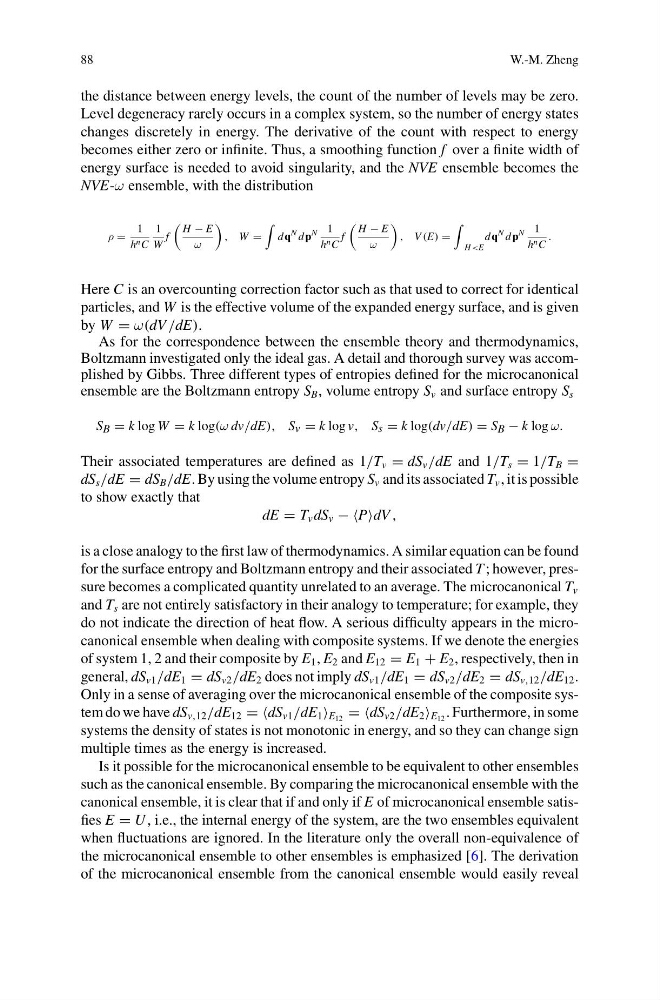
NVE-ω ensemble, with the distribution
ρ =
1
h n C
1
W
f
H − E
ω
, W =
d q
N d p
N 1
h n C
f
H − E
ω
, V (E) =
H
N d p
N 1
h n C
.
Here C is an overcounting correction factor such as that used to correct for identical
particles, and W is the effective volume of the expanded energy surface, and is given
by W = ω(dV /dE).
As for the correspondence between the ensemble theory and thermodynamics,
Boltzmann investigated only the ideal gas. A detail and thorough survey was accomplished by Gibbs. Three different types of entropies defined for the microcanonical
ensemble are the Boltzmann entropy S B , volume entropy S v and surface entropy S s
S B = k log W = k log(ω dv/dE), S v = k log v, S s = k log(dv/dE) = S B − k log ω.
Their associated temperatures are defined as 1/T v = dS v /dE and 1/T s = 1/T B =
dS s /dE = dS B /dE. By using the volume entropy S v and its associated T v , it is possible
to show exactly that
dE = T v dS v − −PdV ,
is a close analogy to the first law of thermodynamics. A similar equation can be found
for the surface entropy and Boltzmann entropy and their associated T ; however, pressure becomes a complicated quantity unrelated to an average. The microcanonical T v
and T s are not entirely satisfactory in their analogy to temperature; for example, they
do not indicate the direction of heat flow. A serious difficulty appears in the microcanonical ensemble when dealing with composite systems. If we denote the energies
of system 1, 2 and their composite by E 1 , E 2 and E 12 = E 1 + E 2 , respectively, then in
general, dS v1 /dE 1 = dS v2 /dE 2 does not imply dS v1 /dE 1 = dS v2 /dE 2 = dS v,12 /dE 12 .
Only in a sense of averaging over the microcanonical ensemble of the composite system do we have dS v,12 /dE 12 = =dS v1 /dE 1 E 12 = =dS v2 /dE 2 E 12 . Furthermore, in some
systems the density of states is not monotonic in energy, and so they can change sign
multiple times as the energy is increased.
Is it possible for the microcanonical ensemble to be equivalent to other ensembles
such as the canonical ensemble. By comparing the microcanonical ensemble with the
canonical ensemble, it is clear that if and only if E of microcanonical ensemble satisfies E = U , i.e., the internal energy of the system, are the two ensembles equivalent
when fluctuations are ignored. In the literature only the overall non-equivalence of
the microcanonical ensemble to other ensembles is emphasized [6]. The derivation
of the microcanonical ensemble from the canonical ensemble would easily reveal
W.-M. Zheng
the distance between energy levels, the count of the number of levels may be zero.
Level degeneracy rarely occurs in a complex system, so the number of energy states
changes discretely in energy. The derivative of the count with respect to energy
becomes either zero or infinite. Thus, a smoothing function f over a finite width of
energy surface is needed to avoid singularity, and the NVE ensemble becomes the
NVE-ω ensemble, with the distribution
ρ =
1
h n C
1
W
f
H − E
ω
, W =
d q
N d p
N 1
h n C
f
H − E
ω
, V (E) =
H
N d p
N 1
h n C
.
Here C is an overcounting correction factor such as that used to correct for identical
particles, and W is the effective volume of the expanded energy surface, and is given
by W = ω(dV /dE).
As for the correspondence between the ensemble theory and thermodynamics,
Boltzmann investigated only the ideal gas. A detail and thorough survey was accomplished by Gibbs. Three different types of entropies defined for the microcanonical
ensemble are the Boltzmann entropy S B , volume entropy S v and surface entropy S s
S B = k log W = k log(ω dv/dE), S v = k log v, S s = k log(dv/dE) = S B − k log ω.
Their associated temperatures are defined as 1/T v = dS v /dE and 1/T s = 1/T B =
dS s /dE = dS B /dE. By using the volume entropy S v and its associated T v , it is possible
to show exactly that
dE = T v dS v − −PdV ,
is a close analogy to the first law of thermodynamics. A similar equation can be found
for the surface entropy and Boltzmann entropy and their associated T ; however, pressure becomes a complicated quantity unrelated to an average. The microcanonical T v
and T s are not entirely satisfactory in their analogy to temperature; for example, they
do not indicate the direction of heat flow. A serious difficulty appears in the microcanonical ensemble when dealing with composite systems. If we denote the energies
of system 1, 2 and their composite by E 1 , E 2 and E 12 = E 1 + E 2 , respectively, then in
general, dS v1 /dE 1 = dS v2 /dE 2 does not imply dS v1 /dE 1 = dS v2 /dE 2 = dS v,12 /dE 12 .
Only in a sense of averaging over the microcanonical ensemble of the composite system do we have dS v,12 /dE 12 = =dS v1 /dE 1 E 12 = =dS v2 /dE 2 E 12 . Furthermore, in some
systems the density of states is not monotonic in energy, and so they can change sign
multiple times as the energy is increased.
Is it possible for the microcanonical ensemble to be equivalent to other ensembles
such as the canonical ensemble. By comparing the microcanonical ensemble with the
canonical ensemble, it is clear that if and only if E of microcanonical ensemble satisfies E = U , i.e., the internal energy of the system, are the two ensembles equivalent
when fluctuations are ignored. In the literature only the overall non-equivalence of
the microcanonical ensemble to other ensembles is emphasized [6]. The derivation
of the microcanonical ensemble from the canonical ensemble would easily reveal