

1 Introduction to Nonequilibrium Statistical Physics and Its Foundations
71
1.9.2 t-Mixing and a General Theory of Response
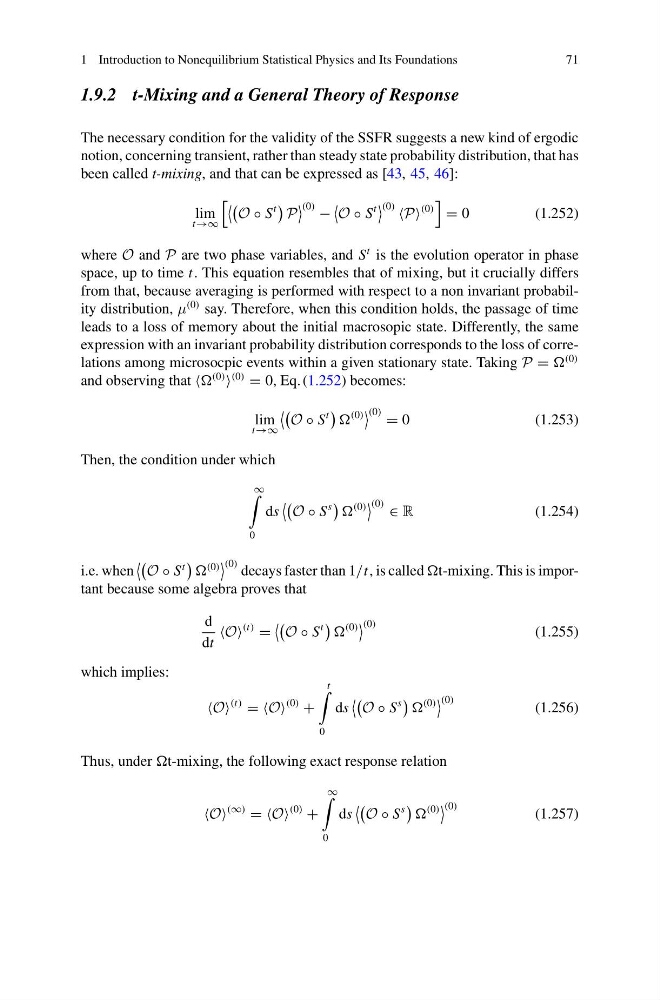
The necessary condition for the validity of the SSFR suggests a new kind of ergodic
notion, concerning transient, rather than steady state probability distribution, that has
been called t-mixing, and that can be expressed as [43, 45, 46]:
lim
t→∞
O ◦ S
t
P
(0) −
O ◦ S
t
(0) P
(0)
= 0
(1.252)
where O and P are two phase variables, and S
t is the evolution operator in phase
space, up to time t. This equation resembles that of mixing, but it crucially differs
from that, because averaging is performed with respect to a non invariant probability distribution, μ
(0) say. Therefore, when this condition holds, the passage of time
leads to a loss of memory about the initial macrosopic state. Differently, the same
expression with an invariant probability distribution corresponds to the loss of correlations among microsocpic events within a given stationary state. Taking P =
(0)
and observing that
(0)
(0)
= 0, Eq. (1.252) becomes:
lim
t→∞
O ◦ S
t
(0)
(0) = 0
(1.253)
Then, the condition under which
∞
0
ds
O ◦ S
s
(0)
(0) ∈ R
(1.254)
i.e. when
O ◦ S
t
(0)
(0) decays faster than 1/t, is called t-mixing. This is important because some algebra proves that
d
dt
O
(t)
=
O ◦ S
t
(0)
(0)
(1.255)
which implies:
O
(t)
= O
(0)
+
t
0
ds
O ◦ S
s
(0)
(0)
(1.256)
Thus, under t-mixing, the following exact response relation
O
(∞)
= O
(0)
+
∞
0
ds
O ◦ S
s
(0)
(0)
(1.257)
71
1.9.2 t-Mixing and a General Theory of Response
The necessary condition for the validity of the SSFR suggests a new kind of ergodic
notion, concerning transient, rather than steady state probability distribution, that has
been called t-mixing, and that can be expressed as [43, 45, 46]:
lim
t→∞
O ◦ S
t
P
(0) −
O ◦ S
t
(0) P
(0)
= 0
(1.252)
where O and P are two phase variables, and S
t is the evolution operator in phase
space, up to time t. This equation resembles that of mixing, but it crucially differs
from that, because averaging is performed with respect to a non invariant probability distribution, μ
(0) say. Therefore, when this condition holds, the passage of time
leads to a loss of memory about the initial macrosopic state. Differently, the same
expression with an invariant probability distribution corresponds to the loss of correlations among microsocpic events within a given stationary state. Taking P =
(0)
and observing that
(0)
(0)
= 0, Eq. (1.252) becomes:
lim
t→∞
O ◦ S
t
(0)
(0) = 0
(1.253)
Then, the condition under which
∞
0
ds
O ◦ S
s
(0)
(0) ∈ R
(1.254)
i.e. when
O ◦ S
t
(0)
(0) decays faster than 1/t, is called t-mixing. This is important because some algebra proves that
d
dt
O
(t)
=
O ◦ S
t
(0)
(0)
(1.255)
which implies:
O
(t)
= O
(0)
+
t
0
ds
O ◦ S
s
(0)
(0)
(1.256)
Thus, under t-mixing, the following exact response relation
O
(∞)
= O
(0)
+
∞
0
ds
O ◦ S
s
(0)
(0)
(1.257)