

70
L. Rondoni
instead been identified. In particular, for the validity of the standard steady state FR,
one needs
lim
t→∞
M(A, δ, τ , t)
(1.248)
to exist, in which case we denote by
M(A, δ, τ ), or at least to remain bounded. When
that happens for any δ > 0, the long τ limit
lim
τ →∞
1
τ
M(A, δ, τ ) = 0
(1.249)
eliminates this term from Eq. (1.245), and one may state that A belongs to the domain
of the steady state FR, which takes the form:
A − δ ≤ lim
τ →∞
1
τ
ln
μ ∞ (
(0)
0,τ ∈ A
+
δ )
μ ∞ (
(0)
0,τ ∈ A
−
δ )
≤ A + δ , ∀δ > 0
(1.250)
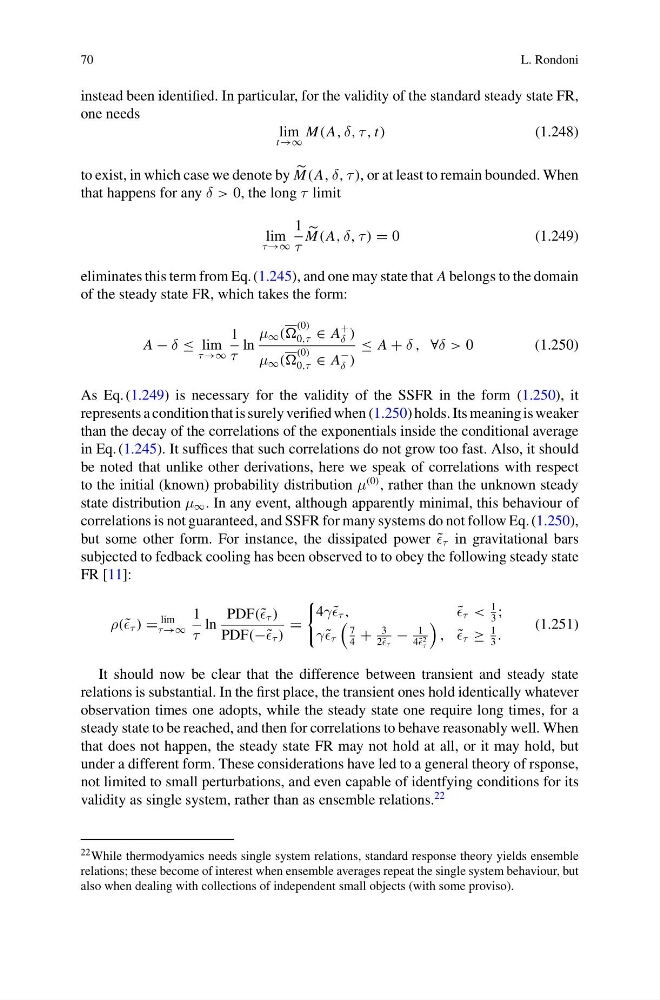
As Eq. (1.249) is necessary for the validity of the SSFR in the form (1.250), it
represents a condition that is surely verified when (1.250) holds. Its meaning is weaker
than the decay of the correlations of the exponentials inside the conditional average
in Eq. (1.245). It suffices that such correlations do not grow too fast. Also, it should
be noted that unlike other derivations, here we speak of correlations with respect
to the initial (known) probability distribution μ
(0) , rather than the unknown steady
state distribution μ ∞ . In any event, although apparently minimal, this behaviour of
correlations is not guaranteed, and SSFR for many systems do not follow Eq. (1.250),
but some other form. For instance, the dissipated power ˜
τ in gravitational bars
subjected to fedback cooling has been observed to to obey the following steady state
FR [11]:
ρ(˜ τ ) =
lim
τ →∞
1
τ
ln
PDF(˜ τ )
PDF(−˜ τ )
=
4γ ˜
τ ,
˜
τ <
1
3
;
γ ˜
τ
7
4
+
3
2˜ τ
−
1
4˜ 2
τ
, ˜
τ ≥
1
3
.
(1.251)
It should now be clear that the difference between transient and steady state
relations is substantial. In the first place, the transient ones hold identically whatever
observation times one adopts, while the steady state one require long times, for a
steady state to be reached, and then for correlations to behave reasonably well. When
that does not happen, the steady state FR may not hold at all, or it may hold, but
under a different form. These considerations have led to a general theory of rsponse,
not limited to small perturbations, and even capable of identfying conditions for its
validity as single system, rather than as ensemble relations.
22
22 While thermodyamics needs single system relations, standard response theory yields ensemble
relations; these become of interest when ensemble averages repeat the single system behaviour, but
also when dealing with collections of independent small objects (with some proviso).
L. Rondoni
instead been identified. In particular, for the validity of the standard steady state FR,
one needs
lim
t→∞
M(A, δ, τ , t)
(1.248)
to exist, in which case we denote by
M(A, δ, τ ), or at least to remain bounded. When
that happens for any δ > 0, the long τ limit
lim
τ →∞
1
τ
M(A, δ, τ ) = 0
(1.249)
eliminates this term from Eq. (1.245), and one may state that A belongs to the domain
of the steady state FR, which takes the form:
A − δ ≤ lim
τ →∞
1
τ
ln
μ ∞ (
(0)
0,τ ∈ A
+
δ )
μ ∞ (
(0)
0,τ ∈ A
−
δ )
≤ A + δ , ∀δ > 0
(1.250)
As Eq. (1.249) is necessary for the validity of the SSFR in the form (1.250), it
represents a condition that is surely verified when (1.250) holds. Its meaning is weaker
than the decay of the correlations of the exponentials inside the conditional average
in Eq. (1.245). It suffices that such correlations do not grow too fast. Also, it should
be noted that unlike other derivations, here we speak of correlations with respect
to the initial (known) probability distribution μ
(0) , rather than the unknown steady
state distribution μ ∞ . In any event, although apparently minimal, this behaviour of
correlations is not guaranteed, and SSFR for many systems do not follow Eq. (1.250),
but some other form. For instance, the dissipated power ˜
τ in gravitational bars
subjected to fedback cooling has been observed to to obey the following steady state
FR [11]:
ρ(˜ τ ) =
lim
τ →∞
1
τ
ln
PDF(˜ τ )
PDF(−˜ τ )
=
4γ ˜
τ ,
˜
τ <
1
3
;
γ ˜
τ
7
4
+
3
2˜ τ
−
1
4˜ 2
τ
, ˜
τ ≥
1
3
.
(1.251)
It should now be clear that the difference between transient and steady state
relations is substantial. In the first place, the transient ones hold identically whatever
observation times one adopts, while the steady state one require long times, for a
steady state to be reached, and then for correlations to behave reasonably well. When
that does not happen, the steady state FR may not hold at all, or it may hold, but
under a different form. These considerations have led to a general theory of rsponse,
not limited to small perturbations, and even capable of identfying conditions for its
validity as single system, rather than as ensemble relations.
22
22 While thermodyamics needs single system relations, standard response theory yields ensemble
relations; these become of interest when ensemble averages repeat the single system behaviour, but
also when dealing with collections of independent small objects (with some proviso).