

72
L. Rondoni
holds. As in standard linear response theory, this formula expresses relaxation to a
stationary state in the sense of ensembles, but is exact, and not limited to the linear
regime. Furthemore, it applies to dynamical systems in general, and can be extended
to stochastic processes as well. Finally, conditions can be given so that it expresses
single system relaxation rather than ensemble response, which is important in view
of the difficulties that affect the notion of ensmbles in time dependent situations,
[45].
1.10 From Ergodic Theory to Big Data
One of the main ideas behind big data and machine learning is that knowledge of the
past (data) suffices to predict the future. So given time series of some kind of signal,
one may think that there is an unknown underlying dynamical system that generates
the signal. For simplicity, take the dynamics to be discrete in time:
x 1 = Sx 0
(1.258)
x 2 = Sx 1 = S
2 x 0
(1.259)
. . .
x k = Sx k−1 = S
k x 0
(1.260)
Then, let A ⊂ M be a measurable set in phase space, and denote by τ A (x) the
recurrence time in that set, i.e. the shortest time after which a point of A returns to
A:
τ A (x) = inf{k ≥ 1 : x ∈ A, and S
k x ∈ A} ,
(1.261)
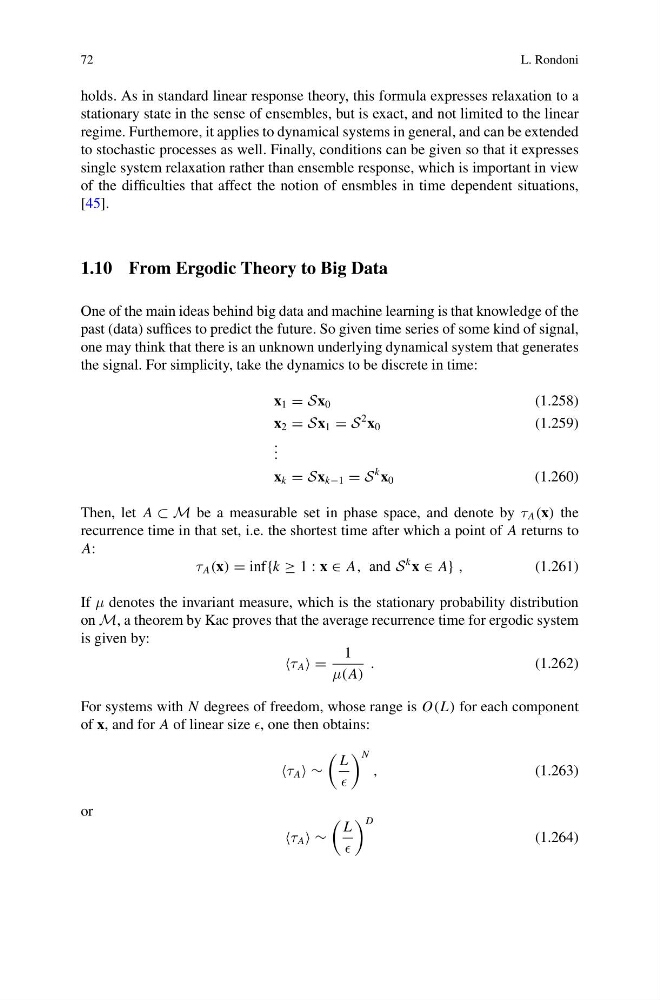
If μ denotes the invariant measure, which is the stationary probability distribution
on M, a theorem by Kac proves that the average recurrence time for ergodic system
is given by:
τ A =
1
μ(A)
.
(1.262)
For systems with N degrees of freedom, whose range is O(L) for each component
of x, and for A of linear size , one then obtains:
τ A ∼
L
N
,
(1.263)
or
τ A ∼
L
D
(1.264)
L. Rondoni
holds. As in standard linear response theory, this formula expresses relaxation to a
stationary state in the sense of ensembles, but is exact, and not limited to the linear
regime. Furthemore, it applies to dynamical systems in general, and can be extended
to stochastic processes as well. Finally, conditions can be given so that it expresses
single system relaxation rather than ensemble response, which is important in view
of the difficulties that affect the notion of ensmbles in time dependent situations,
[45].
1.10 From Ergodic Theory to Big Data
One of the main ideas behind big data and machine learning is that knowledge of the
past (data) suffices to predict the future. So given time series of some kind of signal,
one may think that there is an unknown underlying dynamical system that generates
the signal. For simplicity, take the dynamics to be discrete in time:
x 1 = Sx 0
(1.258)
x 2 = Sx 1 = S
2 x 0
(1.259)
. . .
x k = Sx k−1 = S
k x 0
(1.260)
Then, let A ⊂ M be a measurable set in phase space, and denote by τ A (x) the
recurrence time in that set, i.e. the shortest time after which a point of A returns to
A:
τ A (x) = inf{k ≥ 1 : x ∈ A, and S
k x ∈ A} ,
(1.261)
If μ denotes the invariant measure, which is the stationary probability distribution
on M, a theorem by Kac proves that the average recurrence time for ergodic system
is given by:
τ A =
1
μ(A)
.
(1.262)
For systems with N degrees of freedom, whose range is O(L) for each component
of x, and for A of linear size , one then obtains:
τ A ∼
L
N
,
(1.263)
or
τ A ∼
L
D
(1.264)