

1 Introduction to Nonequilibrium Statistical Physics and Its Foundations
57
1.8 Linear Response
The next natural question is what happens if an equilibrium state is perturbed by some
external action. The simplest case consists of a particle system with Hamiltonian
H 0 (P, Q), which is given some extra energy λ A(P, Q) say, with λ ∈ R, so that a
new Hamiltonian H(P, Q) = H 0 (P, Q) + λA(P, Q) is produced. If both the initial
and the final states correspond to equilibria at inverse temperature β = 1/kT , the
canonical ensembles:
f 0 (P, Q) =
exp(−βH 0 )
dPdQ exp(−βH 0 )
, f (P, Q) =
exp(−βH)
dPdQ exp(−βH)
(1.199)
describe the statistics of the microscopic phases. Provided λ is small, the first order
approximation in λ constitutes a good approximation of f :
f (P, Q)
exp(−βH 0 )
dPdQ exp(−βH 0 )
1 − λβ A(P, Q)
1 − λβA(P, Q) 0
(1.200)
= f 0 (P, Q)
1 − λβ [A(P, Q) − −A(P, Q) 0 ]
(1.201)
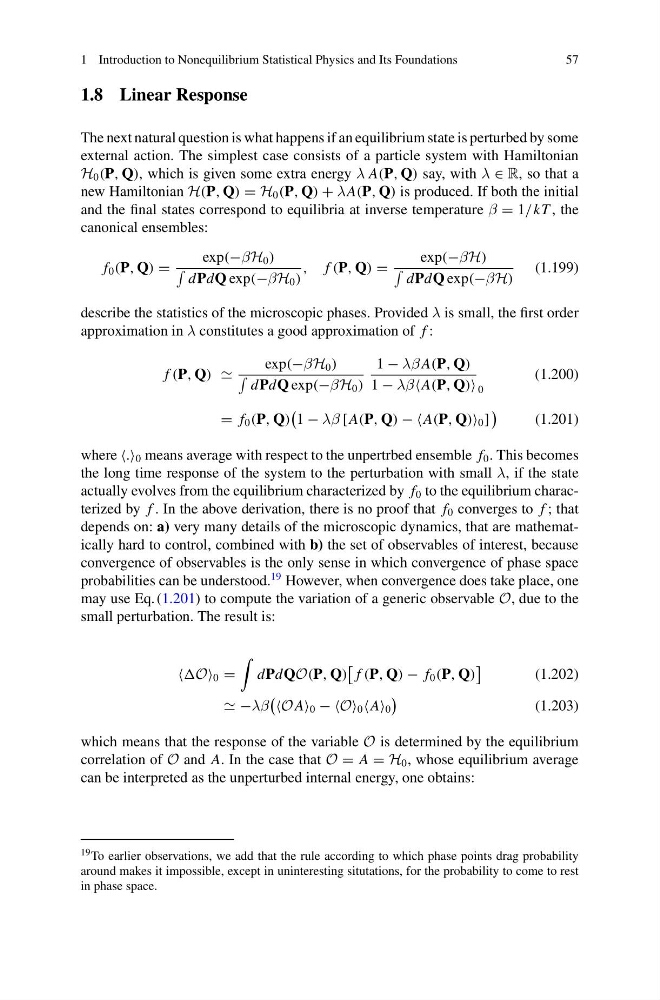
where . 0 means average with respect to the unpertrbed ensemble f 0 . This becomes
the long time response of the system to the perturbation with small λ, if the state
actually evolves from the equilibrium characterized by f 0 to the equilibrium characterized by f . In the above derivation, there is no proof that f 0 converges to f ; that
depends on: a) very many details of the microscopic dynamics, that are mathematically hard to control, combined with b) the set of observables of interest, because
convergence of observables is the only sense in which convergence of phase space
probabilities can be understood.
19 However, when convergence does take place, one
may use Eq. (1.201) to compute the variation of a generic observable O, due to the
small perturbation. The result is:
O 0 =
dPdQO(P, Q)
f (P, Q) − f 0 (P, Q)
(1.202)
−λβ
O A 0 − −O 0 A 0
(1.203)
which means that the response of the variable O is determined by the equilibrium
correlation of O and A. In the case that O = A = H 0 , whose equilibrium average
can be interpreted as the unperturbed internal energy, one obtains:
19 To earlier observations, we add that the rule according to which phase points drag probability
around makes it impossible, except in uninteresting situtations, for the probability to come to rest
in phase space.
57
1.8 Linear Response
The next natural question is what happens if an equilibrium state is perturbed by some
external action. The simplest case consists of a particle system with Hamiltonian
H 0 (P, Q), which is given some extra energy λ A(P, Q) say, with λ ∈ R, so that a
new Hamiltonian H(P, Q) = H 0 (P, Q) + λA(P, Q) is produced. If both the initial
and the final states correspond to equilibria at inverse temperature β = 1/kT , the
canonical ensembles:
f 0 (P, Q) =
exp(−βH 0 )
dPdQ exp(−βH 0 )
, f (P, Q) =
exp(−βH)
dPdQ exp(−βH)
(1.199)
describe the statistics of the microscopic phases. Provided λ is small, the first order
approximation in λ constitutes a good approximation of f :
f (P, Q)
exp(−βH 0 )
dPdQ exp(−βH 0 )
1 − λβ A(P, Q)
1 − λβA(P, Q) 0
(1.200)
= f 0 (P, Q)
1 − λβ [A(P, Q) − −A(P, Q) 0 ]
(1.201)
where . 0 means average with respect to the unpertrbed ensemble f 0 . This becomes
the long time response of the system to the perturbation with small λ, if the state
actually evolves from the equilibrium characterized by f 0 to the equilibrium characterized by f . In the above derivation, there is no proof that f 0 converges to f ; that
depends on: a) very many details of the microscopic dynamics, that are mathematically hard to control, combined with b) the set of observables of interest, because
convergence of observables is the only sense in which convergence of phase space
probabilities can be understood.
19 However, when convergence does take place, one
may use Eq. (1.201) to compute the variation of a generic observable O, due to the
small perturbation. The result is:
O 0 =
dPdQO(P, Q)
f (P, Q) − f 0 (P, Q)
(1.202)
−λβ
O A 0 − −O 0 A 0
(1.203)
which means that the response of the variable O is determined by the equilibrium
correlation of O and A. In the case that O = A = H 0 , whose equilibrium average
can be interpreted as the unperturbed internal energy, one obtains:
19 To earlier observations, we add that the rule according to which phase points drag probability
around makes it impossible, except in uninteresting situtations, for the probability to come to rest
in phase space.