

56
L. Rondoni
Nonlinear generalizations also exist, but they still require LTE for the hydrodynamic/thermodyamic fields to exist.
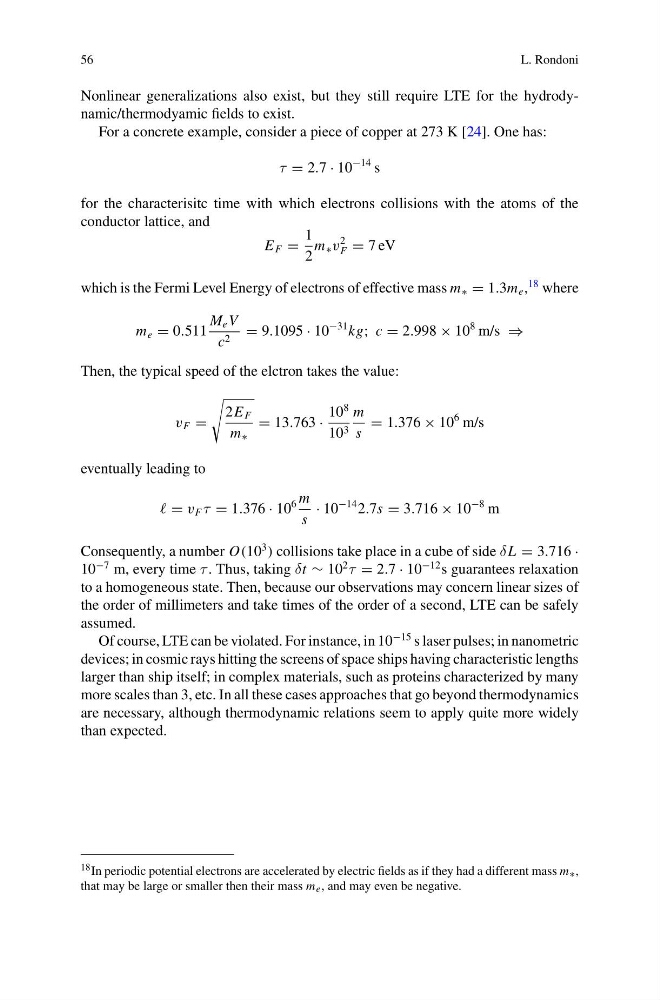
For a concrete example, consider a piece of copper at 273 K [24]. One has:
τ = 2.7 · 10
−14 s
for the characterisitc time with which electrons collisions with the atoms of the
conductor lattice, and
E F =
1
2
m ∗ v
2
F = 7 eV
which is the Fermi Level Energy of electrons of effective mass m ∗ = 1.3m e ,
18 where
m e = 0.511
M e V
c 2 = 9.1095 · 10
−31 kg; c = 2.998 × 10
8 m/s ⇒
Then, the typical speed of the elctron takes the value:
v F =
2E F
m ∗
= 13.763 ·
10
8
10 3
m
s
= 1.376 × 10
6 m/s
eventually leading to
= v F τ = 1.376 · 10
6 m
s
· 10
−14 2.7s = 3.716 × 10
−8 m
Consequently, a number O(10
3
) collisions take place in a cube of side δL = 3.716 ·
10
−7 m, every time τ . Thus, taking δt ∼ 10
2
τ = 2.7 · 10
−12 s guarantees relaxation
to a homogeneous state. Then, because our observations may concern linear sizes of
the order of millimeters and take times of the order of a second, LTE can be safely
assumed.
Of course, LTE can be violated. For instance, in 10
−15 s laser pulses; in nanometric
devices; in cosmic rays hitting the screens of space ships having characteristic lengths
larger than ship itself; in complex materials, such as proteins characterized by many
more scales than 3, etc. In all these cases approaches that go beyond thermodynamics
are necessary, although thermodynamic relations seem to apply quite more widely
than expected.
18 In periodic potential electrons are accelerated by electric fields as if they had a different mass m ∗ ,
that may be large or smaller then their mass m e , and may even be negative.
L. Rondoni
Nonlinear generalizations also exist, but they still require LTE for the hydrodynamic/thermodyamic fields to exist.
For a concrete example, consider a piece of copper at 273 K [24]. One has:
τ = 2.7 · 10
−14 s
for the characterisitc time with which electrons collisions with the atoms of the
conductor lattice, and
E F =
1
2
m ∗ v
2
F = 7 eV
which is the Fermi Level Energy of electrons of effective mass m ∗ = 1.3m e ,
18 where
m e = 0.511
M e V
c 2 = 9.1095 · 10
−31 kg; c = 2.998 × 10
8 m/s ⇒
Then, the typical speed of the elctron takes the value:
v F =
2E F
m ∗
= 13.763 ·
10
8
10 3
m
s
= 1.376 × 10
6 m/s
eventually leading to
= v F τ = 1.376 · 10
6 m
s
· 10
−14 2.7s = 3.716 × 10
−8 m
Consequently, a number O(10
3
) collisions take place in a cube of side δL = 3.716 ·
10
−7 m, every time τ . Thus, taking δt ∼ 10
2
τ = 2.7 · 10
−12 s guarantees relaxation
to a homogeneous state. Then, because our observations may concern linear sizes of
the order of millimeters and take times of the order of a second, LTE can be safely
assumed.
Of course, LTE can be violated. For instance, in 10
−15 s laser pulses; in nanometric
devices; in cosmic rays hitting the screens of space ships having characteristic lengths
larger than ship itself; in complex materials, such as proteins characterized by many
more scales than 3, etc. In all these cases approaches that go beyond thermodynamics
are necessary, although thermodynamic relations seem to apply quite more widely
than expected.
18 In periodic potential electrons are accelerated by electric fields as if they had a different mass m ∗ ,
that may be large or smaller then their mass m e , and may even be negative.