

58
L. Rondoni
H 0 0
λβ
−
H
2
0 0 − −H 0
2
0
= −k B T
2 C V with H
n
0 0 =
H 0 (P, Q)
n f 0 (P, Q)dPdQ
(1.204)
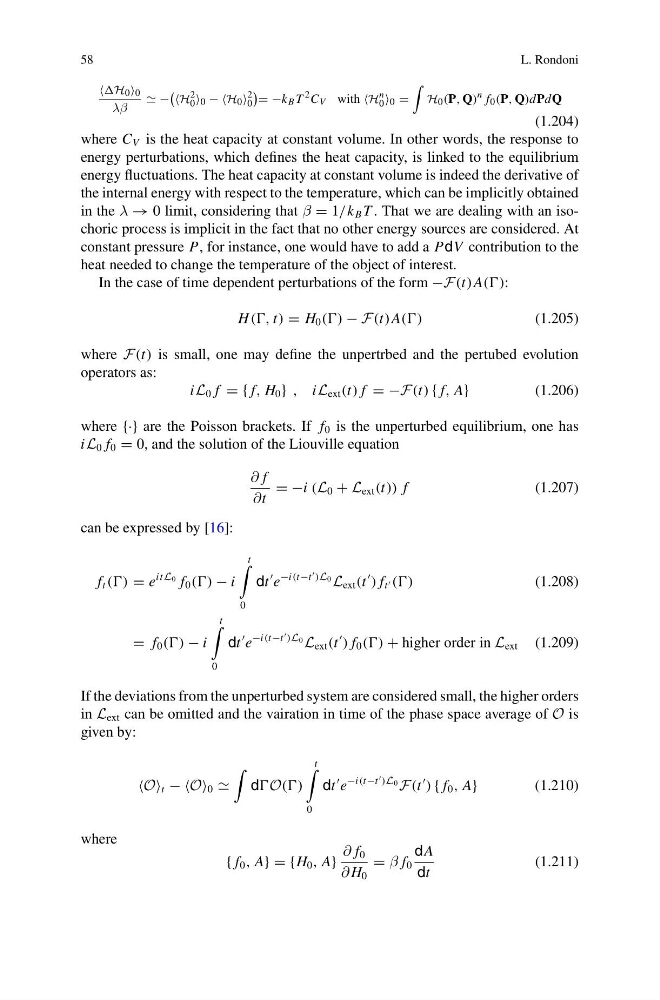
where C V is the heat capacity at constant volume. In other words, the response to
energy perturbations, which defines the heat capacity, is linked to the equilibrium
energy fluctuations. The heat capacity at constant volume is indeed the derivative of
the internal energy with respect to the temperature, which can be implicitly obtained
in the λ → 0 limit, considering that β = 1/k B T . That we are dealing with an isochoric process is implicit in the fact that no other energy sources are considered. At
constant pressure P, for instance, one would have to add a PdV contribution to the
heat needed to change the temperature of the object of interest.
In the case of time dependent perturbations of the form −F(t)A(():
H ((, t) = H 0 (() − F(t)A(()
(1.205)
where F(t) is small, one may define the unpertrbed and the pertubed evolution
operators as:
iL 0 f = { f, H 0 } , iL ext (t) f = −F(t) { f, A}
(1.206)
where {·} are the Poisson brackets. If f 0 is the unperturbed equilibrium, one has
iL 0 f 0 = 0, and the solution of the Liouville equation
∂ f
∂t
= −i (L 0 + L ext (t)) f
(1.207)
can be expressed by [16]:
f t (() = e
itL 0 f 0 (() − i
t
0
dt
e
−i(t−t
)L 0 L ext (t
) f t (()
(1.208)
= f 0 (() − i
t
0
dt
e
−i(t−t
)L 0 L ext (t
) f 0 (() + higher order in L ext (1.209)
If the deviations from the unperturbed system are considered small, the higher orders
in L ext can be omitted and the vairation in time of the phase space average of O is
given by:
O t − −O 0
dO(()
t
0
dt
e
−i(t−t
)L 0 F(t
) { f 0 , A}
(1.210)
where
{ f 0 , A} = {H 0 , A}
∂ f 0
∂ H 0
= β f 0
dA
dt
(1.211)
L. Rondoni
H 0 0
λβ
−
H
2
0 0 − −H 0
2
0
= −k B T
2 C V with H
n
0 0 =
H 0 (P, Q)
n f 0 (P, Q)dPdQ
(1.204)
where C V is the heat capacity at constant volume. In other words, the response to
energy perturbations, which defines the heat capacity, is linked to the equilibrium
energy fluctuations. The heat capacity at constant volume is indeed the derivative of
the internal energy with respect to the temperature, which can be implicitly obtained
in the λ → 0 limit, considering that β = 1/k B T . That we are dealing with an isochoric process is implicit in the fact that no other energy sources are considered. At
constant pressure P, for instance, one would have to add a PdV contribution to the
heat needed to change the temperature of the object of interest.
In the case of time dependent perturbations of the form −F(t)A(():
H ((, t) = H 0 (() − F(t)A(()
(1.205)
where F(t) is small, one may define the unpertrbed and the pertubed evolution
operators as:
iL 0 f = { f, H 0 } , iL ext (t) f = −F(t) { f, A}
(1.206)
where {·} are the Poisson brackets. If f 0 is the unperturbed equilibrium, one has
iL 0 f 0 = 0, and the solution of the Liouville equation
∂ f
∂t
= −i (L 0 + L ext (t)) f
(1.207)
can be expressed by [16]:
f t (() = e
itL 0 f 0 (() − i
t
0
dt
e
−i(t−t
)L 0 L ext (t
) f t (()
(1.208)
= f 0 (() − i
t
0
dt
e
−i(t−t
)L 0 L ext (t
) f 0 (() + higher order in L ext (1.209)
If the deviations from the unperturbed system are considered small, the higher orders
in L ext can be omitted and the vairation in time of the phase space average of O is
given by:
O t − −O 0
dO(()
t
0
dt
e
−i(t−t
)L 0 F(t
) { f 0 , A}
(1.210)
where
{ f 0 , A} = {H 0 , A}
∂ f 0
∂ H 0
= β f 0
dA
dt
(1.211)