

1 Introduction to Nonequilibrium Statistical Physics and Its Foundations
33
where the angular brackets denote a thermal average, and ρ(x) =
i δ(x − x i ) is
the number density. Exchanging ∂ L for −∂ x , one obtains:
P =
dxρ(x)∂ x U (x − L)
(1.128)
The authors of Ref. [12] then conclude that this system does not have an intrinsic
pressure, because it depends on the wall potential confining the system.
There are various open questions concerning this result. In the first place, the
applicability of the overdamped picture for particles equipped with an internal engine
should be investigated; moreover the role of the the canonical expression for the
pressure should also be analyzed. In fact, unlike the BM, activity of particles leads
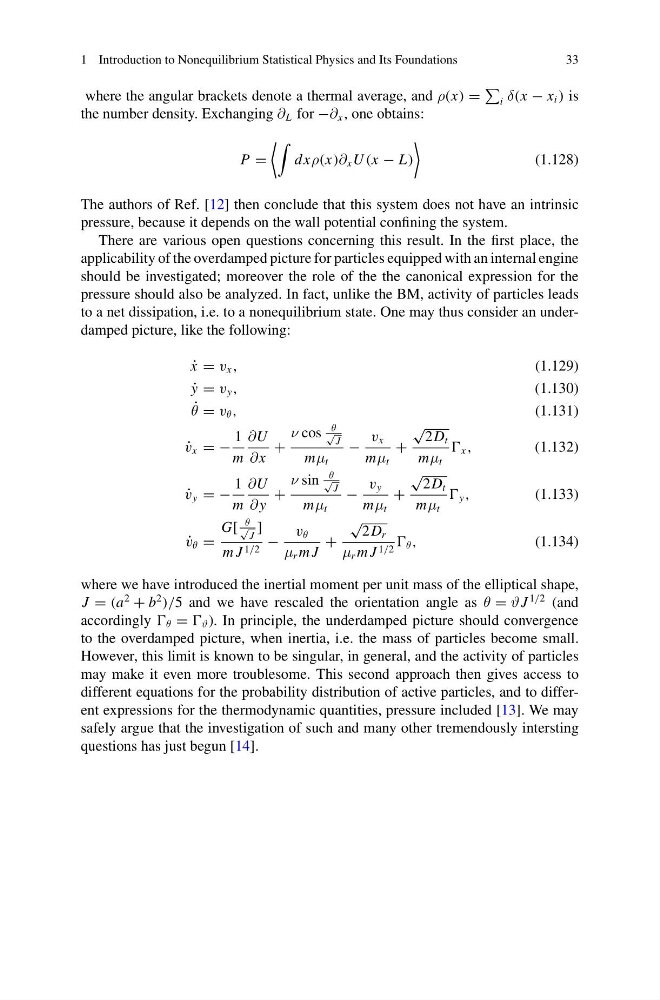
to a net dissipation, i.e. to a nonequilibrium state. One may thus consider an underdamped picture, like the following:
˙
x = v x ,
(1.129)
˙
y = v y ,
(1.130)
˙
θ = v θ ,
(1.131)
˙
v x = −
1
m
∂U
∂x
+
ν cos
θ
√
J
mμ t
−
v x
mμ t
+
√
2D t
mμ t
x ,
(1.132)
˙
v y = −
1
m
∂U
∂ y
+
ν sin
θ
√
J
mμ t
−
v y
mμ t
+
√
2D t
mμ t
y ,
(1.133)
˙
v θ =
G[
θ
√
J
]
m J 1/2 −
v θ
μ r m J
+
√
2D r
μ r m J 1/2 θ ,
(1.134)
where we have introduced the inertial moment per unit mass of the elliptical shape,
J = (a
2
+ b
2
)/5 and we have rescaled the orientation angle as θ = ϑJ
1/2 (and
accordingly θ = ϑ ). In principle, the underdamped picture should convergence
to the overdamped picture, when inertia, i.e. the mass of particles become small.
However, this limit is known to be singular, in general, and the activity of particles
may make it even more troublesome. This second approach then gives access to
different equations for the probability distribution of active particles, and to different expressions for the thermodynamic quantities, pressure included [13]. We may
safely argue that the investigation of such and many other tremendously intersting
questions has just begun [14].
33
where the angular brackets denote a thermal average, and ρ(x) =
i δ(x − x i ) is
the number density. Exchanging ∂ L for −∂ x , one obtains:
P =
dxρ(x)∂ x U (x − L)
(1.128)
The authors of Ref. [12] then conclude that this system does not have an intrinsic
pressure, because it depends on the wall potential confining the system.
There are various open questions concerning this result. In the first place, the
applicability of the overdamped picture for particles equipped with an internal engine
should be investigated; moreover the role of the the canonical expression for the
pressure should also be analyzed. In fact, unlike the BM, activity of particles leads
to a net dissipation, i.e. to a nonequilibrium state. One may thus consider an underdamped picture, like the following:
˙
x = v x ,
(1.129)
˙
y = v y ,
(1.130)
˙
θ = v θ ,
(1.131)
˙
v x = −
1
m
∂U
∂x
+
ν cos
θ
√
J
mμ t
−
v x
mμ t
+
√
2D t
mμ t
x ,
(1.132)
˙
v y = −
1
m
∂U
∂ y
+
ν sin
θ
√
J
mμ t
−
v y
mμ t
+
√
2D t
mμ t
y ,
(1.133)
˙
v θ =
G[
θ
√
J
]
m J 1/2 −
v θ
μ r m J
+
√
2D r
μ r m J 1/2 θ ,
(1.134)
where we have introduced the inertial moment per unit mass of the elliptical shape,
J = (a
2
+ b
2
)/5 and we have rescaled the orientation angle as θ = ϑJ
1/2 (and
accordingly θ = ϑ ). In principle, the underdamped picture should convergence
to the overdamped picture, when inertia, i.e. the mass of particles become small.
However, this limit is known to be singular, in general, and the activity of particles
may make it even more troublesome. This second approach then gives access to
different equations for the probability distribution of active particles, and to different expressions for the thermodynamic quantities, pressure included [13]. We may
safely argue that the investigation of such and many other tremendously intersting
questions has just begun [14].