

34
L. Rondoni
1.4.4 Recent Variations of Brownian Motion: Detection of
Gravitational Waves
One second variation of the BM gives us a glimpse of the breadth of phenomena
to which this kind of models has been succesfully applied: the study of noise in
gravitational waves detectors [11]. Here we consider the resonant bars, which are
one kind of detectors that are supposed to resonate with gravitational waves, when
they pass. In the absence of gravitational waves, these bars vibrate and, like any solid
in an equilibrium state at a given temperature T , the variance of such vibrations is
proportional to T . This is the thermal noise which a classical macroscopic object
cannot avoid, and interferes with the vibrations induced by the gravitational waves.
However, it can be reduced by reducing T . In particular, the bar known as AURIGA
is an aluminum bar of mass 2.2 × 10
3 kg and length of 3 m, which is cooled to liquid
helium temperature T 0 = (4.6 ± 0.2) K. Then, in order to improve the stability of
the device, its modes of vibration are further “cooled” by a feedback mechanism,
which acts as a kind of viscosity.
Such an experimental device can be described through separate oscillators normal
modes, each of which behaves like an RLC series electrical circuit. Denotng the
effective different inductance of a mode by L, the capacitance by C and the resistance
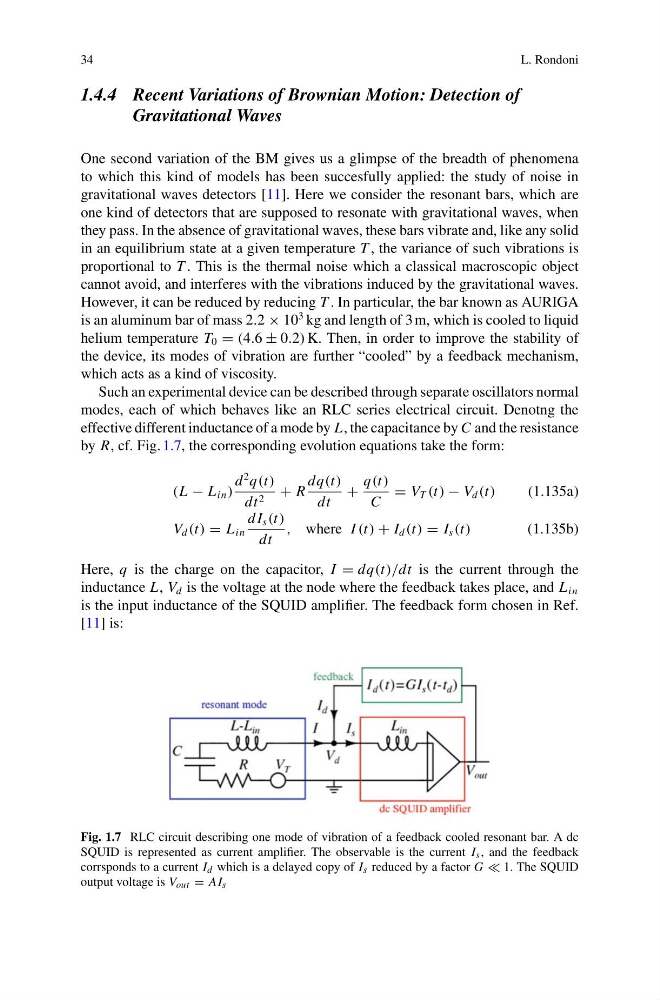
by R, cf. Fig. 1.7, the corresponding evolution equations take the form:
(L − L in )
d
2 q(t)
dt 2 + R
dq(t)
dt
+
q(t)
C
= V T (t) − V d (t)
(1.135a)
V d (t) = L in
d I s (t)
dt
, where I (t) + I d (t) = I s (t)
(1.135b)
Here, q is the charge on the capacitor, I = dq(t)/dt is the current through the
inductance L, V d is the voltage at the node where the feedback takes place, and L in
is the input inductance of the SQUID amplifier. The feedback form chosen in Ref.
[11] is:
Fig. 1.7 RLC circuit describing one mode of vibration of a feedback cooled resonant bar. A dc
SQUID is represented as current amplifier. The observable is the current I s , and the feedback
corrsponds to a current I d which is a delayed copy of I s reduced by a factor G 1. The SQUID
output voltage is V out = AI s
L. Rondoni
1.4.4 Recent Variations of Brownian Motion: Detection of
Gravitational Waves
One second variation of the BM gives us a glimpse of the breadth of phenomena
to which this kind of models has been succesfully applied: the study of noise in
gravitational waves detectors [11]. Here we consider the resonant bars, which are
one kind of detectors that are supposed to resonate with gravitational waves, when
they pass. In the absence of gravitational waves, these bars vibrate and, like any solid
in an equilibrium state at a given temperature T , the variance of such vibrations is
proportional to T . This is the thermal noise which a classical macroscopic object
cannot avoid, and interferes with the vibrations induced by the gravitational waves.
However, it can be reduced by reducing T . In particular, the bar known as AURIGA
is an aluminum bar of mass 2.2 × 10
3 kg and length of 3 m, which is cooled to liquid
helium temperature T 0 = (4.6 ± 0.2) K. Then, in order to improve the stability of
the device, its modes of vibration are further “cooled” by a feedback mechanism,
which acts as a kind of viscosity.
Such an experimental device can be described through separate oscillators normal
modes, each of which behaves like an RLC series electrical circuit. Denotng the
effective different inductance of a mode by L, the capacitance by C and the resistance
by R, cf. Fig. 1.7, the corresponding evolution equations take the form:
(L − L in )
d
2 q(t)
dt 2 + R
dq(t)
dt
+
q(t)
C
= V T (t) − V d (t)
(1.135a)
V d (t) = L in
d I s (t)
dt
, where I (t) + I d (t) = I s (t)
(1.135b)
Here, q is the charge on the capacitor, I = dq(t)/dt is the current through the
inductance L, V d is the voltage at the node where the feedback takes place, and L in
is the input inductance of the SQUID amplifier. The feedback form chosen in Ref.
[11] is:
Fig. 1.7 RLC circuit describing one mode of vibration of a feedback cooled resonant bar. A dc
SQUID is represented as current amplifier. The observable is the current I s , and the feedback
corrsponds to a current I d which is a delayed copy of I s reduced by a factor G 1. The SQUID
output voltage is V out = AI s