

32
L. Rondoni
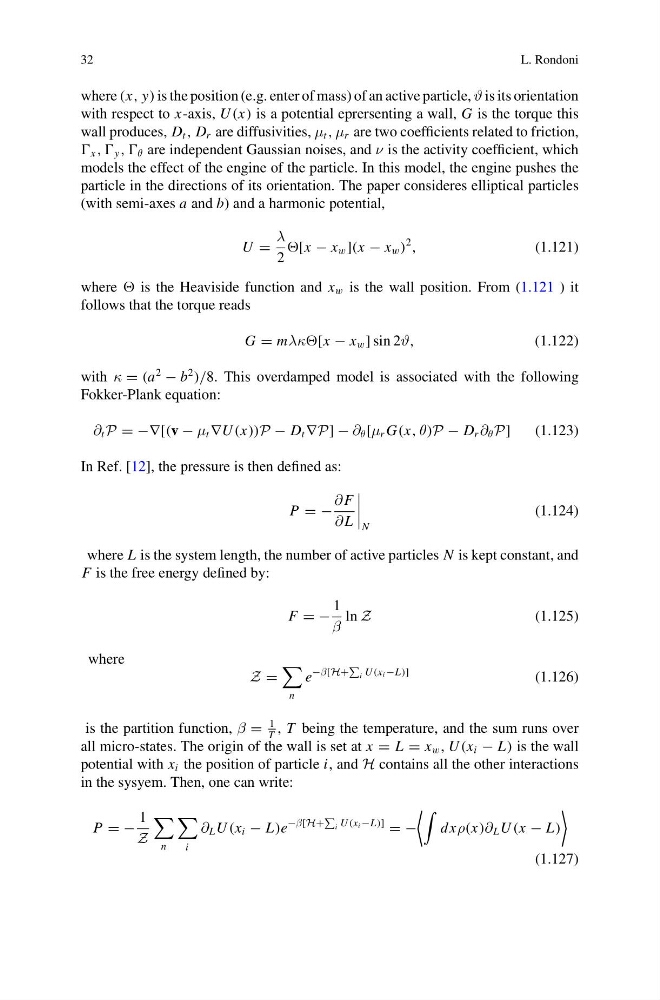
where (x, y) is the position (e.g. enter of mass) of an active particle, ϑ is its orientation
with respect to x-axis, U (x) is a potential eprersenting a wall, G is the torque this
wall produces, D t , D r are diffusivities, μ t , μ r are two coefficients related to friction,
x , , y , , θ are independent Gaussian noises, and ν is the activity coefficient, which
models the effect of the engine of the particle. In this model, the engine pushes the
particle in the directions of its orientation. The paper consideres elliptical particles
(with semi-axes a and b) and a harmonic potential,
U =
λ
2
[x − x w ](x − x w )
2
,
(1.121)
where is the Heaviside function and x w is the wall position. From (1.121 ) it
follows that the torque reads
G = mλκ[x − x w ] sin 2ϑ,
(1.122)
with κ = (a
2
− b
2
)/8. This overdamped model is associated with the following
Fokker-Plank equation:
∂ t P = −∇[(v − μ t ∇U (x))P − D t ∇P] − ∂ θ [μ r G(x, θ)P − D r ∂ θ P]
(1.123)
In Ref. [12], the pressure is then defined as:
P = −
∂ F
∂ L
N
(1.124)
where L is the system length, the number of active particles N is kept constant, and
F is the free energy defined by:
F = −
1
β
ln Z
(1.125)
where
Z =
n
e
−β[H+
i U (x i −L)]
(1.126)
is the partition function, β =
1
T
, T being the temperature, and the sum runs over
all micro-states. The origin of the wall is set at x = L = x w , U (x i − L) is the wall
potential with x i the position of particle i, and H contains all the other interactions
in the sysyem. Then, one can write:
P = −
1
Z
n
i
∂ L U (x i − L)e
−β[H+
i U (x i −L)]
= −
dxρ(x)∂ L U (x − L)
(1.127)
L. Rondoni
where (x, y) is the position (e.g. enter of mass) of an active particle, ϑ is its orientation
with respect to x-axis, U (x) is a potential eprersenting a wall, G is the torque this
wall produces, D t , D r are diffusivities, μ t , μ r are two coefficients related to friction,
x , , y , , θ are independent Gaussian noises, and ν is the activity coefficient, which
models the effect of the engine of the particle. In this model, the engine pushes the
particle in the directions of its orientation. The paper consideres elliptical particles
(with semi-axes a and b) and a harmonic potential,
U =
λ
2
[x − x w ](x − x w )
2
,
(1.121)
where is the Heaviside function and x w is the wall position. From (1.121 ) it
follows that the torque reads
G = mλκ[x − x w ] sin 2ϑ,
(1.122)
with κ = (a
2
− b
2
)/8. This overdamped model is associated with the following
Fokker-Plank equation:
∂ t P = −∇[(v − μ t ∇U (x))P − D t ∇P] − ∂ θ [μ r G(x, θ)P − D r ∂ θ P]
(1.123)
In Ref. [12], the pressure is then defined as:
P = −
∂ F
∂ L
N
(1.124)
where L is the system length, the number of active particles N is kept constant, and
F is the free energy defined by:
F = −
1
β
ln Z
(1.125)
where
Z =
n
e
−β[H+
i U (x i −L)]
(1.126)
is the partition function, β =
1
T
, T being the temperature, and the sum runs over
all micro-states. The origin of the wall is set at x = L = x w , U (x i − L) is the wall
potential with x i the position of particle i, and H contains all the other interactions
in the sysyem. Then, one can write:
P = −
1
Z
n
i
∂ L U (x i − L)e
−β[H+
i U (x i −L)]
= −
dxρ(x)∂ L U (x − L)
(1.127)