

8 Fréedericksz-Like Positional Transition Triggered by An External Electric Field
347
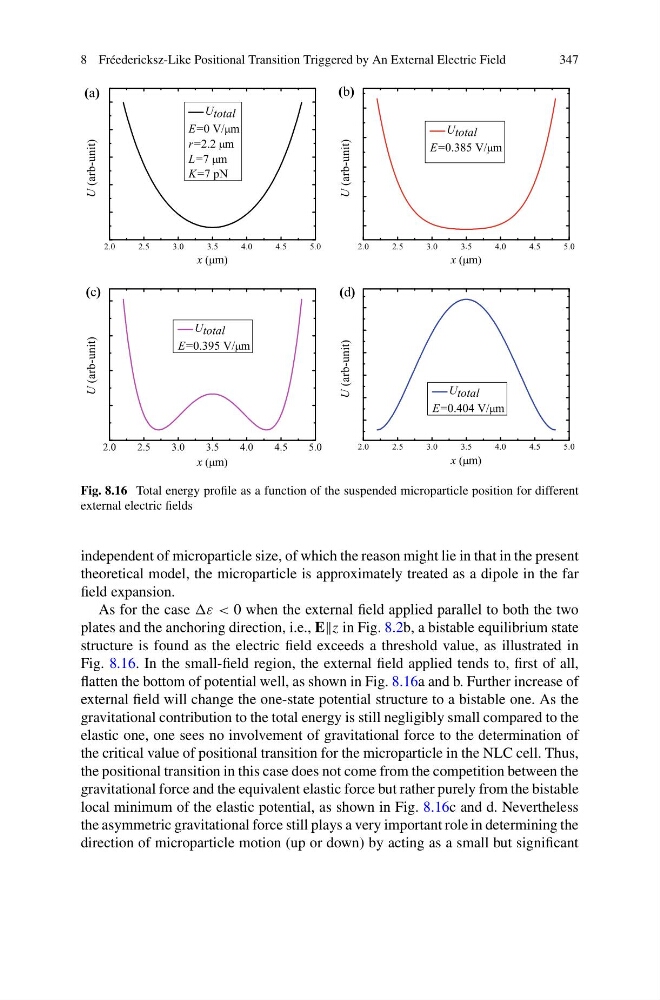
Fig. 8.16 Total energy profile as a function of the suspended microparticle position for different
external electric fields
independent of microparticle size, of which the reason might lie in that in the present
theoretical model, the microparticle is approximately treated as a dipole in the far
field expansion.
As for the case ε < 0 when the external field applied parallel to both the two
plates and the anchoring direction, i.e., E in Fig. 8.2b, a bistable equilibrium state
structure is found as the electric field exceeds a threshold value, as illustrated in
Fig. 8.16. In the small-field region, the external field applied tends to, first of all,
flatten the bottom of potential well, as shown in Fig. 8.16a and b. Further increase of
external field will change the one-state potential structure to a bistable one. As the
gravitational contribution to the total energy is still negligibly small compared to the
elastic one, one sees no involvement of gravitational force to the determination of
the critical value of positional transition for the microparticle in the NLC cell. Thus,
the positional transition in this case does not come from the competition between the
gravitational force and the equivalent elastic force but rather purely from the bistable
local minimum of the elastic potential, as shown in Fig. 8.16c and d. Nevertheless
the asymmetric gravitational force still plays a very important role in determining the
direction of microparticle motion (up or down) by acting as a small but significant
347
Fig. 8.16 Total energy profile as a function of the suspended microparticle position for different
external electric fields
independent of microparticle size, of which the reason might lie in that in the present
theoretical model, the microparticle is approximately treated as a dipole in the far
field expansion.
As for the case ε < 0 when the external field applied parallel to both the two
plates and the anchoring direction, i.e., E in Fig. 8.2b, a bistable equilibrium state
structure is found as the electric field exceeds a threshold value, as illustrated in
Fig. 8.16. In the small-field region, the external field applied tends to, first of all,
flatten the bottom of potential well, as shown in Fig. 8.16a and b. Further increase of
external field will change the one-state potential structure to a bistable one. As the
gravitational contribution to the total energy is still negligibly small compared to the
elastic one, one sees no involvement of gravitational force to the determination of
the critical value of positional transition for the microparticle in the NLC cell. Thus,
the positional transition in this case does not come from the competition between the
gravitational force and the equivalent elastic force but rather purely from the bistable
local minimum of the elastic potential, as shown in Fig. 8.16c and d. Nevertheless
the asymmetric gravitational force still plays a very important role in determining the
direction of microparticle motion (up or down) by acting as a small but significant