

348
K. Xiao and C.-X. Wu
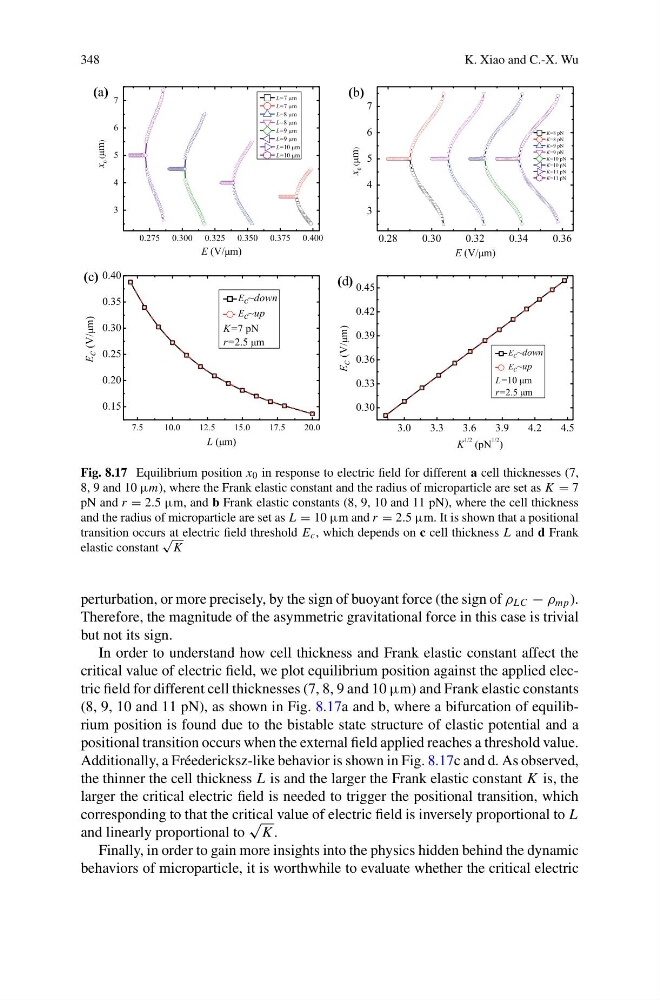
Fig. 8.17 Equilibrium position x 0 in response to electric field for different a cell thicknesses (7,
8, 9 and 10 µm), where the Frank elastic constant and the radius of microparticle are set as K = 7
pN and r = 2.5 µm, and b Frank elastic constants (8, 9, 10 and 11 pN), where the cell thickness
and the radius of microparticle are set as L = 10 µm and r = 2.5 µm. It is shown that a positional
transition occurs at electric field threshold E c , which depends on c cell thickness L and d Frank
elastic constant
√
K
perturbation, or more precisely, by the sign of buoyant force (the sign of ρ LC − ρ mp ).
Therefore, the magnitude of the asymmetric gravitational force in this case is trivial
but not its sign.
In order to understand how cell thickness and Frank elastic constant affect the
critical value of electric field, we plot equilibrium position against the applied electric field for different cell thicknesses (7, 8, 9 and 10 µm) and Frank elastic constants
(8, 9, 10 and 11 pN), as shown in Fig. 8.17a and b, where a bifurcation of equilibrium position is found due to the bistable state structure of elastic potential and a
positional transition occurs when the external field applied reaches a threshold value.
Additionally, a Fréedericksz-like behavior is shown in Fig. 8.17c and d. As observed,
the thinner the cell thickness L is and the larger the Frank elastic constant K is, the
larger the critical electric field is needed to trigger the positional transition, which
corresponding to that the critical value of electric field is inversely proportional to L
and linearly proportional to
√
K .
Finally, in order to gain more insights into the physics hidden behind the dynamic
behaviors of microparticle, it is worthwhile to evaluate whether the critical electric
K. Xiao and C.-X. Wu
Fig. 8.17 Equilibrium position x 0 in response to electric field for different a cell thicknesses (7,
8, 9 and 10 µm), where the Frank elastic constant and the radius of microparticle are set as K = 7
pN and r = 2.5 µm, and b Frank elastic constants (8, 9, 10 and 11 pN), where the cell thickness
and the radius of microparticle are set as L = 10 µm and r = 2.5 µm. It is shown that a positional
transition occurs at electric field threshold E c , which depends on c cell thickness L and d Frank
elastic constant
√
K
perturbation, or more precisely, by the sign of buoyant force (the sign of ρ LC − ρ mp ).
Therefore, the magnitude of the asymmetric gravitational force in this case is trivial
but not its sign.
In order to understand how cell thickness and Frank elastic constant affect the
critical value of electric field, we plot equilibrium position against the applied electric field for different cell thicknesses (7, 8, 9 and 10 µm) and Frank elastic constants
(8, 9, 10 and 11 pN), as shown in Fig. 8.17a and b, where a bifurcation of equilibrium position is found due to the bistable state structure of elastic potential and a
positional transition occurs when the external field applied reaches a threshold value.
Additionally, a Fréedericksz-like behavior is shown in Fig. 8.17c and d. As observed,
the thinner the cell thickness L is and the larger the Frank elastic constant K is, the
larger the critical electric field is needed to trigger the positional transition, which
corresponding to that the critical value of electric field is inversely proportional to L
and linearly proportional to
√
K .
Finally, in order to gain more insights into the physics hidden behind the dynamic
behaviors of microparticle, it is worthwhile to evaluate whether the critical electric