

344
K. Xiao and C.-X. Wu
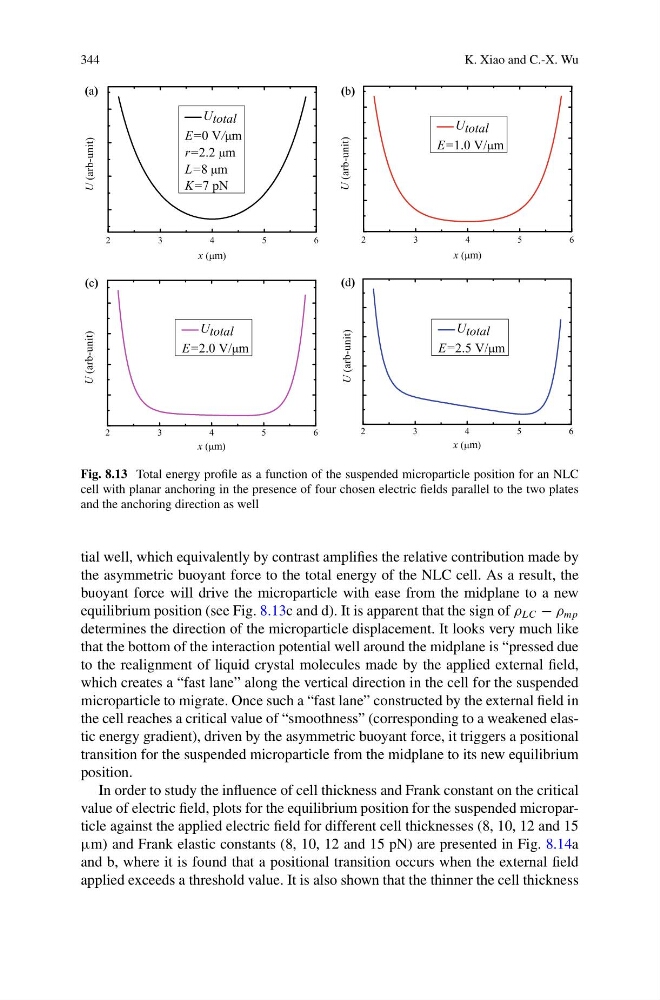
Fig. 8.13 Total energy profile as a function of the suspended microparticle position for an NLC
cell with planar anchoring in the presence of four chosen electric fields parallel to the two plates
and the anchoring direction as well
tial well, which equivalently by contrast amplifies the relative contribution made by
the asymmetric buoyant force to the total energy of the NLC cell. As a result, the
buoyant force will drive the microparticle with ease from the midplane to a new
equilibrium position (see Fig. 8.13c and d). It is apparent that the sign of ρ LC − ρ mp
determines the direction of the microparticle displacement. It looks very much like
that the bottom of the interaction potential well around the midplane is “pressed due
to the realignment of liquid crystal molecules made by the applied external field,
which creates a “fast lane” along the vertical direction in the cell for the suspended
microparticle to migrate. Once such a “fast lane” constructed by the external field in
the cell reaches a critical value of “smoothness” (corresponding to a weakened elastic energy gradient), driven by the asymmetric buoyant force, it triggers a positional
transition for the suspended microparticle from the midplane to its new equilibrium
position.
In order to study the influence of cell thickness and Frank constant on the critical
value of electric field, plots for the equilibrium position for the suspended microparticle against the applied electric field for different cell thicknesses (8, 10, 12 and 15
µm) and Frank elastic constants (8, 10, 12 and 15 pN) are presented in Fig. 8.14a
and b, where it is found that a positional transition occurs when the external field
applied exceeds a threshold value. It is also shown that the thinner the cell thickness
K. Xiao and C.-X. Wu
Fig. 8.13 Total energy profile as a function of the suspended microparticle position for an NLC
cell with planar anchoring in the presence of four chosen electric fields parallel to the two plates
and the anchoring direction as well
tial well, which equivalently by contrast amplifies the relative contribution made by
the asymmetric buoyant force to the total energy of the NLC cell. As a result, the
buoyant force will drive the microparticle with ease from the midplane to a new
equilibrium position (see Fig. 8.13c and d). It is apparent that the sign of ρ LC − ρ mp
determines the direction of the microparticle displacement. It looks very much like
that the bottom of the interaction potential well around the midplane is “pressed due
to the realignment of liquid crystal molecules made by the applied external field,
which creates a “fast lane” along the vertical direction in the cell for the suspended
microparticle to migrate. Once such a “fast lane” constructed by the external field in
the cell reaches a critical value of “smoothness” (corresponding to a weakened elastic energy gradient), driven by the asymmetric buoyant force, it triggers a positional
transition for the suspended microparticle from the midplane to its new equilibrium
position.
In order to study the influence of cell thickness and Frank constant on the critical
value of electric field, plots for the equilibrium position for the suspended microparticle against the applied electric field for different cell thicknesses (8, 10, 12 and 15
µm) and Frank elastic constants (8, 10, 12 and 15 pN) are presented in Fig. 8.14a
and b, where it is found that a positional transition occurs when the external field
applied exceeds a threshold value. It is also shown that the thinner the cell thickness