

8 Fréedericksz-Like Positional Transition Triggered by An External Electric Field
343
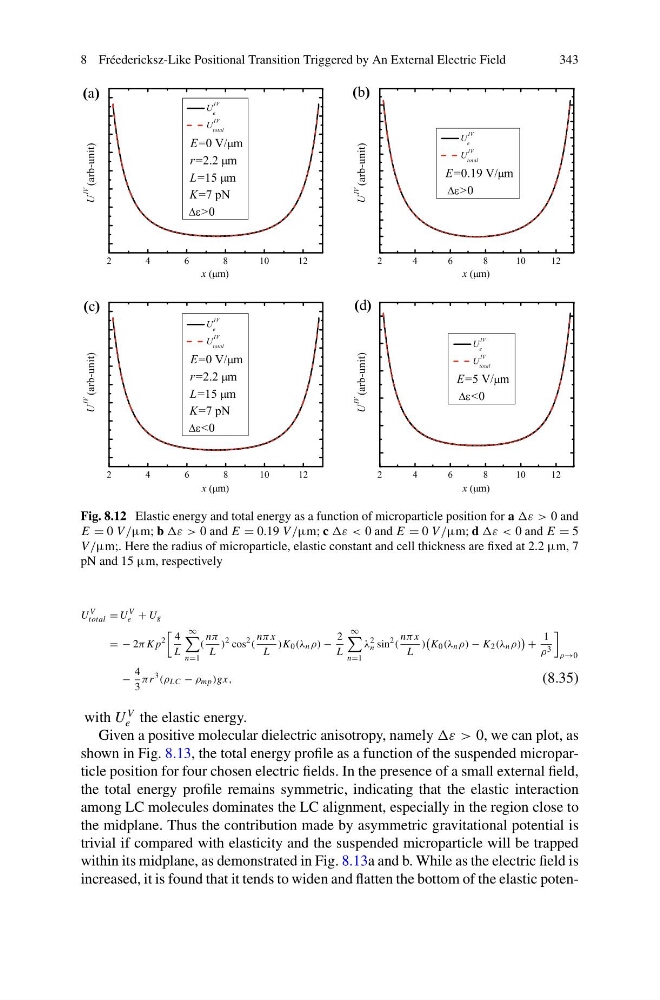
Fig. 8.12 Elastic energy and total energy as a function of microparticle position for a ε > 0 and
E = 0 V /µm; b ε > 0 and E = 0.19 V /µm; c ε < 0 and E = 0 V /µm; d ε < 0 and E = 5
V /µm;. Here the radius of microparticle, elastic constant and cell thickness are fixed at 2.2 µm, 7
pN and 15 µm, respectively
U
V
total = U
V
e + U g
= − 2π K p
2
4
L
∞
n=1
(
nπ
L
)
2 cos
2 (
nπ x
L
)K 0 (λ n ρ) −
2
L
∞
n=1
λ
2
n sin
2 (
nπ x
L
)
K 0 (λ n ρ) − K 2 (λ n ρ)
+
1
ρ 3
ρ→0
−
4
3
πr
3 (ρ LC − ρ mp )gx,
(8.35)
with U
V
e the elastic energy.
Given a positive molecular dielectric anisotropy, namely ε > 0, we can plot, as
shown in Fig. 8.13, the total energy profile as a function of the suspended microparticle position for four chosen electric fields. In the presence of a small external field,
the total energy profile remains symmetric, indicating that the elastic interaction
among LC molecules dominates the LC alignment, especially in the region close to
the midplane. Thus the contribution made by asymmetric gravitational potential is
trivial if compared with elasticity and the suspended microparticle will be trapped
within its midplane, as demonstrated in Fig. 8.13a and b. While as the electric field is
increased, it is found that it tends to widen and flatten the bottom of the elastic poten-
343
Fig. 8.12 Elastic energy and total energy as a function of microparticle position for a ε > 0 and
E = 0 V /µm; b ε > 0 and E = 0.19 V /µm; c ε < 0 and E = 0 V /µm; d ε < 0 and E = 5
V /µm;. Here the radius of microparticle, elastic constant and cell thickness are fixed at 2.2 µm, 7
pN and 15 µm, respectively
U
V
total = U
V
e + U g
= − 2π K p
2
4
L
∞
n=1
(
nπ
L
)
2 cos
2 (
nπ x
L
)K 0 (λ n ρ) −
2
L
∞
n=1
λ
2
n sin
2 (
nπ x
L
)
K 0 (λ n ρ) − K 2 (λ n ρ)
+
1
ρ 3
ρ→0
−
4
3
πr
3 (ρ LC − ρ mp )gx,
(8.35)
with U
V
e the elastic energy.
Given a positive molecular dielectric anisotropy, namely ε > 0, we can plot, as
shown in Fig. 8.13, the total energy profile as a function of the suspended microparticle position for four chosen electric fields. In the presence of a small external field,
the total energy profile remains symmetric, indicating that the elastic interaction
among LC molecules dominates the LC alignment, especially in the region close to
the midplane. Thus the contribution made by asymmetric gravitational potential is
trivial if compared with elasticity and the suspended microparticle will be trapped
within its midplane, as demonstrated in Fig. 8.13a and b. While as the electric field is
increased, it is found that it tends to widen and flatten the bottom of the elastic poten-