

338
K. Xiao and C.-X. Wu
U
I I I
total = U
I I I
e
+ U g
= − 2π K p
2
4
L
∞
n=1
μ
2
n
cos
2 (
nπ x
L
)K 0 (ν n ρ) −
1
2
sin
2 (
nπ x
L
)
K 0 (μ n ρ) − K 2 (μ n ρ)
+
1
ρ 3
ρ→0
−
4
3
πr
3 (ρ LC − ρ mp )gx,
(8.30)
where x denotes the vertical position of the microparticle.
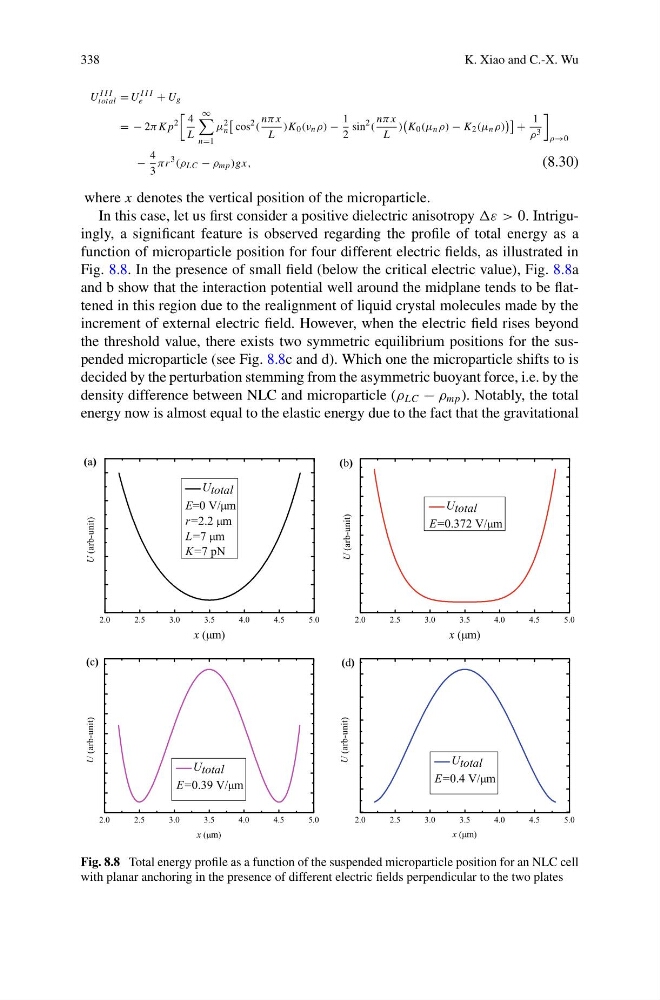
In this case, let us first consider a positive dielectric anisotropy ε > 0. Intriguingly, a significant feature is observed regarding the profile of total energy as a
function of microparticle position for four different electric fields, as illustrated in
Fig. 8.8. In the presence of small field (below the critical electric value), Fig. 8.8a
and b show that the interaction potential well around the midplane tends to be flattened in this region due to the realignment of liquid crystal molecules made by the
increment of external electric field. However, when the electric field rises beyond
the threshold value, there exists two symmetric equilibrium positions for the suspended microparticle (see Fig. 8.8c and d). Which one the microparticle shifts to is
decided by the perturbation stemming from the asymmetric buoyant force, i.e. by the
density difference between NLC and microparticle (ρ LC − ρ mp ). Notably, the total
energy now is almost equal to the elastic energy due to the fact that the gravitational
Fig. 8.8 Total energy profile as a function of the suspended microparticle position for an NLC cell
with planar anchoring in the presence of different electric fields perpendicular to the two plates
K. Xiao and C.-X. Wu
U
I I I
total = U
I I I
e
+ U g
= − 2π K p
2
4
L
∞
n=1
μ
2
n
cos
2 (
nπ x
L
)K 0 (ν n ρ) −
1
2
sin
2 (
nπ x
L
)
K 0 (μ n ρ) − K 2 (μ n ρ)
+
1
ρ 3
ρ→0
−
4
3
πr
3 (ρ LC − ρ mp )gx,
(8.30)
where x denotes the vertical position of the microparticle.
In this case, let us first consider a positive dielectric anisotropy ε > 0. Intriguingly, a significant feature is observed regarding the profile of total energy as a
function of microparticle position for four different electric fields, as illustrated in
Fig. 8.8. In the presence of small field (below the critical electric value), Fig. 8.8a
and b show that the interaction potential well around the midplane tends to be flattened in this region due to the realignment of liquid crystal molecules made by the
increment of external electric field. However, when the electric field rises beyond
the threshold value, there exists two symmetric equilibrium positions for the suspended microparticle (see Fig. 8.8c and d). Which one the microparticle shifts to is
decided by the perturbation stemming from the asymmetric buoyant force, i.e. by the
density difference between NLC and microparticle (ρ LC − ρ mp ). Notably, the total
energy now is almost equal to the elastic energy due to the fact that the gravitational
Fig. 8.8 Total energy profile as a function of the suspended microparticle position for an NLC cell
with planar anchoring in the presence of different electric fields perpendicular to the two plates