

8 Fréedericksz-Like Positional Transition Triggered by An External Electric Field
337
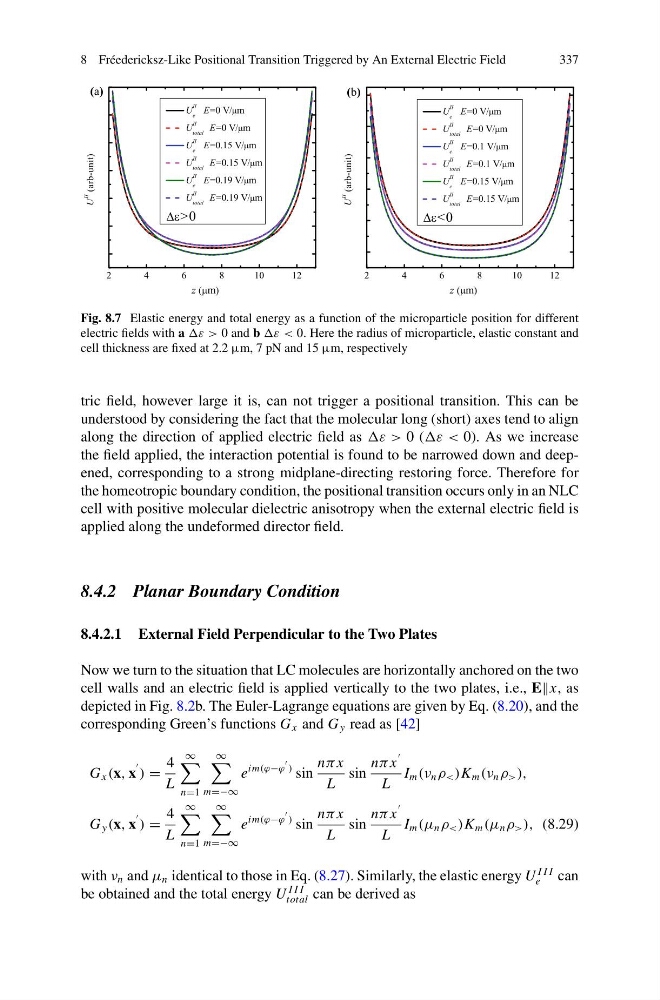
Fig. 8.7 Elastic energy and total energy as a function of the microparticle position for different
electric fields with a ε > 0 and b < 0. Here the radius of microparticle, elastic constant and
cell thickness are fixed at 2.2 µm, 7 pN and 15 µm, respectively
tric field, however large it is, can not trigger a positional transition. This can be
understood by considering the fact that the molecular long (short) axes tend to align
along the direction of applied electric field as ε > 0 (ε < 0). As we increase
the field applied, the interaction potential is found to be narrowed down and deepened, corresponding to a strong midplane-directing restoring force. Therefore for
the homeotropic boundary condition, the positional transition occurs only in an NLC
cell with positive molecular dielectric anisotropy when the external electric field is
applied along the undeformed director field.
8.4.2 Planar Boundary Condition
8.4.2.1 External Field Perpendicular to the Two Plates
Now we turn to the situation that LC molecules are horizontally anchored on the two
cell walls and an electric field is applied vertically to the two plates, i.e., E as
depicted in Fig. 8.2b. The Euler-Lagrange equations are given by Eq. (8.20), and the
corresponding Green’s functions G x and G y read as [42]
G x (x, x
) =
4
L
∞
n=1
∞
m=−∞
e
im(ϕ−ϕ
) sin
nπ x
L
sin
nπ x
L
I m (ν n ρ < )K m (ν n ρ > ),
G y (x, x
) =
4
L
∞
n=1
∞
m=−∞
e
im(ϕ−ϕ
) sin
nπ x
L
sin
nπ x
L
I m (μ n ρ < )K m (μ n ρ > ), (8.29)
with ν n and μ n identical to those in Eq. (8.27). Similarly, the elastic energy U
I I I
e
can
be obtained and the total energy U
I I I
total can be derived as
337
Fig. 8.7 Elastic energy and total energy as a function of the microparticle position for different
electric fields with a ε > 0 and b < 0. Here the radius of microparticle, elastic constant and
cell thickness are fixed at 2.2 µm, 7 pN and 15 µm, respectively
tric field, however large it is, can not trigger a positional transition. This can be
understood by considering the fact that the molecular long (short) axes tend to align
along the direction of applied electric field as ε > 0 (ε < 0). As we increase
the field applied, the interaction potential is found to be narrowed down and deepened, corresponding to a strong midplane-directing restoring force. Therefore for
the homeotropic boundary condition, the positional transition occurs only in an NLC
cell with positive molecular dielectric anisotropy when the external electric field is
applied along the undeformed director field.
8.4.2 Planar Boundary Condition
8.4.2.1 External Field Perpendicular to the Two Plates
Now we turn to the situation that LC molecules are horizontally anchored on the two
cell walls and an electric field is applied vertically to the two plates, i.e., E as
depicted in Fig. 8.2b. The Euler-Lagrange equations are given by Eq. (8.20), and the
corresponding Green’s functions G x and G y read as [42]
G x (x, x
) =
4
L
∞
n=1
∞
m=−∞
e
im(ϕ−ϕ
) sin
nπ x
L
sin
nπ x
L
I m (ν n ρ < )K m (ν n ρ > ),
G y (x, x
) =
4
L
∞
n=1
∞
m=−∞
e
im(ϕ−ϕ
) sin
nπ x
L
sin
nπ x
L
I m (μ n ρ < )K m (μ n ρ > ), (8.29)
with ν n and μ n identical to those in Eq. (8.27). Similarly, the elastic energy U
I I I
e
can
be obtained and the total energy U
I I I
total can be derived as