

8 Fréedericksz-Like Positional Transition Triggered by An External Electric Field
333
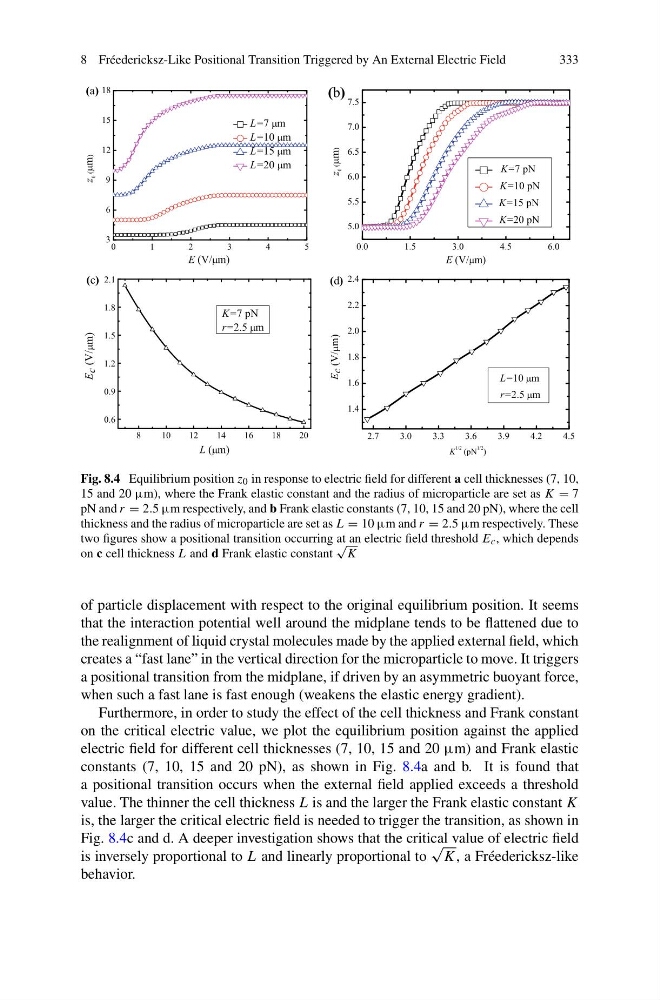
Fig. 8.4 Equilibrium position z 0 in response to electric field for different a cell thicknesses (7, 10,
15 and 20 µm), where the Frank elastic constant and the radius of microparticle are set as K = 7
pN and r = 2.5 µm respectively, and b Frank elastic constants (7, 10, 15 and 20 pN), where the cell
thickness and the radius of microparticle are set as L = 10 µm and r = 2.5 µm respectively. These
two figures show a positional transition occurring at an electric field threshold E c , which depends
on c cell thickness L and d Frank elastic constant
√
K
of particle displacement with respect to the original equilibrium position. It seems
that the interaction potential well around the midplane tends to be flattened due to
the realignment of liquid crystal molecules made by the applied external field, which
creates a “fast lane” in the vertical direction for the microparticle to move. It triggers
a positional transition from the midplane, if driven by an asymmetric buoyant force,
when such a fast lane is fast enough (weakens the elastic energy gradient).
Furthermore, in order to study the effect of the cell thickness and Frank constant
on the critical electric value, we plot the equilibrium position against the applied
electric field for different cell thicknesses (7, 10, 15 and 20 µm) and Frank elastic
constants (7, 10, 15 and 20 pN), as shown in Fig. 8.4a and b. It is found that
a positional transition occurs when the external field applied exceeds a threshold
value. The thinner the cell thickness L is and the larger the Frank elastic constant K
is, the larger the critical electric field is needed to trigger the transition, as shown in
Fig. 8.4c and d. A deeper investigation shows that the critical value of electric field
is inversely proportional to L and linearly proportional to
√
K , a Fréedericksz-like
behavior.
333
Fig. 8.4 Equilibrium position z 0 in response to electric field for different a cell thicknesses (7, 10,
15 and 20 µm), where the Frank elastic constant and the radius of microparticle are set as K = 7
pN and r = 2.5 µm respectively, and b Frank elastic constants (7, 10, 15 and 20 pN), where the cell
thickness and the radius of microparticle are set as L = 10 µm and r = 2.5 µm respectively. These
two figures show a positional transition occurring at an electric field threshold E c , which depends
on c cell thickness L and d Frank elastic constant
√
K
of particle displacement with respect to the original equilibrium position. It seems
that the interaction potential well around the midplane tends to be flattened due to
the realignment of liquid crystal molecules made by the applied external field, which
creates a “fast lane” in the vertical direction for the microparticle to move. It triggers
a positional transition from the midplane, if driven by an asymmetric buoyant force,
when such a fast lane is fast enough (weakens the elastic energy gradient).
Furthermore, in order to study the effect of the cell thickness and Frank constant
on the critical electric value, we plot the equilibrium position against the applied
electric field for different cell thicknesses (7, 10, 15 and 20 µm) and Frank elastic
constants (7, 10, 15 and 20 pN), as shown in Fig. 8.4a and b. It is found that
a positional transition occurs when the external field applied exceeds a threshold
value. The thinner the cell thickness L is and the larger the Frank elastic constant K
is, the larger the critical electric field is needed to trigger the transition, as shown in
Fig. 8.4c and d. A deeper investigation shows that the critical value of electric field
is inversely proportional to L and linearly proportional to
√
K , a Fréedericksz-like
behavior.