

332
K. Xiao and C.-X. Wu
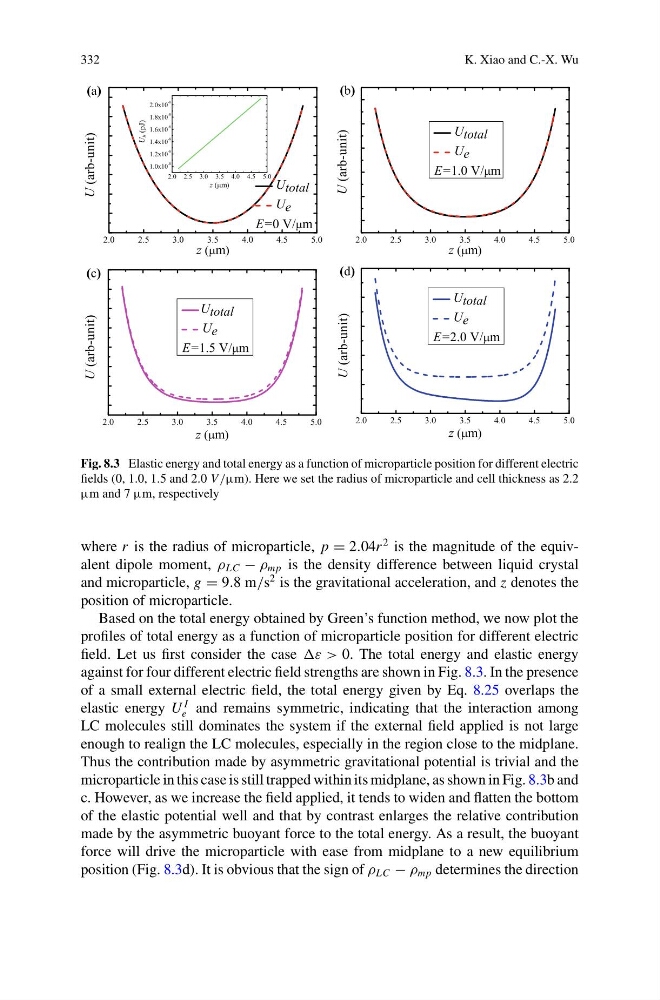
Fig. 8.3 Elastic energy and total energy as a function of microparticle position for different electric
fields (0, 1.0, 1.5 and 2.0 V /µm). Here we set the radius of microparticle and cell thickness as 2.2
µm and 7 µm, respectively
where r is the radius of microparticle, p = 2.04r
2 is the magnitude of the equivalent dipole moment, ρ LC − ρ mp is the density difference between liquid crystal
and microparticle, g = 9.8 m/s
2 is the gravitational acceleration, and z denotes the
position of microparticle.
Based on the total energy obtained by Green’s function method, we now plot the
profiles of total energy as a function of microparticle position for different electric
field. Let us first consider the case ε > 0. The total energy and elastic energy
against for four different electric field strengths are shown in Fig. 8.3. In the presence
of a small external electric field, the total energy given by Eq. 8.25 overlaps the
elastic energy U
I
e and remains symmetric, indicating that the interaction among
LC molecules still dominates the system if the external field applied is not large
enough to realign the LC molecules, especially in the region close to the midplane.
Thus the contribution made by asymmetric gravitational potential is trivial and the
microparticle in this case is still trapped within its midplane, as shown in Fig. 8.3b and
c. However, as we increase the field applied, it tends to widen and flatten the bottom
of the elastic potential well and that by contrast enlarges the relative contribution
made by the asymmetric buoyant force to the total energy. As a result, the buoyant
force will drive the microparticle with ease from midplane to a new equilibrium
position (Fig. 8.3d). It is obvious that the sign of ρ LC − ρ mp determines the direction
K. Xiao and C.-X. Wu
Fig. 8.3 Elastic energy and total energy as a function of microparticle position for different electric
fields (0, 1.0, 1.5 and 2.0 V /µm). Here we set the radius of microparticle and cell thickness as 2.2
µm and 7 µm, respectively
where r is the radius of microparticle, p = 2.04r
2 is the magnitude of the equivalent dipole moment, ρ LC − ρ mp is the density difference between liquid crystal
and microparticle, g = 9.8 m/s
2 is the gravitational acceleration, and z denotes the
position of microparticle.
Based on the total energy obtained by Green’s function method, we now plot the
profiles of total energy as a function of microparticle position for different electric
field. Let us first consider the case ε > 0. The total energy and elastic energy
against for four different electric field strengths are shown in Fig. 8.3. In the presence
of a small external electric field, the total energy given by Eq. 8.25 overlaps the
elastic energy U
I
e and remains symmetric, indicating that the interaction among
LC molecules still dominates the system if the external field applied is not large
enough to realign the LC molecules, especially in the region close to the midplane.
Thus the contribution made by asymmetric gravitational potential is trivial and the
microparticle in this case is still trapped within its midplane, as shown in Fig. 8.3b and
c. However, as we increase the field applied, it tends to widen and flatten the bottom
of the elastic potential well and that by contrast enlarges the relative contribution
made by the asymmetric buoyant force to the total energy. As a result, the buoyant
force will drive the microparticle with ease from midplane to a new equilibrium
position (Fig. 8.3d). It is obvious that the sign of ρ LC − ρ mp determines the direction