

7 A Primer on Gels (with an Emphasis on Molecular Gels)
311
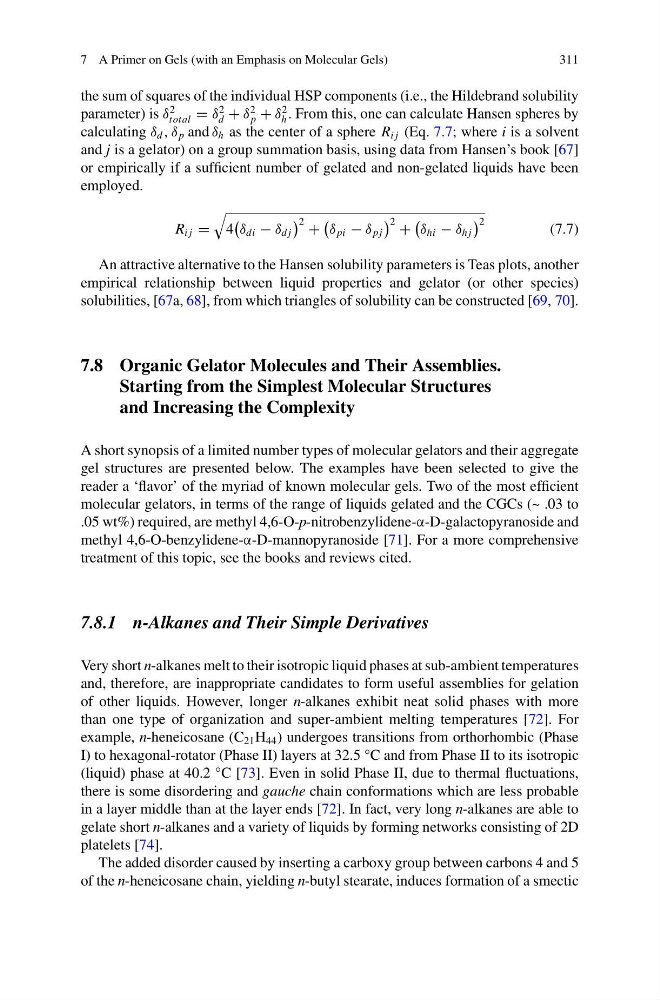
the sum of squares of the individual HSP components (i.e., the Hildebrand solubility
parameter) is δ
2
total = δ
2
d + δ
2
p + δ
2
h . From this, one can calculate Hansen spheres by
calculating δ d , δ p and δ h as the center of a sphere R i j (Eq. 7.7; where i is a solvent
and j is a gelator) on a group summation basis, using data from Hansen’s book [67]
or empirically if a sufficient number of gelated and non-gelated liquids have been
employed.
R i j =
4
δ di − δ d j
2 +
δ pi − δ pj
2 +
δ hi − δ h j
2
(7.7)
An attractive alternative to the Hansen solubility parameters is Teas plots, another
empirical relationship between liquid properties and gelator (or other species)
solubilities, [67a, 68], from which triangles of solubility can be constructed [69, 70].
7.8 Organic Gelator Molecules and Their Assemblies.
Starting from the Simplest Molecular Structures
and Increasing the Complexity
A short synopsis of a limited number types of molecular gelators and their aggregate
gel structures are presented below. The examples have been selected to give the
reader a ‘flavor’ of the myriad of known molecular gels. Two of the most efficient
molecular gelators, in terms of the range of liquids gelated and the CGCs (~ .03 to
.05 wt%) required, are methyl 4,6-O-p-nitrobenzylidene-α-D-galactopyranoside and
methyl 4,6-O-benzylidene-α-D-mannopyranoside [71]. For a more comprehensive
treatment of this topic, see the books and reviews cited.
7.8.1 n-Alkanes and Their Simple Derivatives
Very short n-alkanes melt to their isotropic liquid phases at sub-ambient temperatures
and, therefore, are inappropriate candidates to form useful assemblies for gelation
of other liquids. However, longer n-alkanes exhibit neat solid phases with more
than one type of organization and super-ambient melting temperatures [72]. For
example, n-heneicosane (C 21 H 44 ) undergoes transitions from orthorhombic (Phase
I) to hexagonal-rotator (Phase II) layers at 32.5 °C and from Phase II to its isotropic
(liquid) phase at 40.2 °C [73]. Even in solid Phase II, due to thermal fluctuations,
there is some disordering and gauche chain conformations which are less probable
in a layer middle than at the layer ends [72]. In fact, very long n-alkanes are able to
gelate short n-alkanes and a variety of liquids by forming networks consisting of 2D
platelets [74].
The added disorder caused by inserting a carboxy group between carbons 4 and 5
of the n-heneicosane chain, yielding n-butyl stearate, induces formation of a smectic
311
the sum of squares of the individual HSP components (i.e., the Hildebrand solubility
parameter) is δ
2
total = δ
2
d + δ
2
p + δ
2
h . From this, one can calculate Hansen spheres by
calculating δ d , δ p and δ h as the center of a sphere R i j (Eq. 7.7; where i is a solvent
and j is a gelator) on a group summation basis, using data from Hansen’s book [67]
or empirically if a sufficient number of gelated and non-gelated liquids have been
employed.
R i j =
4
δ di − δ d j
2 +
δ pi − δ pj
2 +
δ hi − δ h j
2
(7.7)
An attractive alternative to the Hansen solubility parameters is Teas plots, another
empirical relationship between liquid properties and gelator (or other species)
solubilities, [67a, 68], from which triangles of solubility can be constructed [69, 70].
7.8 Organic Gelator Molecules and Their Assemblies.
Starting from the Simplest Molecular Structures
and Increasing the Complexity
A short synopsis of a limited number types of molecular gelators and their aggregate
gel structures are presented below. The examples have been selected to give the
reader a ‘flavor’ of the myriad of known molecular gels. Two of the most efficient
molecular gelators, in terms of the range of liquids gelated and the CGCs (~ .03 to
.05 wt%) required, are methyl 4,6-O-p-nitrobenzylidene-α-D-galactopyranoside and
methyl 4,6-O-benzylidene-α-D-mannopyranoside [71]. For a more comprehensive
treatment of this topic, see the books and reviews cited.
7.8.1 n-Alkanes and Their Simple Derivatives
Very short n-alkanes melt to their isotropic liquid phases at sub-ambient temperatures
and, therefore, are inappropriate candidates to form useful assemblies for gelation
of other liquids. However, longer n-alkanes exhibit neat solid phases with more
than one type of organization and super-ambient melting temperatures [72]. For
example, n-heneicosane (C 21 H 44 ) undergoes transitions from orthorhombic (Phase
I) to hexagonal-rotator (Phase II) layers at 32.5 °C and from Phase II to its isotropic
(liquid) phase at 40.2 °C [73]. Even in solid Phase II, due to thermal fluctuations,
there is some disordering and gauche chain conformations which are less probable
in a layer middle than at the layer ends [72]. In fact, very long n-alkanes are able to
gelate short n-alkanes and a variety of liquids by forming networks consisting of 2D
platelets [74].
The added disorder caused by inserting a carboxy group between carbons 4 and 5
of the n-heneicosane chain, yielding n-butyl stearate, induces formation of a smectic