

312
R. G. Weiss
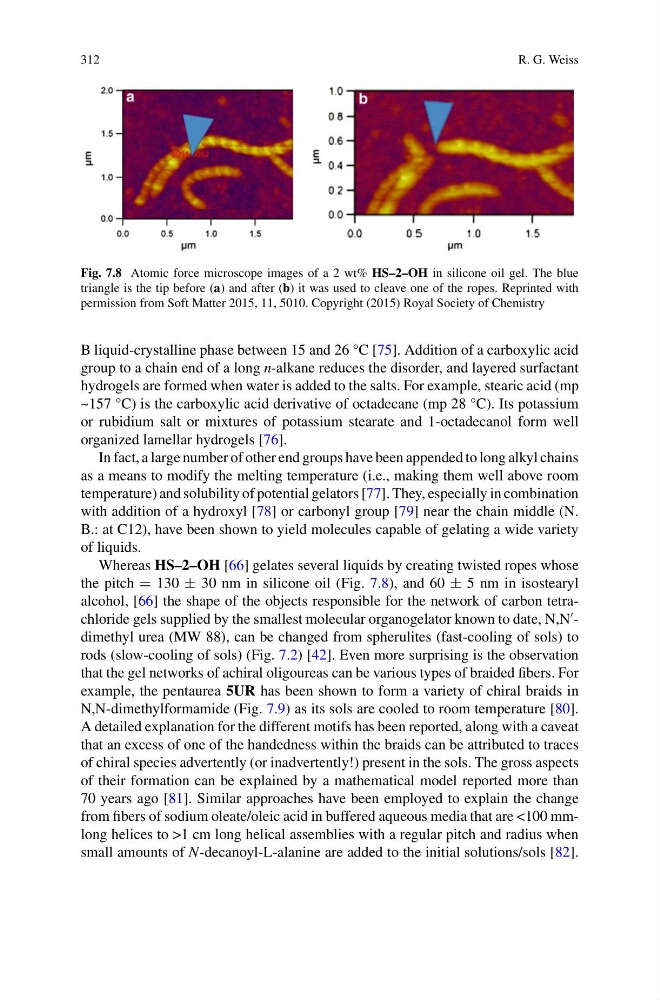
Fig. 7.8 Atomic force microscope images of a 2 wt% HS–2–OH in silicone oil gel. The blue
triangle is the tip before (a) and after (b) it was used to cleave one of the ropes. Reprinted with
permission from Soft Matter 2015, 11, 5010. Copyright (2015) Royal Society of Chemistry
B liquid-crystalline phase between 15 and 26 °C [75]. Addition of a carboxylic acid
group to a chain end of a long n-alkane reduces the disorder, and layered surfactant
hydrogels are formed when water is added to the salts. For example, stearic acid (mp
~157 °C) is the carboxylic acid derivative of octadecane (mp 28 °C). Its potassium
or rubidium salt or mixtures of potassium stearate and 1-octadecanol form well
organized lamellar hydrogels [76].
In fact, a large number of other end groups have been appended to long alkyl chains
as a means to modify the melting temperature (i.e., making them well above room
temperature) and solubility of potential gelators [77]. They, especially in combination
with addition of a hydroxyl [78] or carbonyl group [79] near the chain middle (N.
B.: at C12), have been shown to yield molecules capable of gelating a wide variety
of liquids.
Whereas HS–2–OH [66] gelates several liquids by creating twisted ropes whose
the pitch = 130 ± 30 nm in silicone oil (Fig. 7.8), and 60 ± 5 nm in isostearyl
alcohol, [66] the shape of the objects responsible for the network of carbon tetrachloride gels supplied by the smallest molecular organogelator known to date, N,N
-
dimethyl urea (MW 88), can be changed from spherulites (fast-cooling of sols) to
rods (slow-cooling of sols) (Fig. 7.2) [42]. Even more surprising is the observation
that the gel networks of achiral oligoureas can be various types of braided fibers. For
example, the pentaurea 5UR has been shown to form a variety of chiral braids in
N,N-dimethylformamide (Fig. 7.9) as its sols are cooled to room temperature [80].
A detailed explanation for the different motifs has been reported, along with a caveat
that an excess of one of the handedness within the braids can be attributed to traces
of chiral species advertently (or inadvertently!) present in the sols. The gross aspects
of their formation can be explained by a mathematical model reported more than
70 years ago [81]. Similar approaches have been employed to explain the change
from fibers of sodium oleate/oleic acid in buffered aqueous media that are <100 mmlong helices to >1 cm long helical assemblies with a regular pitch and radius when
small amounts of N-decanoyl-L-alanine are added to the initial solutions/sols [82].
R. G. Weiss
Fig. 7.8 Atomic force microscope images of a 2 wt% HS–2–OH in silicone oil gel. The blue
triangle is the tip before (a) and after (b) it was used to cleave one of the ropes. Reprinted with
permission from Soft Matter 2015, 11, 5010. Copyright (2015) Royal Society of Chemistry
B liquid-crystalline phase between 15 and 26 °C [75]. Addition of a carboxylic acid
group to a chain end of a long n-alkane reduces the disorder, and layered surfactant
hydrogels are formed when water is added to the salts. For example, stearic acid (mp
~157 °C) is the carboxylic acid derivative of octadecane (mp 28 °C). Its potassium
or rubidium salt or mixtures of potassium stearate and 1-octadecanol form well
organized lamellar hydrogels [76].
In fact, a large number of other end groups have been appended to long alkyl chains
as a means to modify the melting temperature (i.e., making them well above room
temperature) and solubility of potential gelators [77]. They, especially in combination
with addition of a hydroxyl [78] or carbonyl group [79] near the chain middle (N.
B.: at C12), have been shown to yield molecules capable of gelating a wide variety
of liquids.
Whereas HS–2–OH [66] gelates several liquids by creating twisted ropes whose
the pitch = 130 ± 30 nm in silicone oil (Fig. 7.8), and 60 ± 5 nm in isostearyl
alcohol, [66] the shape of the objects responsible for the network of carbon tetrachloride gels supplied by the smallest molecular organogelator known to date, N,N
-
dimethyl urea (MW 88), can be changed from spherulites (fast-cooling of sols) to
rods (slow-cooling of sols) (Fig. 7.2) [42]. Even more surprising is the observation
that the gel networks of achiral oligoureas can be various types of braided fibers. For
example, the pentaurea 5UR has been shown to form a variety of chiral braids in
N,N-dimethylformamide (Fig. 7.9) as its sols are cooled to room temperature [80].
A detailed explanation for the different motifs has been reported, along with a caveat
that an excess of one of the handedness within the braids can be attributed to traces
of chiral species advertently (or inadvertently!) present in the sols. The gross aspects
of their formation can be explained by a mathematical model reported more than
70 years ago [81]. Similar approaches have been employed to explain the change
from fibers of sodium oleate/oleic acid in buffered aqueous media that are <100 mmlong helices to >1 cm long helical assemblies with a regular pitch and radius when
small amounts of N-decanoyl-L-alanine are added to the initial solutions/sols [82].