

310
R. G. Weiss
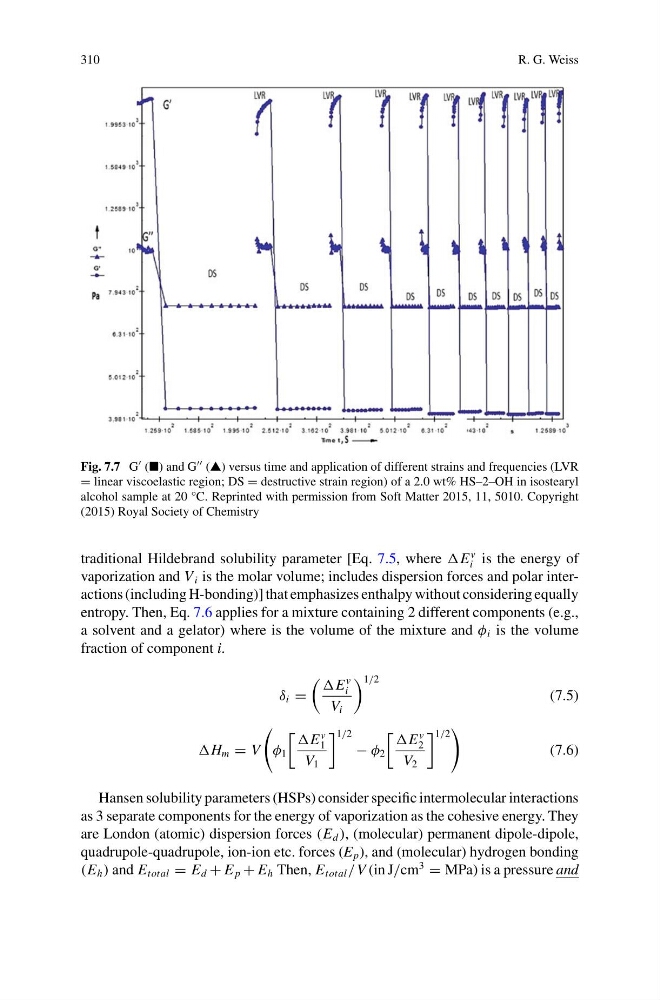
Fig. 7.7 G () and G (▲) versus time and application of different strains and frequencies (LVR
= linear viscoelastic region; DS = destructive strain region) of a 2.0 wt% HS–2–OH in isostearyl
alcohol sample at 20 °C. Reprinted with permission from Soft Matter 2015, 11, 5010. Copyright
(2015) Royal Society of Chemistry
traditional Hildebrand solubility parameter [Eq. 7.5, where E
v
i is the energy of
vaporization and V i is the molar volume; includes dispersion forces and polar interactions (including H-bonding)] that emphasizes enthalpy without considering equally
entropy. Then, Eq. 7.6 applies for a mixture containing 2 different components (e.g.,
a solvent and a gelator) where is the volume of the mixture and φ i is the volume
fraction of component i.
δ i =
E
v
i
V i
1/2
(7.5)
H m = V
φ 1
E
v
1
V 1
1/2
− φ 2
E
v
2
V 2
1/2
(7.6)
Hansen solubility parameters (HSPs) consider specific intermolecular interactions
as 3 separate components for the energy of vaporization as the cohesive energy. They
are London (atomic) dispersion forces (E d ), (molecular) permanent dipole-dipole,
quadrupole-quadrupole, ion-ion etc. forces (E p ), and (molecular) hydrogen bonding
(E h ) and E total = E d + E p + E h Then, E total /V (in J/cm
3
= MPa) is a pressure and
R. G. Weiss
Fig. 7.7 G () and G (▲) versus time and application of different strains and frequencies (LVR
= linear viscoelastic region; DS = destructive strain region) of a 2.0 wt% HS–2–OH in isostearyl
alcohol sample at 20 °C. Reprinted with permission from Soft Matter 2015, 11, 5010. Copyright
(2015) Royal Society of Chemistry
traditional Hildebrand solubility parameter [Eq. 7.5, where E
v
i is the energy of
vaporization and V i is the molar volume; includes dispersion forces and polar interactions (including H-bonding)] that emphasizes enthalpy without considering equally
entropy. Then, Eq. 7.6 applies for a mixture containing 2 different components (e.g.,
a solvent and a gelator) where is the volume of the mixture and φ i is the volume
fraction of component i.
δ i =
E
v
i
V i
1/2
(7.5)
H m = V
φ 1
E
v
1
V 1
1/2
− φ 2
E
v
2
V 2
1/2
(7.6)
Hansen solubility parameters (HSPs) consider specific intermolecular interactions
as 3 separate components for the energy of vaporization as the cohesive energy. They
are London (atomic) dispersion forces (E d ), (molecular) permanent dipole-dipole,
quadrupole-quadrupole, ion-ion etc. forces (E p ), and (molecular) hydrogen bonding
(E h ) and E total = E d + E p + E h Then, E total /V (in J/cm
3
= MPa) is a pressure and