

6 Cocoon Silk: From Mesoscopic Materials Design …
251
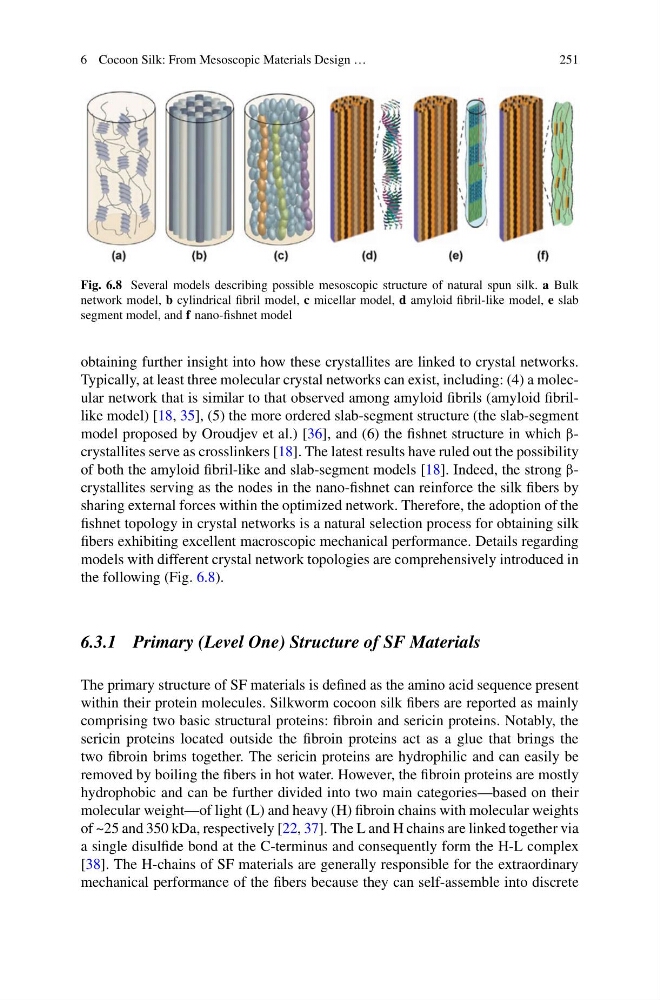
Fig. 6.8 Several models describing possible mesoscopic structure of natural spun silk. a Bulk
network model, b cylindrical fibril model, c micellar model, d amyloid fibril-like model, e slab
segment model, and f nano-fishnet model
obtaining further insight into how these crystallites are linked to crystal networks.
Typically, at least three molecular crystal networks can exist, including: (4) a molecular network that is similar to that observed among amyloid fibrils (amyloid fibrillike model) [18, 35], (5) the more ordered slab-segment structure (the slab-segment
model proposed by Oroudjev et al.) [36], and (6) the fishnet structure in which βcrystallites serve as crosslinkers [18]. The latest results have ruled out the possibility
of both the amyloid fibril-like and slab-segment models [18]. Indeed, the strong βcrystallites serving as the nodes in the nano-fishnet can reinforce the silk fibers by
sharing external forces within the optimized network. Therefore, the adoption of the
fishnet topology in crystal networks is a natural selection process for obtaining silk
fibers exhibiting excellent macroscopic mechanical performance. Details regarding
models with different crystal network topologies are comprehensively introduced in
the following (Fig. 6.8).
6.3.1 Primary (Level One) Structure of SF Materials
The primary structure of SF materials is defined as the amino acid sequence present
within their protein molecules. Silkworm cocoon silk fibers are reported as mainly
comprising two basic structural proteins: fibroin and sericin proteins. Notably, the
sericin proteins located outside the fibroin proteins act as a glue that brings the
two fibroin brims together. The sericin proteins are hydrophilic and can easily be
removed by boiling the fibers in hot water. However, the fibroin proteins are mostly
hydrophobic and can be further divided into two main categories—based on their
molecular weight—of light (L) and heavy (H) fibroin chains with molecular weights
of ~25 and 350 kDa, respectively [22, 37]. The L and H chains are linked together via
a single disulfide bond at the C-terminus and consequently form the H-L complex
[38]. The H-chains of SF materials are generally responsible for the extraordinary
mechanical performance of the fibers because they can self-assemble into discrete
251
Fig. 6.8 Several models describing possible mesoscopic structure of natural spun silk. a Bulk
network model, b cylindrical fibril model, c micellar model, d amyloid fibril-like model, e slab
segment model, and f nano-fishnet model
obtaining further insight into how these crystallites are linked to crystal networks.
Typically, at least three molecular crystal networks can exist, including: (4) a molecular network that is similar to that observed among amyloid fibrils (amyloid fibrillike model) [18, 35], (5) the more ordered slab-segment structure (the slab-segment
model proposed by Oroudjev et al.) [36], and (6) the fishnet structure in which βcrystallites serve as crosslinkers [18]. The latest results have ruled out the possibility
of both the amyloid fibril-like and slab-segment models [18]. Indeed, the strong βcrystallites serving as the nodes in the nano-fishnet can reinforce the silk fibers by
sharing external forces within the optimized network. Therefore, the adoption of the
fishnet topology in crystal networks is a natural selection process for obtaining silk
fibers exhibiting excellent macroscopic mechanical performance. Details regarding
models with different crystal network topologies are comprehensively introduced in
the following (Fig. 6.8).
6.3.1 Primary (Level One) Structure of SF Materials
The primary structure of SF materials is defined as the amino acid sequence present
within their protein molecules. Silkworm cocoon silk fibers are reported as mainly
comprising two basic structural proteins: fibroin and sericin proteins. Notably, the
sericin proteins located outside the fibroin proteins act as a glue that brings the
two fibroin brims together. The sericin proteins are hydrophilic and can easily be
removed by boiling the fibers in hot water. However, the fibroin proteins are mostly
hydrophobic and can be further divided into two main categories—based on their
molecular weight—of light (L) and heavy (H) fibroin chains with molecular weights
of ~25 and 350 kDa, respectively [22, 37]. The L and H chains are linked together via
a single disulfide bond at the C-terminus and consequently form the H-L complex
[38]. The H-chains of SF materials are generally responsible for the extraordinary
mechanical performance of the fibers because they can self-assemble into discrete