

252
W. Qiu and X.-Y. Liu
β-sheet crystallites (β-crystallites) [16, 18]. L-chains play a much less important
role because their sizes are significantly smaller than that of H-chains; moreover, no
L-chain amino acid sequences have been observed in the crystalline region.
The H- and L-chains are composed of 5263 and 266 amino acids, respectively.
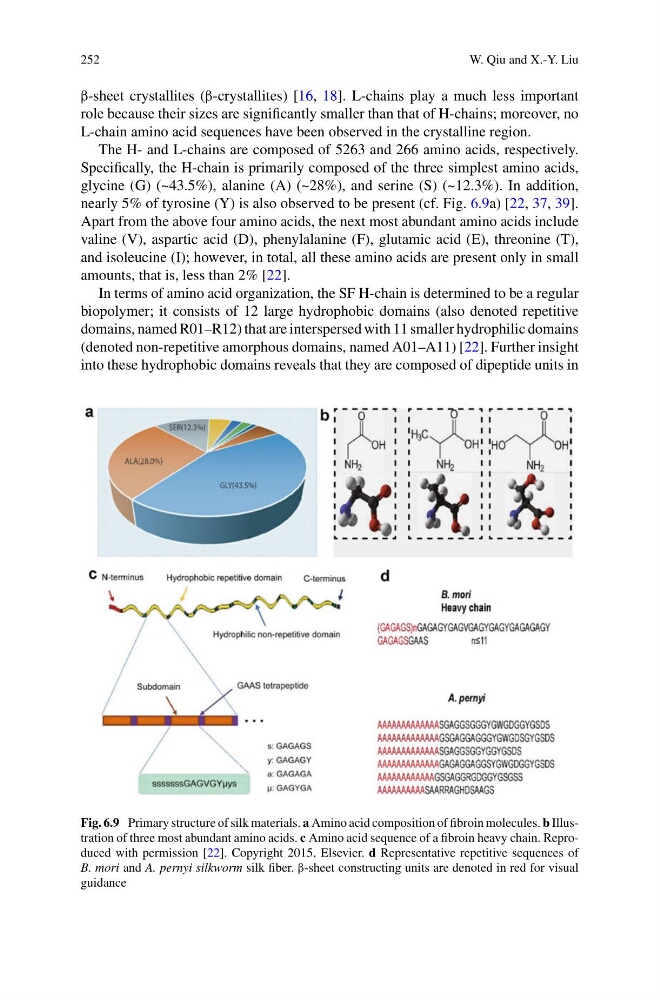
Specifically, the H-chain is primarily composed of the three simplest amino acids,
glycine (G) (~43.5%), alanine (A) (~28%), and serine (S) (~12.3%). In addition,
nearly 5% of tyrosine (Y) is also observed to be present (cf. Fig. 6.9a) [22, 37, 39].
Apart from the above four amino acids, the next most abundant amino acids include
valine (V), aspartic acid (D), phenylalanine (F), glutamic acid (E), threonine (T),
and isoleucine (I); however, in total, all these amino acids are present only in small
amounts, that is, less than 2% [22].
In terms of amino acid organization, the SF H-chain is determined to be a regular
biopolymer; it consists of 12 large hydrophobic domains (also denoted repetitive
domains, named R01–R12) that are interspersed with 11 smaller hydrophilic domains
(denoted non-repetitive amorphous domains, named A01–A11) [22]. Further insight
into these hydrophobic domains reveals that they are composed of dipeptide units in
Fig. 6.9 Primary structure of silk materials. a Amino acid composition of fibroin molecules. b Illustration of three most abundant amino acids. c Amino acid sequence of a fibroin heavy chain. Reproduced with permission [22]. Copyright 2015, Elsevier. d Representative repetitive sequences of
B. mori and A. pernyi silkworm silk fiber. β-sheet constructing units are denoted in red for visual
guidance
W. Qiu and X.-Y. Liu
β-sheet crystallites (β-crystallites) [16, 18]. L-chains play a much less important
role because their sizes are significantly smaller than that of H-chains; moreover, no
L-chain amino acid sequences have been observed in the crystalline region.
The H- and L-chains are composed of 5263 and 266 amino acids, respectively.
Specifically, the H-chain is primarily composed of the three simplest amino acids,
glycine (G) (~43.5%), alanine (A) (~28%), and serine (S) (~12.3%). In addition,
nearly 5% of tyrosine (Y) is also observed to be present (cf. Fig. 6.9a) [22, 37, 39].
Apart from the above four amino acids, the next most abundant amino acids include
valine (V), aspartic acid (D), phenylalanine (F), glutamic acid (E), threonine (T),
and isoleucine (I); however, in total, all these amino acids are present only in small
amounts, that is, less than 2% [22].
In terms of amino acid organization, the SF H-chain is determined to be a regular
biopolymer; it consists of 12 large hydrophobic domains (also denoted repetitive
domains, named R01–R12) that are interspersed with 11 smaller hydrophilic domains
(denoted non-repetitive amorphous domains, named A01–A11) [22]. Further insight
into these hydrophobic domains reveals that they are composed of dipeptide units in
Fig. 6.9 Primary structure of silk materials. a Amino acid composition of fibroin molecules. b Illustration of three most abundant amino acids. c Amino acid sequence of a fibroin heavy chain. Reproduced with permission [22]. Copyright 2015, Elsevier. d Representative repetitive sequences of
B. mori and A. pernyi silkworm silk fiber. β-sheet constructing units are denoted in red for visual
guidance