

250
W. Qiu and X.-Y. Liu
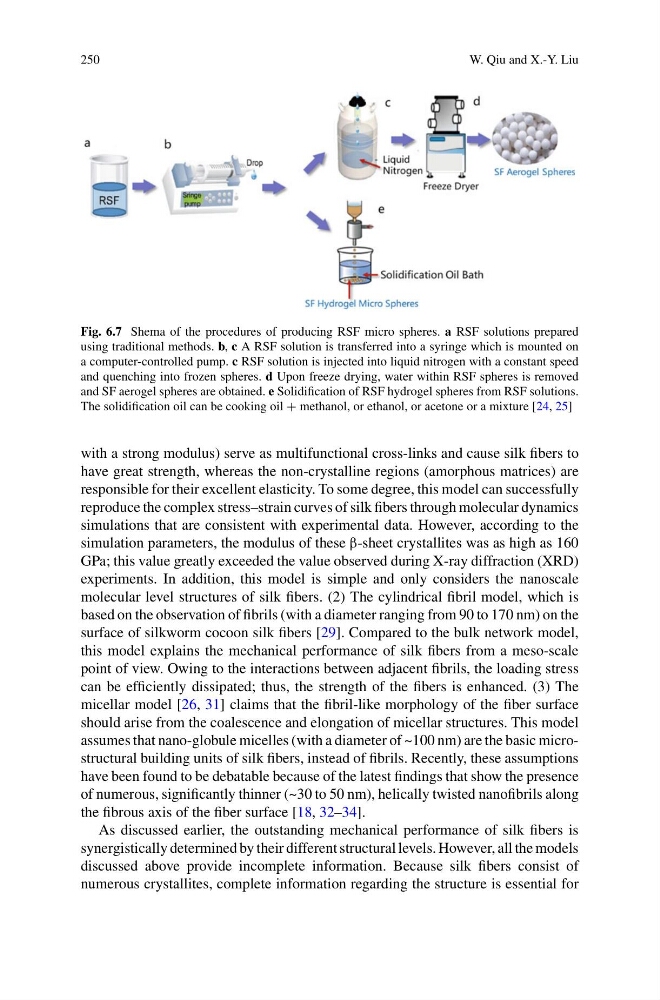
Fig. 6.7 Shema of the procedures of producing RSF micro spheres. a RSF solutions prepared
using traditional methods. b, c A RSF solution is transferred into a syringe which is mounted on
a computer-controlled pump. c RSF solution is injected into liquid nitrogen with a constant speed
and quenching into frozen spheres. d Upon freeze drying, water within RSF spheres is removed
and SF aerogel spheres are obtained. e Solidification of RSF hydrogel spheres from RSF solutions.
The solidification oil can be cooking oil + methanol, or ethanol, or acetone or a mixture [24, 25]
with a strong modulus) serve as multifunctional cross-links and cause silk fibers to
have great strength, whereas the non-crystalline regions (amorphous matrices) are
responsible for their excellent elasticity. To some degree, this model can successfully
reproduce the complex stress–strain curves of silk fibers through molecular dynamics
simulations that are consistent with experimental data. However, according to the
simulation parameters, the modulus of these β-sheet crystallites was as high as 160
GPa; this value greatly exceeded the value observed during X-ray diffraction (XRD)
experiments. In addition, this model is simple and only considers the nanoscale
molecular level structures of silk fibers. (2) The cylindrical fibril model, which is
based on the observation of fibrils (with a diameter ranging from 90 to 170 nm) on the
surface of silkworm cocoon silk fibers [29]. Compared to the bulk network model,
this model explains the mechanical performance of silk fibers from a meso-scale
point of view. Owing to the interactions between adjacent fibrils, the loading stress
can be efficiently dissipated; thus, the strength of the fibers is enhanced. (3) The
micellar model [26, 31] claims that the fibril-like morphology of the fiber surface
should arise from the coalescence and elongation of micellar structures. This model
assumes that nano-globule micelles (with a diameter of ~100 nm) are the basic microstructural building units of silk fibers, instead of fibrils. Recently, these assumptions
have been found to be debatable because of the latest findings that show the presence
of numerous, significantly thinner (~30 to 50 nm), helically twisted nanofibrils along
the fibrous axis of the fiber surface [18, 32–34].
As discussed earlier, the outstanding mechanical performance of silk fibers is
synergistically determined by their different structural levels. However, all the models
discussed above provide incomplete information. Because silk fibers consist of
numerous crystallites, complete information regarding the structure is essential for
W. Qiu and X.-Y. Liu
Fig. 6.7 Shema of the procedures of producing RSF micro spheres. a RSF solutions prepared
using traditional methods. b, c A RSF solution is transferred into a syringe which is mounted on
a computer-controlled pump. c RSF solution is injected into liquid nitrogen with a constant speed
and quenching into frozen spheres. d Upon freeze drying, water within RSF spheres is removed
and SF aerogel spheres are obtained. e Solidification of RSF hydrogel spheres from RSF solutions.
The solidification oil can be cooking oil + methanol, or ethanol, or acetone or a mixture [24, 25]
with a strong modulus) serve as multifunctional cross-links and cause silk fibers to
have great strength, whereas the non-crystalline regions (amorphous matrices) are
responsible for their excellent elasticity. To some degree, this model can successfully
reproduce the complex stress–strain curves of silk fibers through molecular dynamics
simulations that are consistent with experimental data. However, according to the
simulation parameters, the modulus of these β-sheet crystallites was as high as 160
GPa; this value greatly exceeded the value observed during X-ray diffraction (XRD)
experiments. In addition, this model is simple and only considers the nanoscale
molecular level structures of silk fibers. (2) The cylindrical fibril model, which is
based on the observation of fibrils (with a diameter ranging from 90 to 170 nm) on the
surface of silkworm cocoon silk fibers [29]. Compared to the bulk network model,
this model explains the mechanical performance of silk fibers from a meso-scale
point of view. Owing to the interactions between adjacent fibrils, the loading stress
can be efficiently dissipated; thus, the strength of the fibers is enhanced. (3) The
micellar model [26, 31] claims that the fibril-like morphology of the fiber surface
should arise from the coalescence and elongation of micellar structures. This model
assumes that nano-globule micelles (with a diameter of ~100 nm) are the basic microstructural building units of silk fibers, instead of fibrils. Recently, these assumptions
have been found to be debatable because of the latest findings that show the presence
of numerous, significantly thinner (~30 to 50 nm), helically twisted nanofibrils along
the fibrous axis of the fiber surface [18, 32–34].
As discussed earlier, the outstanding mechanical performance of silk fibers is
synergistically determined by their different structural levels. However, all the models
discussed above provide incomplete information. Because silk fibers consist of
numerous crystallites, complete information regarding the structure is essential for