

248
W. Qiu and X.-Y. Liu
Pupa: As indicated above, the larvae enclose themselves in a protective shell called
a cocoon. Inside cocoons, the larvae are almost motionless until their metamorphosis
into a pupa occurs, which usually takes two or three weeks.
Moth: Once the conditions are favorable, the pupa releases proteolytic cocoonase,
an enzyme that partially dissolves the cocoon walls so that the adult moth can emerge
for mating. Male moths vary significantly from female moths in their body size as
well as physiology; that is, the males are more active, and the females have a larger
abdomen.
6.2.2 Processing and Fabrication of Cocoon Silk and Various
Forms of SF Materials
During cocoon formation, the silkworms swing themselves from side to side in a
figure-eight and continuously produce silk from their silk glands. In general, an
individual silkworm spins approximately 800–1600 meters of filaments [22]. Note
that the quantity of usable quality silk flament in each cocoon is small, therefore,
it usually takes thousands of silkworm cocoons to produce a kilogram of raw silk
fibers.
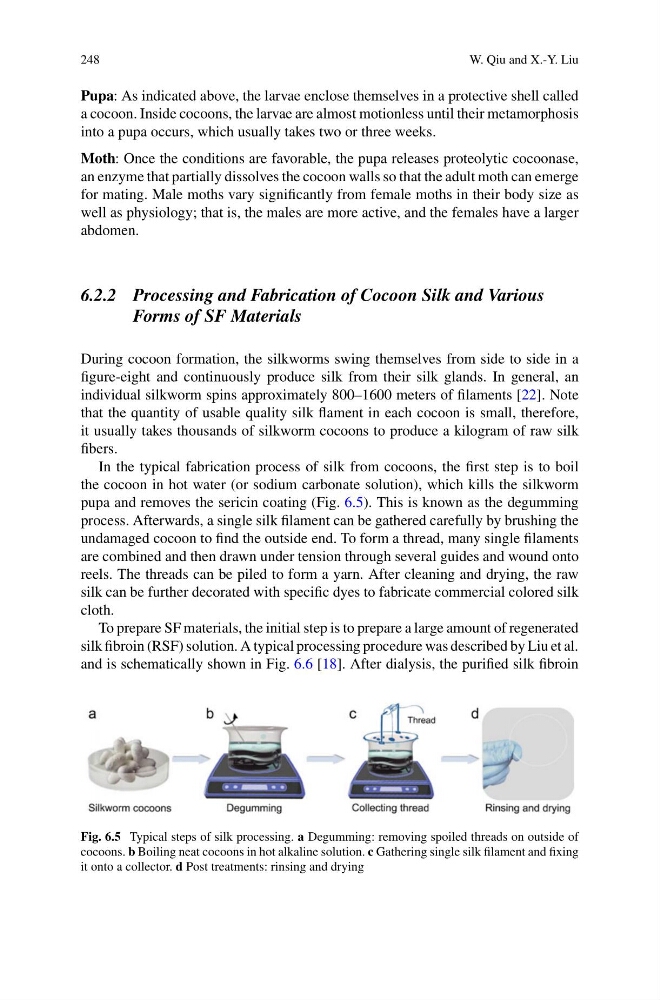
In the typical fabrication process of silk from cocoons, the first step is to boil
the cocoon in hot water (or sodium carbonate solution), which kills the silkworm
pupa and removes the sericin coating (Fig. 6.5). This is known as the degumming
process. Afterwards, a single silk filament can be gathered carefully by brushing the
undamaged cocoon to find the outside end. To form a thread, many single filaments
are combined and then drawn under tension through several guides and wound onto
reels. The threads can be piled to form a yarn. After cleaning and drying, the raw
silk can be further decorated with specific dyes to fabricate commercial colored silk
cloth.
To prepare SF materials, the initial step is to prepare a large amount of regenerated
silk fibroin (RSF) solution. A typical processing procedure was described by Liu et al.
and is schematically shown in Fig. 6.6 [18]. After dialysis, the purified silk fibroin
Fig. 6.5 Typical steps of silk processing. a Degumming: removing spoiled threads on outside of
cocoons. b Boiling neat cocoons in hot alkaline solution. c Gathering single silk filament and fixing
it onto a collector. d Post treatments: rinsing and drying
W. Qiu and X.-Y. Liu
Pupa: As indicated above, the larvae enclose themselves in a protective shell called
a cocoon. Inside cocoons, the larvae are almost motionless until their metamorphosis
into a pupa occurs, which usually takes two or three weeks.
Moth: Once the conditions are favorable, the pupa releases proteolytic cocoonase,
an enzyme that partially dissolves the cocoon walls so that the adult moth can emerge
for mating. Male moths vary significantly from female moths in their body size as
well as physiology; that is, the males are more active, and the females have a larger
abdomen.
6.2.2 Processing and Fabrication of Cocoon Silk and Various
Forms of SF Materials
During cocoon formation, the silkworms swing themselves from side to side in a
figure-eight and continuously produce silk from their silk glands. In general, an
individual silkworm spins approximately 800–1600 meters of filaments [22]. Note
that the quantity of usable quality silk flament in each cocoon is small, therefore,
it usually takes thousands of silkworm cocoons to produce a kilogram of raw silk
fibers.
In the typical fabrication process of silk from cocoons, the first step is to boil
the cocoon in hot water (or sodium carbonate solution), which kills the silkworm
pupa and removes the sericin coating (Fig. 6.5). This is known as the degumming
process. Afterwards, a single silk filament can be gathered carefully by brushing the
undamaged cocoon to find the outside end. To form a thread, many single filaments
are combined and then drawn under tension through several guides and wound onto
reels. The threads can be piled to form a yarn. After cleaning and drying, the raw
silk can be further decorated with specific dyes to fabricate commercial colored silk
cloth.
To prepare SF materials, the initial step is to prepare a large amount of regenerated
silk fibroin (RSF) solution. A typical processing procedure was described by Liu et al.
and is schematically shown in Fig. 6.6 [18]. After dialysis, the purified silk fibroin
Fig. 6.5 Typical steps of silk processing. a Degumming: removing spoiled threads on outside of
cocoons. b Boiling neat cocoons in hot alkaline solution. c Gathering single silk filament and fixing
it onto a collector. d Post treatments: rinsing and drying