

6 Cocoon Silk: From Mesoscopic Materials Design …
247
In comparison, non-mulberry silkworms are wild heterogeneous in nature and widely
distributed throughout the world. Based on their location, non-mulberry silkworms
can be further classified as temperate and tropical. Among them, typical temperate
silkworms include Antheraea pernyi (A. pernyi) found in China, Antheraea Assama
found in Japan, and Attacus cynthia ricini found in northeastern India; tropical nonmulberry silkworms mainly refer to Antheraea mylitta (A. mylitta), which is mostly
confined to central India [21]. In terms of structure and properties, the silk spun by
non-mulberry and mulberry silkworms are very similar. However, as non-mulberry
silkworms mainly live in the wild, their cocoons are always contaminated by several
inorganic minerals, which consequently bring great difficulty in further purification,
spinning, and the weaving process.
Although wild and domesticated silkworms differ greatly from each other in terms
of their physiology, morphology, and feeding conditions, they still share substantial
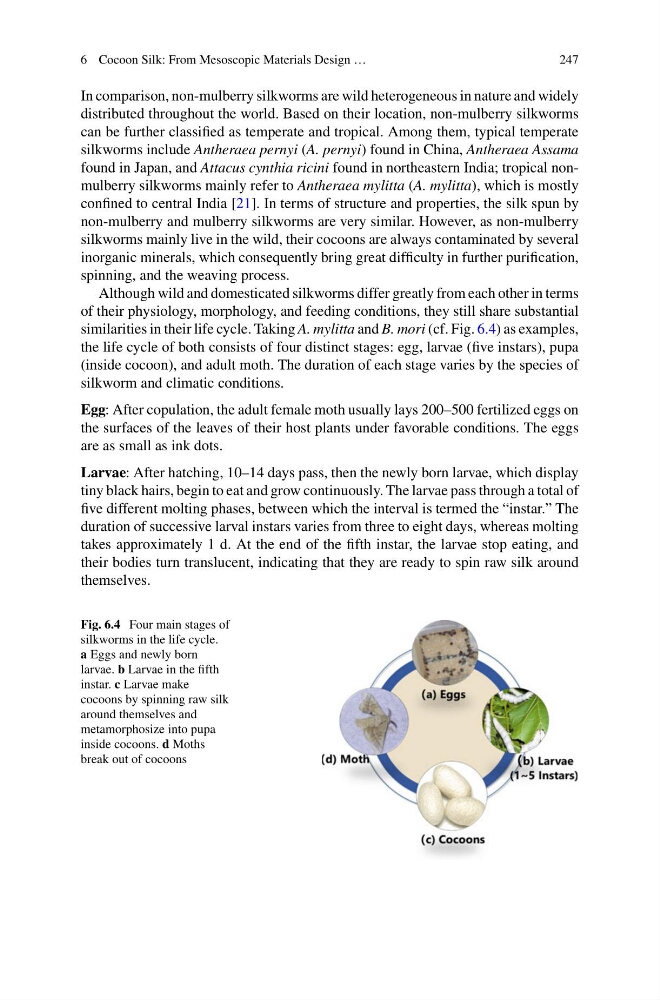
similarities in their life cycle. Taking A. mylitta and B. mori (cf. Fig. 6.4) as examples,
the life cycle of both consists of four distinct stages: egg, larvae (five instars), pupa
(inside cocoon), and adult moth. The duration of each stage varies by the species of
silkworm and climatic conditions.
Egg: After copulation, the adult female moth usually lays 200–500 fertilized eggs on
the surfaces of the leaves of their host plants under favorable conditions. The eggs
are as small as ink dots.
Larvae: After hatching, 10–14 days pass, then the newly born larvae, which display
tiny black hairs, begin to eat and grow continuously. The larvae pass through a total of
five different molting phases, between which the interval is termed the “instar.” The
duration of successive larval instars varies from three to eight days, whereas molting
takes approximately 1 d. At the end of the fifth instar, the larvae stop eating, and
their bodies turn translucent, indicating that they are ready to spin raw silk around
themselves.
Fig. 6.4 Four main stages of
silkworms in the life cycle.
a Eggs and newly born
larvae. b Larvae in the fifth
instar. c Larvae make
cocoons by spinning raw silk
around themselves and
metamorphosize into pupa
inside cocoons. d Moths
break out of cocoons
247
In comparison, non-mulberry silkworms are wild heterogeneous in nature and widely
distributed throughout the world. Based on their location, non-mulberry silkworms
can be further classified as temperate and tropical. Among them, typical temperate
silkworms include Antheraea pernyi (A. pernyi) found in China, Antheraea Assama
found in Japan, and Attacus cynthia ricini found in northeastern India; tropical nonmulberry silkworms mainly refer to Antheraea mylitta (A. mylitta), which is mostly
confined to central India [21]. In terms of structure and properties, the silk spun by
non-mulberry and mulberry silkworms are very similar. However, as non-mulberry
silkworms mainly live in the wild, their cocoons are always contaminated by several
inorganic minerals, which consequently bring great difficulty in further purification,
spinning, and the weaving process.
Although wild and domesticated silkworms differ greatly from each other in terms
of their physiology, morphology, and feeding conditions, they still share substantial
similarities in their life cycle. Taking A. mylitta and B. mori (cf. Fig. 6.4) as examples,
the life cycle of both consists of four distinct stages: egg, larvae (five instars), pupa
(inside cocoon), and adult moth. The duration of each stage varies by the species of
silkworm and climatic conditions.
Egg: After copulation, the adult female moth usually lays 200–500 fertilized eggs on
the surfaces of the leaves of their host plants under favorable conditions. The eggs
are as small as ink dots.
Larvae: After hatching, 10–14 days pass, then the newly born larvae, which display
tiny black hairs, begin to eat and grow continuously. The larvae pass through a total of
five different molting phases, between which the interval is termed the “instar.” The
duration of successive larval instars varies from three to eight days, whereas molting
takes approximately 1 d. At the end of the fifth instar, the larvae stop eating, and
their bodies turn translucent, indicating that they are ready to spin raw silk around
themselves.
Fig. 6.4 Four main stages of
silkworms in the life cycle.
a Eggs and newly born
larvae. b Larvae in the fifth
instar. c Larvae make
cocoons by spinning raw silk
around themselves and
metamorphosize into pupa
inside cocoons. d Moths
break out of cocoons