

236
C. Tang (唐晨宇) and Y. Wang (王延颋)
5.7 Simple Data Analysis
5.7.1 Energy-Related Data
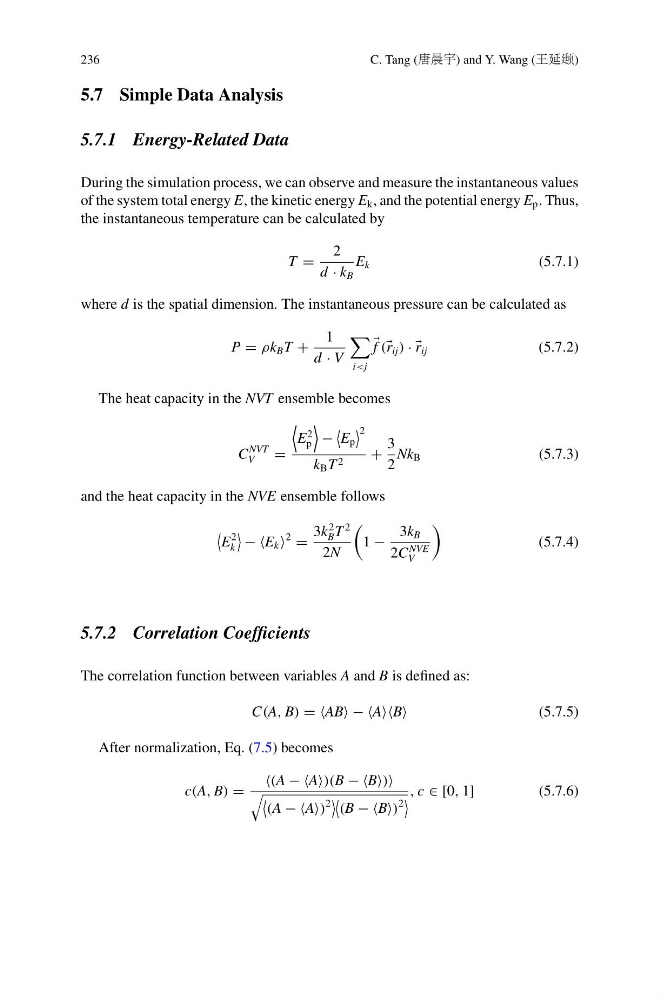
During the simulation process, we can observe and measure the instantaneous values
of the system total energy E, the kinetic energy E k , and the potential energy E p . Thus,
the instantaneous temperature can be calculated by
T =
2
d · k B
E k
(5.7.1)
where d is the spatial dimension. The instantaneous pressure can be calculated as
P = ρk B T +
1
d · V
i
(5.7.2)
The heat capacity in the NVT ensemble becomes
C
NVT
V
=
E
2
p
−
E p
2
k B T 2
+
3
2
Nk B
(5.7.3)
and the heat capacity in the NVE ensemble follows
E
2
k
− E k
2
=
3k
2
B T
2
2N
1 −
3k B
2C
NVE
V
(5.7.4)
5.7.2 Correlation Coefficients
The correlation function between variables A and B is defined as:
C(A, B) = AB − AB
(5.7.5)
After normalization, Eq. (7.5) becomes
c(A, B) =
(A − A)(B − B)
(A − A)
2
(B − B)
2
, c ∈ [0, 1]
(5.7.6)
C. Tang (唐晨宇) and Y. Wang (王延颋)
5.7 Simple Data Analysis
5.7.1 Energy-Related Data
During the simulation process, we can observe and measure the instantaneous values
of the system total energy E, the kinetic energy E k , and the potential energy E p . Thus,
the instantaneous temperature can be calculated by
T =
2
d · k B
E k
(5.7.1)
where d is the spatial dimension. The instantaneous pressure can be calculated as
P = ρk B T +
1
d · V
i
(5.7.2)
The heat capacity in the NVT ensemble becomes
C
NVT
V
=
E
2
p
−
E p
2
k B T 2
+
3
2
Nk B
(5.7.3)
and the heat capacity in the NVE ensemble follows
E
2
k
− E k
2
=
3k
2
B T
2
2N
1 −
3k B
2C
NVE
V
(5.7.4)
5.7.2 Correlation Coefficients
The correlation function between variables A and B is defined as:
C(A, B) = AB − AB
(5.7.5)
After normalization, Eq. (7.5) becomes
c(A, B) =
(A − A)(B − B)
(A − A)
2
(B − B)
2
, c ∈ [0, 1]
(5.7.6)