

5 Basics of Molecular Modeling and Molecular Simulation
237
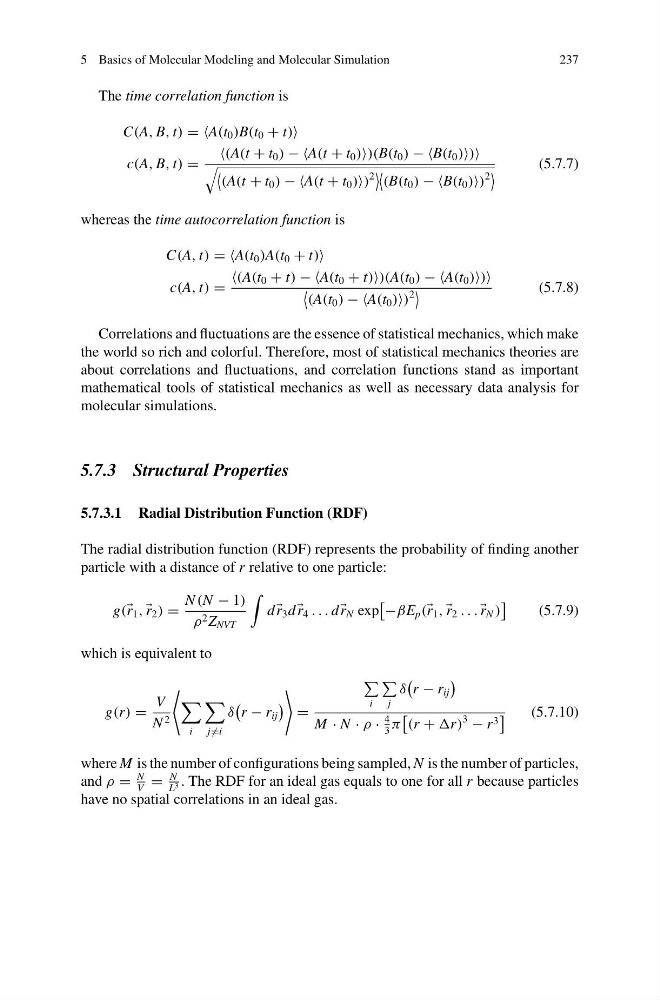
The time correlation function is
C(A, B, t) = A(t 0 )B(t 0 + t)
c(A, B, t) =
(A(t + t 0 ) − A(t + t 0 ))(B(t 0 ) − B(t 0 ))
(A(t + t 0 ) − A(t + t 0 ))
2
(B(t 0 ) − B(t 0 ))
2
(5.7.7)
whereas the time autocorrelation function is
C(A, t) = A(t 0 )A(t 0 + t)
c(A, t) =
(A(t 0 + t) − A(t 0 + t))(A(t 0 ) − A(t 0 ))
(A(t 0 ) − A(t 0 ))
2
(5.7.8)
Correlations and fluctuations are the essence of statistical mechanics, which make
the world so rich and colorful. Therefore, most of statistical mechanics theories are
about correlations and fluctuations, and correlation functions stand as important
mathematical tools of statistical mechanics as well as necessary data analysis for
molecular simulations.
5.7.3 Structural Properties
5.7.3.1 Radial Distribution Function (RDF)
The radial distribution function (RDF) represents the probability of finding another
particle with a distance of r relative to one particle:
g( r 1 , r 2 ) =
N (N − 1)
ρ 2 Z NVT
d r 3 d r 4 . . . d r N exp
−βE p ( r 1 , r 2 . . . r N )
(5.7.9)
which is equivalent to
g(r) =
V
N 2
i
j =i
δ
r − r ij
=
i
j
δ
r − r ij
M · N · ρ ·
4
3
π
(r + r)
3
− r 3
(5.7.10)
where M is the number of configurations being sampled, N is the number of particles,
and ρ =
N
V
=
N
L 3 . The RDF for an ideal gas equals to one for all r because particles
have no spatial correlations in an ideal gas.
237
The time correlation function is
C(A, B, t) = A(t 0 )B(t 0 + t)
c(A, B, t) =
(A(t + t 0 ) − A(t + t 0 ))(B(t 0 ) − B(t 0 ))
(A(t + t 0 ) − A(t + t 0 ))
2
(B(t 0 ) − B(t 0 ))
2
(5.7.7)
whereas the time autocorrelation function is
C(A, t) = A(t 0 )A(t 0 + t)
c(A, t) =
(A(t 0 + t) − A(t 0 + t))(A(t 0 ) − A(t 0 ))
(A(t 0 ) − A(t 0 ))
2
(5.7.8)
Correlations and fluctuations are the essence of statistical mechanics, which make
the world so rich and colorful. Therefore, most of statistical mechanics theories are
about correlations and fluctuations, and correlation functions stand as important
mathematical tools of statistical mechanics as well as necessary data analysis for
molecular simulations.
5.7.3 Structural Properties
5.7.3.1 Radial Distribution Function (RDF)
The radial distribution function (RDF) represents the probability of finding another
particle with a distance of r relative to one particle:
g( r 1 , r 2 ) =
N (N − 1)
ρ 2 Z NVT
d r 3 d r 4 . . . d r N exp
−βE p ( r 1 , r 2 . . . r N )
(5.7.9)
which is equivalent to
g(r) =
V
N 2
i
j =i
δ
r − r ij
=
i
j
δ
r − r ij
M · N · ρ ·
4
3
π
(r + r)
3
− r 3
(5.7.10)
where M is the number of configurations being sampled, N is the number of particles,
and ρ =
N
V
=
N
L 3 . The RDF for an ideal gas equals to one for all r because particles
have no spatial correlations in an ideal gas.