

218
C. Tang (唐晨宇) and Y. Wang (王延颋)
V angel =
1
2
k θ (θ − θ 0 )
2
(5.3.41)
(c) Dihedral Angle: the dihedral angle between four sequential atoms, depicted
in the form of:
V dihedral = V n cos(nφ − γ )
(5.3.42)
(d) Improper Dihedral Angle: the angle that constrains four atoms in one plane,
which could also be depicted in the form of equation Eq. (3.42).
2. Non-bonded Interactions:
(a) VDW interactions: as we have mentioned in Sect. 4.2, the VDW interactions
can be depicted by the LJ-potential:
V LJ = 4ε
σ
12
r 12 −
σ
6
r 6
(5.3.43)
(b) Electrostatic interactions:
V EL =
Kq 1 q 2
r
=
1
4πε 0
q 1 q 2
r
(5.3.44)
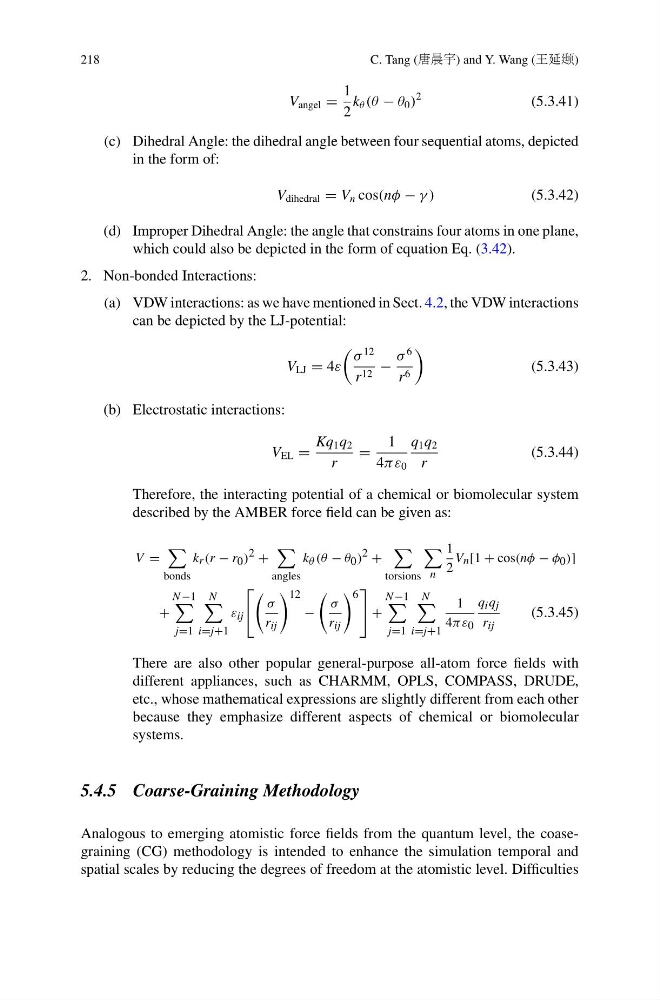
Therefore, the interacting potential of a chemical or biomolecular system
described by the AMBER force field can be given as:
V =
bonds
k r (r − r 0 ) 2 +
angles
k θ (θ − θ 0 ) 2 +
torsions
n
1
2
V n [1 + cos(nφ − φ 0 )]
+
N −1
j=1
N
i=j+1
ε ij
⎡
⎣
σ
r ij
12
−
σ
r ij
6
⎤
⎦ +
N −1
j=1
N
i=j+1
1
4πε 0
q i q j
r ij
(5.3.45)
There are also other popular general-purpose all-atom force fields with
different appliances, such as CHARMM, OPLS, COMPASS, DRUDE,
etc., whose mathematical expressions are slightly different from each other
because they emphasize different aspects of chemical or biomolecular
systems.
5.4.5 Coarse-Graining Methodology
Analogous to emerging atomistic force fields from the quantum level, the coasegraining (CG) methodology is intended to enhance the simulation temporal and
spatial scales by reducing the degrees of freedom at the atomistic level. Difficulties
C. Tang (唐晨宇) and Y. Wang (王延颋)
V angel =
1
2
k θ (θ − θ 0 )
2
(5.3.41)
(c) Dihedral Angle: the dihedral angle between four sequential atoms, depicted
in the form of:
V dihedral = V n cos(nφ − γ )
(5.3.42)
(d) Improper Dihedral Angle: the angle that constrains four atoms in one plane,
which could also be depicted in the form of equation Eq. (3.42).
2. Non-bonded Interactions:
(a) VDW interactions: as we have mentioned in Sect. 4.2, the VDW interactions
can be depicted by the LJ-potential:
V LJ = 4ε
σ
12
r 12 −
σ
6
r 6
(5.3.43)
(b) Electrostatic interactions:
V EL =
Kq 1 q 2
r
=
1
4πε 0
q 1 q 2
r
(5.3.44)
Therefore, the interacting potential of a chemical or biomolecular system
described by the AMBER force field can be given as:
V =
bonds
k r (r − r 0 ) 2 +
angles
k θ (θ − θ 0 ) 2 +
torsions
n
1
2
V n [1 + cos(nφ − φ 0 )]
+
N −1
j=1
N
i=j+1
ε ij
⎡
⎣
σ
r ij
12
−
σ
r ij
6
⎤
⎦ +
N −1
j=1
N
i=j+1
1
4πε 0
q i q j
r ij
(5.3.45)
There are also other popular general-purpose all-atom force fields with
different appliances, such as CHARMM, OPLS, COMPASS, DRUDE,
etc., whose mathematical expressions are slightly different from each other
because they emphasize different aspects of chemical or biomolecular
systems.
5.4.5 Coarse-Graining Methodology
Analogous to emerging atomistic force fields from the quantum level, the coasegraining (CG) methodology is intended to enhance the simulation temporal and
spatial scales by reducing the degrees of freedom at the atomistic level. Difficulties