

5 Basics of Molecular Modeling and Molecular Simulation
217
5.4.4 Chemical and Biomolecular Force Fields
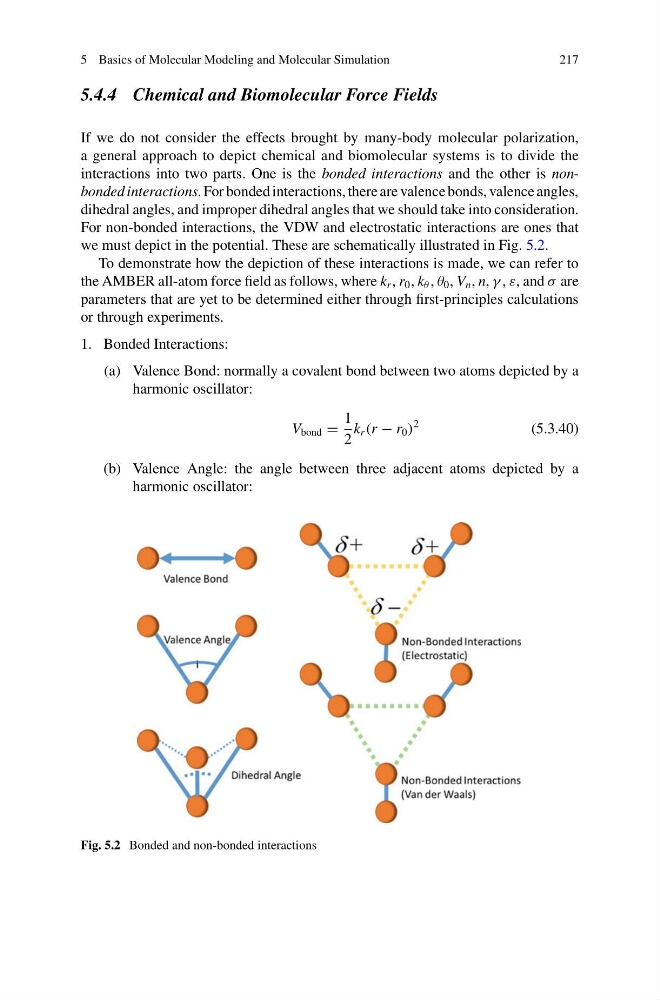
If we do not consider the effects brought by many-body molecular polarization,
a general approach to depict chemical and biomolecular systems is to divide the
interactions into two parts. One is the bonded interactions and the other is nonbonded interactions. For bonded interactions, there are valence bonds, valence angles,
dihedral angles, and improper dihedral angles that we should take into consideration.
For non-bonded interactions, the VDW and electrostatic interactions are ones that
we must depict in the potential. These are schematically illustrated in Fig. 5.2.
To demonstrate how the depiction of these interactions is made, we can refer to
the AMBER all-atom force field as follows, where k r , r 0 , k θ , θ 0 , V n , n, γ , ε, and σ are
parameters that are yet to be determined either through first-principles calculations
or through experiments.
1. Bonded Interactions:
(a) Valence Bond: normally a covalent bond between two atoms depicted by a
harmonic oscillator:
V bond =
1
2
k r (r − r 0 )
2
(5.3.40)
(b) Valence Angle: the angle between three adjacent atoms depicted by a
harmonic oscillator:
Fig. 5.2 Bonded and non-bonded interactions
217
5.4.4 Chemical and Biomolecular Force Fields
If we do not consider the effects brought by many-body molecular polarization,
a general approach to depict chemical and biomolecular systems is to divide the
interactions into two parts. One is the bonded interactions and the other is nonbonded interactions. For bonded interactions, there are valence bonds, valence angles,
dihedral angles, and improper dihedral angles that we should take into consideration.
For non-bonded interactions, the VDW and electrostatic interactions are ones that
we must depict in the potential. These are schematically illustrated in Fig. 5.2.
To demonstrate how the depiction of these interactions is made, we can refer to
the AMBER all-atom force field as follows, where k r , r 0 , k θ , θ 0 , V n , n, γ , ε, and σ are
parameters that are yet to be determined either through first-principles calculations
or through experiments.
1. Bonded Interactions:
(a) Valence Bond: normally a covalent bond between two atoms depicted by a
harmonic oscillator:
V bond =
1
2
k r (r − r 0 )
2
(5.3.40)
(b) Valence Angle: the angle between three adjacent atoms depicted by a
harmonic oscillator:
Fig. 5.2 Bonded and non-bonded interactions