

212
C. Tang (唐晨宇) and Y. Wang (王延颋)
5.3.3 Common Thermodynamic Variables
There are certain thermodynamic variables and the relationships between them that
are of much significance in dressing. Thus, in this segment, we are to introduce
some of the important variables that researchers might encounter during MC or MD
simulations. The detailed derivation and explanation of these variables are not the
focus of this chapter. Interested readers may find them easily in any textbooks about
statistical physics and thermodynamics.
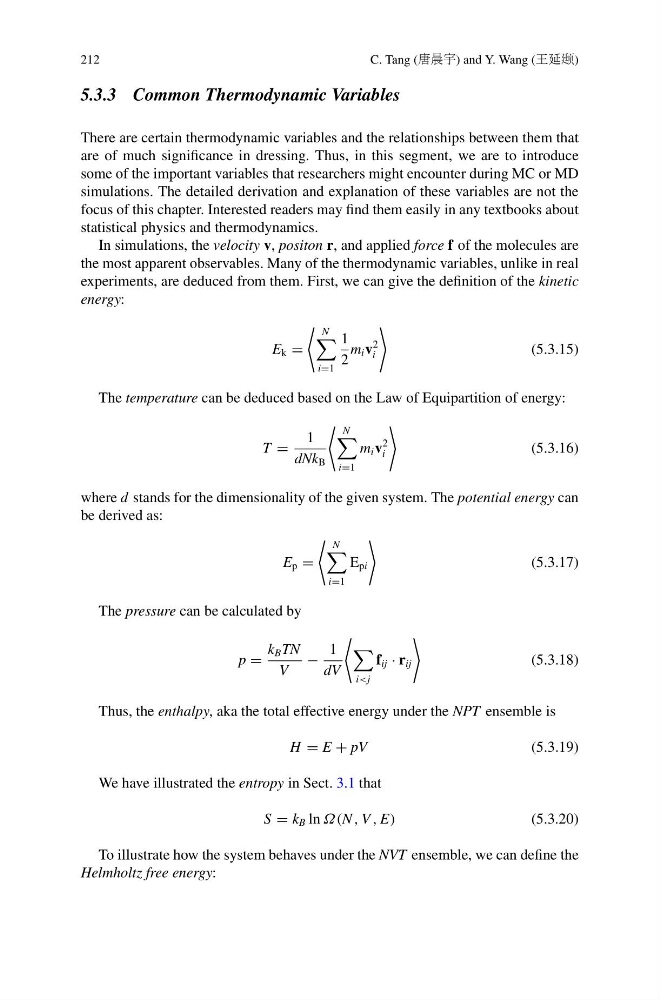
In simulations, the velocity v, positon r, and applied force f of the molecules are
the most apparent observables. Many of the thermodynamic variables, unlike in real
experiments, are deduced from them. First, we can give the definition of the kinetic
energy:
E k =
N
i=1
1
2
m i v
2
i
(5.3.15)
The temperature can be deduced based on the Law of Equipartition of energy:
T =
1
dNk B
N
i=1
m i v
2
i
(5.3.16)
where d stands for the dimensionality of the given system. The potential energy can
be derived as:
E p =
N
i=1
E pi
(5.3.17)
The pressure can be calculated by
p =
k B TN
V
−
1
dV
i
(5.3.18)
Thus, the enthalpy, aka the total effective energy under the NPT ensemble is
H = E + pV
(5.3.19)
We have illustrated the entropy in Sect. 3.1 that
S = k B ln Ω(N , V , E)
(5.3.20)
To illustrate how the system behaves under the NVT ensemble, we can define the
Helmholtz free energy:
C. Tang (唐晨宇) and Y. Wang (王延颋)
5.3.3 Common Thermodynamic Variables
There are certain thermodynamic variables and the relationships between them that
are of much significance in dressing. Thus, in this segment, we are to introduce
some of the important variables that researchers might encounter during MC or MD
simulations. The detailed derivation and explanation of these variables are not the
focus of this chapter. Interested readers may find them easily in any textbooks about
statistical physics and thermodynamics.
In simulations, the velocity v, positon r, and applied force f of the molecules are
the most apparent observables. Many of the thermodynamic variables, unlike in real
experiments, are deduced from them. First, we can give the definition of the kinetic
energy:
E k =
N
i=1
1
2
m i v
2
i
(5.3.15)
The temperature can be deduced based on the Law of Equipartition of energy:
T =
1
dNk B
N
i=1
m i v
2
i
(5.3.16)
where d stands for the dimensionality of the given system. The potential energy can
be derived as:
E p =
N
i=1
E pi
(5.3.17)
The pressure can be calculated by
p =
k B TN
V
−
1
dV
i
(5.3.18)
Thus, the enthalpy, aka the total effective energy under the NPT ensemble is
H = E + pV
(5.3.19)
We have illustrated the entropy in Sect. 3.1 that
S = k B ln Ω(N , V , E)
(5.3.20)
To illustrate how the system behaves under the NVT ensemble, we can define the
Helmholtz free energy: