

5 Basics of Molecular Modeling and Molecular Simulation
213
F = E − TS = −k B T ln Z
(5.3.21)
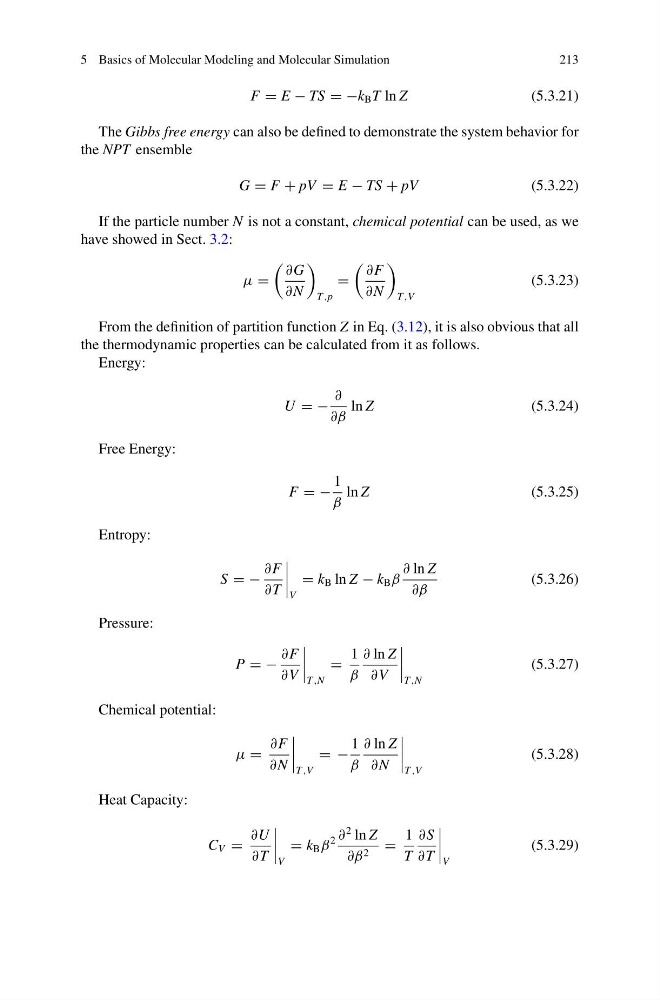
The Gibbs free energy can also be defined to demonstrate the system behavior for
the NPT ensemble
G = F + pV = E − TS + pV
(5.3.22)
If the particle number N is not a constant, chemical potential can be used, as we
have showed in Sect. 3.2:
μ =
∂G
∂N
T ,p
=
∂F
∂N
T ,V
(5.3.23)
From the definition of partition function Z in Eq. (3.12), it is also obvious that all
the thermodynamic properties can be calculated from it as follows.
Energy:
U = −
∂
∂β
ln Z
(5.3.24)
Free Energy:
F = −
1
β
ln Z
(5.3.25)
Entropy:
S = −
∂F
∂T
V
= k B ln Z − k B β
∂ ln Z
∂β
(5.3.26)
Pressure:
P = −
∂F
∂V
T ,N
=
1
β
∂ ln Z
∂V
T ,N
(5.3.27)
Chemical potential:
μ =
∂F
∂N
T ,V
= −
1
β
∂ ln Z
∂N
T ,V
(5.3.28)
Heat Capacity:
C V =
∂U
∂T
V
= k B β
2 ∂
2 ln Z
∂β 2 =
1
T
∂S
∂T
V
(5.3.29)
213
F = E − TS = −k B T ln Z
(5.3.21)
The Gibbs free energy can also be defined to demonstrate the system behavior for
the NPT ensemble
G = F + pV = E − TS + pV
(5.3.22)
If the particle number N is not a constant, chemical potential can be used, as we
have showed in Sect. 3.2:
μ =
∂G
∂N
T ,p
=
∂F
∂N
T ,V
(5.3.23)
From the definition of partition function Z in Eq. (3.12), it is also obvious that all
the thermodynamic properties can be calculated from it as follows.
Energy:
U = −
∂
∂β
ln Z
(5.3.24)
Free Energy:
F = −
1
β
ln Z
(5.3.25)
Entropy:
S = −
∂F
∂T
V
= k B ln Z − k B β
∂ ln Z
∂β
(5.3.26)
Pressure:
P = −
∂F
∂V
T ,N
=
1
β
∂ ln Z
∂V
T ,N
(5.3.27)
Chemical potential:
μ =
∂F
∂N
T ,V
= −
1
β
∂ ln Z
∂N
T ,V
(5.3.28)
Heat Capacity:
C V =
∂U
∂T
V
= k B β
2 ∂
2 ln Z
∂β 2 =
1
T
∂S
∂T
V
(5.3.29)