

5 Basics of Molecular Modeling and Molecular Simulation
207
E ne [ρ] =
1
2
ρ(r)ρ(r
)
|r − r |
d rd r
(5.2.23)
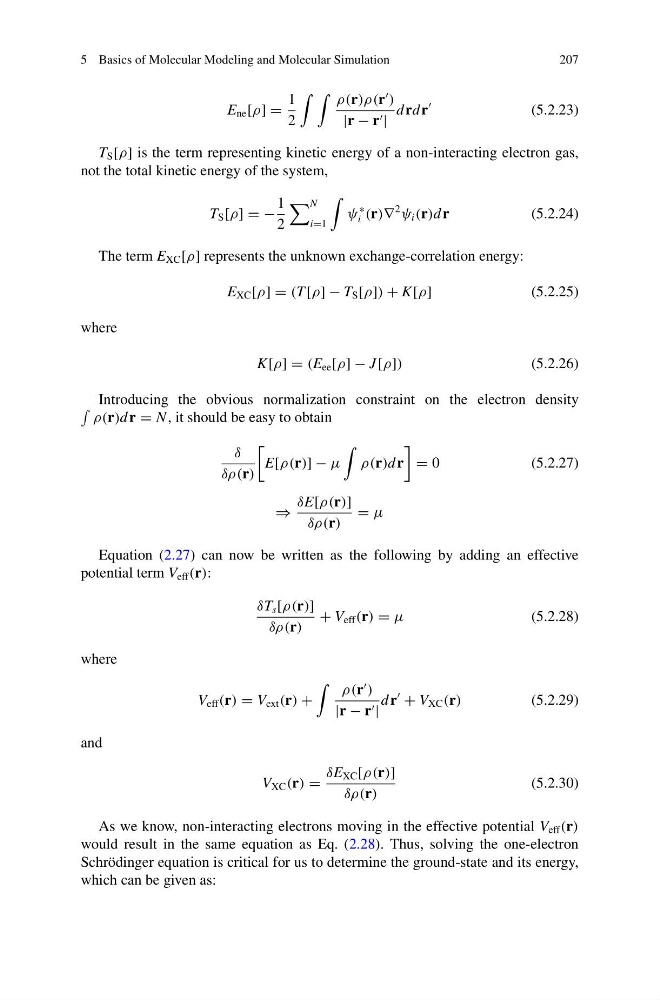
T S [ρ] is the term representing kinetic energy of a non-interacting electron gas,
not the total kinetic energy of the system,
T S [ρ] = −
1
2
N
i=1
ψ
∗
i (r)∇
2
ψ i (r)d r
(5.2.24)
The term E XC [ρ] represents the unknown exchange-correlation energy:
E XC [ρ] = (T [ρ] − T S [ρ]) + K[ρ]
(5.2.25)
where
K[ρ] = (E ee [ρ] − J [ρ])
(5.2.26)
Introducing the obvious normalization constraint on the electron density
ρ(r)d r = N , it should be easy to obtain
δ
δρ(r)
E[ρ(r)] − μ
ρ(r)d r
= 0
(5.2.27)
⇒
δE[ρ(r)]
δρ(r)
= μ
Equation (2.27) can now be written as the following by adding an effective
potential term V eff (r):
δT s [ρ(r)]
δρ(r)
+ V eff (r) = μ
(5.2.28)
where
V eff (r) = V ext (r) +
ρ(r
)
|r − r |
d r
+ V XC (r)
(5.2.29)
and
V XC (r) =
δE XC [ρ(r)]
δρ(r)
(5.2.30)
As we know, non-interacting electrons moving in the effective potential V eff (r)
would result in the same equation as Eq. (2.28). Thus, solving the one-electron
Schrödinger equation is critical for us to determine the ground-state and its energy,
which can be given as:
207
E ne [ρ] =
1
2
ρ(r)ρ(r
)
|r − r |
d rd r
(5.2.23)
T S [ρ] is the term representing kinetic energy of a non-interacting electron gas,
not the total kinetic energy of the system,
T S [ρ] = −
1
2
N
i=1
ψ
∗
i (r)∇
2
ψ i (r)d r
(5.2.24)
The term E XC [ρ] represents the unknown exchange-correlation energy:
E XC [ρ] = (T [ρ] − T S [ρ]) + K[ρ]
(5.2.25)
where
K[ρ] = (E ee [ρ] − J [ρ])
(5.2.26)
Introducing the obvious normalization constraint on the electron density
ρ(r)d r = N , it should be easy to obtain
δ
δρ(r)
E[ρ(r)] − μ
ρ(r)d r
= 0
(5.2.27)
⇒
δE[ρ(r)]
δρ(r)
= μ
Equation (2.27) can now be written as the following by adding an effective
potential term V eff (r):
δT s [ρ(r)]
δρ(r)
+ V eff (r) = μ
(5.2.28)
where
V eff (r) = V ext (r) +
ρ(r
)
|r − r |
d r
+ V XC (r)
(5.2.29)
and
V XC (r) =
δE XC [ρ(r)]
δρ(r)
(5.2.30)
As we know, non-interacting electrons moving in the effective potential V eff (r)
would result in the same equation as Eq. (2.28). Thus, solving the one-electron
Schrödinger equation is critical for us to determine the ground-state and its energy,
which can be given as: