

206
C. Tang (唐晨宇) and Y. Wang (王延颋)
the electron positions r by the electron density ρ({r}), and thus the wave function
becomes a functional of the electron density. With that, Eq. (2.1) can be written in
the form:
H Ψ (ρ({r})) = EΨ (ρ({r}))
(5.2.19)
Two theorems described below are the basis of solving the above equation
numerically.
5.2.2.1 The Hohenberg-Kohn Theorem
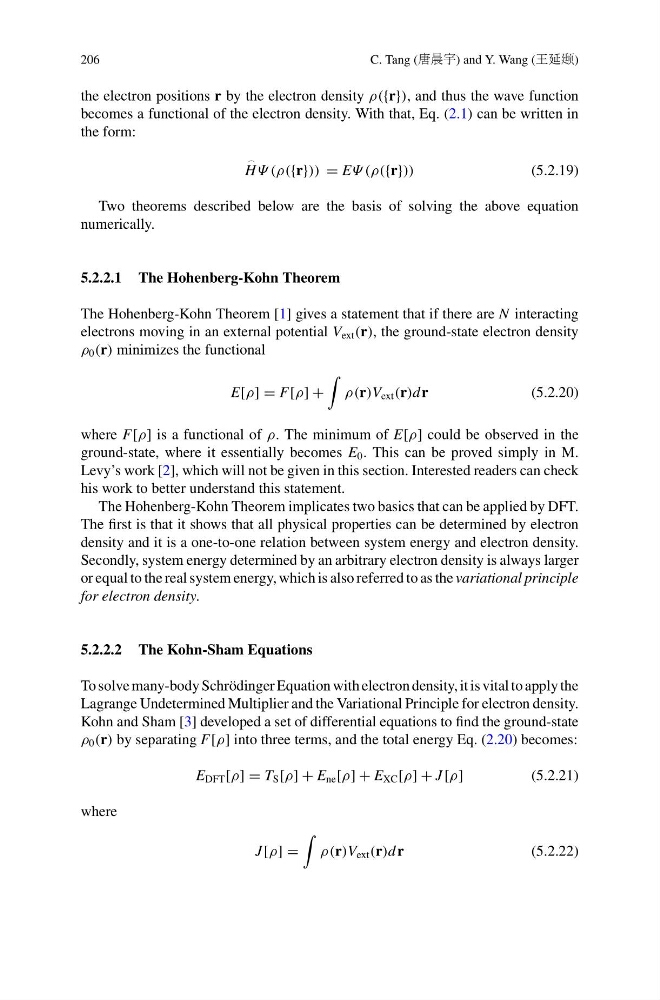
The Hohenberg-Kohn Theorem [1] gives a statement that if there are N interacting
electrons moving in an external potential V ext (r), the ground-state electron density
ρ 0 (r) minimizes the functional
E[ρ] = F[ρ] +
ρ(r)V ext (r)d r
(5.2.20)
where F[ρ] is a functional of ρ. The minimum of E[ρ] could be observed in the
ground-state, where it essentially becomes E 0 . This can be proved simply in M.
Levy’s work [2], which will not be given in this section. Interested readers can check
his work to better understand this statement.
The Hohenberg-Kohn Theorem implicates two basics that can be applied by DFT.
The first is that it shows that all physical properties can be determined by electron
density and it is a one-to-one relation between system energy and electron density.
Secondly, system energy determined by an arbitrary electron density is always larger
or equal to the real system energy, which is also referred to as the variational principle
for electron density.
5.2.2.2 The Kohn-Sham Equations
To solve many-body Schrödinger Equation with electron density, it is vital to apply the
Lagrange Undetermined Multiplier and the Variational Principle for electron density.
Kohn and Sham [3] developed a set of differential equations to find the ground-state
ρ 0 (r) by separating F[ρ] into three terms, and the total energy Eq. (2.20) becomes:
E DFT [ρ] = T S [ρ] + E ne [ρ] + E XC [ρ] + J [ρ]
(5.2.21)
where
J [ρ] =
ρ(r)V ext (r)d r
(5.2.22)
C. Tang (唐晨宇) and Y. Wang (王延颋)
the electron positions r by the electron density ρ({r}), and thus the wave function
becomes a functional of the electron density. With that, Eq. (2.1) can be written in
the form:
H Ψ (ρ({r})) = EΨ (ρ({r}))
(5.2.19)
Two theorems described below are the basis of solving the above equation
numerically.
5.2.2.1 The Hohenberg-Kohn Theorem
The Hohenberg-Kohn Theorem [1] gives a statement that if there are N interacting
electrons moving in an external potential V ext (r), the ground-state electron density
ρ 0 (r) minimizes the functional
E[ρ] = F[ρ] +
ρ(r)V ext (r)d r
(5.2.20)
where F[ρ] is a functional of ρ. The minimum of E[ρ] could be observed in the
ground-state, where it essentially becomes E 0 . This can be proved simply in M.
Levy’s work [2], which will not be given in this section. Interested readers can check
his work to better understand this statement.
The Hohenberg-Kohn Theorem implicates two basics that can be applied by DFT.
The first is that it shows that all physical properties can be determined by electron
density and it is a one-to-one relation between system energy and electron density.
Secondly, system energy determined by an arbitrary electron density is always larger
or equal to the real system energy, which is also referred to as the variational principle
for electron density.
5.2.2.2 The Kohn-Sham Equations
To solve many-body Schrödinger Equation with electron density, it is vital to apply the
Lagrange Undetermined Multiplier and the Variational Principle for electron density.
Kohn and Sham [3] developed a set of differential equations to find the ground-state
ρ 0 (r) by separating F[ρ] into three terms, and the total energy Eq. (2.20) becomes:
E DFT [ρ] = T S [ρ] + E ne [ρ] + E XC [ρ] + J [ρ]
(5.2.21)
where
J [ρ] =
ρ(r)V ext (r)d r
(5.2.22)