

208
C. Tang (唐晨宇) and Y. Wang (王延颋)
−
1
2
∇
2
i + V eff (r) − ε i
ψ i (r) = 0
(5.2.31)
Given that,
ρ(r) =
N
i=1
|ψ i (r)|
2
(5.2.32)
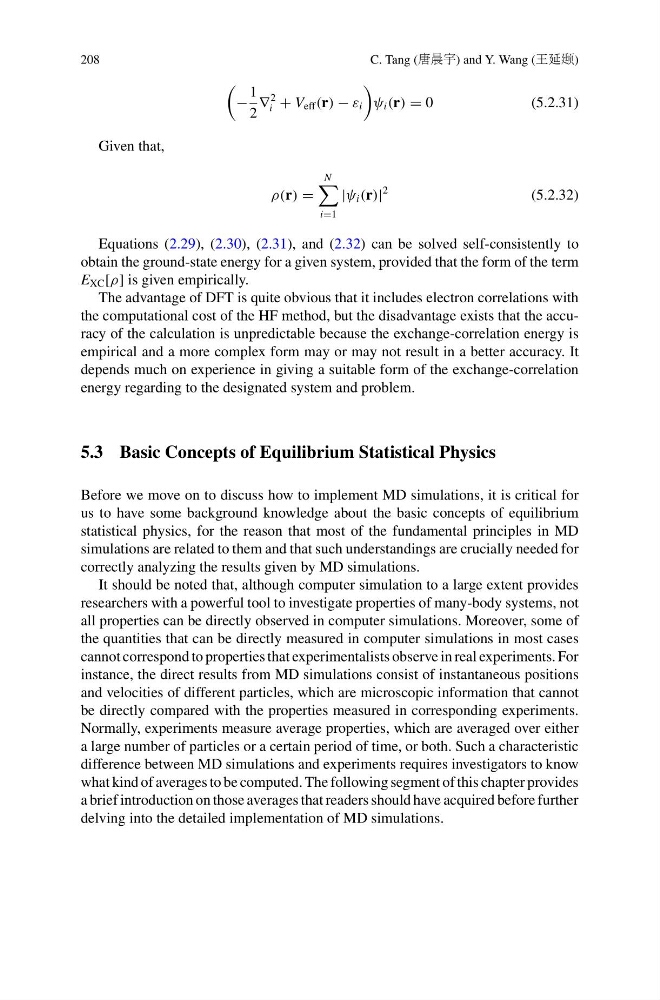
Equations (2.29), (2.30), (2.31), and (2.32) can be solved self-consistently to
obtain the ground-state energy for a given system, provided that the form of the term
E XC [ρ] is given empirically.
The advantage of DFT is quite obvious that it includes electron correlations with
the computational cost of the HF method, but the disadvantage exists that the accuracy of the calculation is unpredictable because the exchange-correlation energy is
empirical and a more complex form may or may not result in a better accuracy. It
depends much on experience in giving a suitable form of the exchange-correlation
energy regarding to the designated system and problem.
5.3 Basic Concepts of Equilibrium Statistical Physics
Before we move on to discuss how to implement MD simulations, it is critical for
us to have some background knowledge about the basic concepts of equilibrium
statistical physics, for the reason that most of the fundamental principles in MD
simulations are related to them and that such understandings are crucially needed for
correctly analyzing the results given by MD simulations.
It should be noted that, although computer simulation to a large extent provides
researchers with a powerful tool to investigate properties of many-body systems, not
all properties can be directly observed in computer simulations. Moreover, some of
the quantities that can be directly measured in computer simulations in most cases
cannot correspond to properties that experimentalists observe in real experiments. For
instance, the direct results from MD simulations consist of instantaneous positions
and velocities of different particles, which are microscopic information that cannot
be directly compared with the properties measured in corresponding experiments.
Normally, experiments measure average properties, which are averaged over either
a large number of particles or a certain period of time, or both. Such a characteristic
difference between MD simulations and experiments requires investigators to know
what kind of averages to be computed. The following segment of this chapter provides
a brief introduction on those averages that readers should have acquired before further
delving into the detailed implementation of MD simulations.
C. Tang (唐晨宇) and Y. Wang (王延颋)
−
1
2
∇
2
i + V eff (r) − ε i
ψ i (r) = 0
(5.2.31)
Given that,
ρ(r) =
N
i=1
|ψ i (r)|
2
(5.2.32)
Equations (2.29), (2.30), (2.31), and (2.32) can be solved self-consistently to
obtain the ground-state energy for a given system, provided that the form of the term
E XC [ρ] is given empirically.
The advantage of DFT is quite obvious that it includes electron correlations with
the computational cost of the HF method, but the disadvantage exists that the accuracy of the calculation is unpredictable because the exchange-correlation energy is
empirical and a more complex form may or may not result in a better accuracy. It
depends much on experience in giving a suitable form of the exchange-correlation
energy regarding to the designated system and problem.
5.3 Basic Concepts of Equilibrium Statistical Physics
Before we move on to discuss how to implement MD simulations, it is critical for
us to have some background knowledge about the basic concepts of equilibrium
statistical physics, for the reason that most of the fundamental principles in MD
simulations are related to them and that such understandings are crucially needed for
correctly analyzing the results given by MD simulations.
It should be noted that, although computer simulation to a large extent provides
researchers with a powerful tool to investigate properties of many-body systems, not
all properties can be directly observed in computer simulations. Moreover, some of
the quantities that can be directly measured in computer simulations in most cases
cannot correspond to properties that experimentalists observe in real experiments. For
instance, the direct results from MD simulations consist of instantaneous positions
and velocities of different particles, which are microscopic information that cannot
be directly compared with the properties measured in corresponding experiments.
Normally, experiments measure average properties, which are averaged over either
a large number of particles or a certain period of time, or both. Such a characteristic
difference between MD simulations and experiments requires investigators to know
what kind of averages to be computed. The following segment of this chapter provides
a brief introduction on those averages that readers should have acquired before further
delving into the detailed implementation of MD simulations.