

186
Z. Zheng
˙
θ h = ω h + K
N
j=1
sin(θ j − θ h − α),
˙
θ j = ω j + K sin(θ h − θ j − α), j ∈ [1, N ],
(4.134)
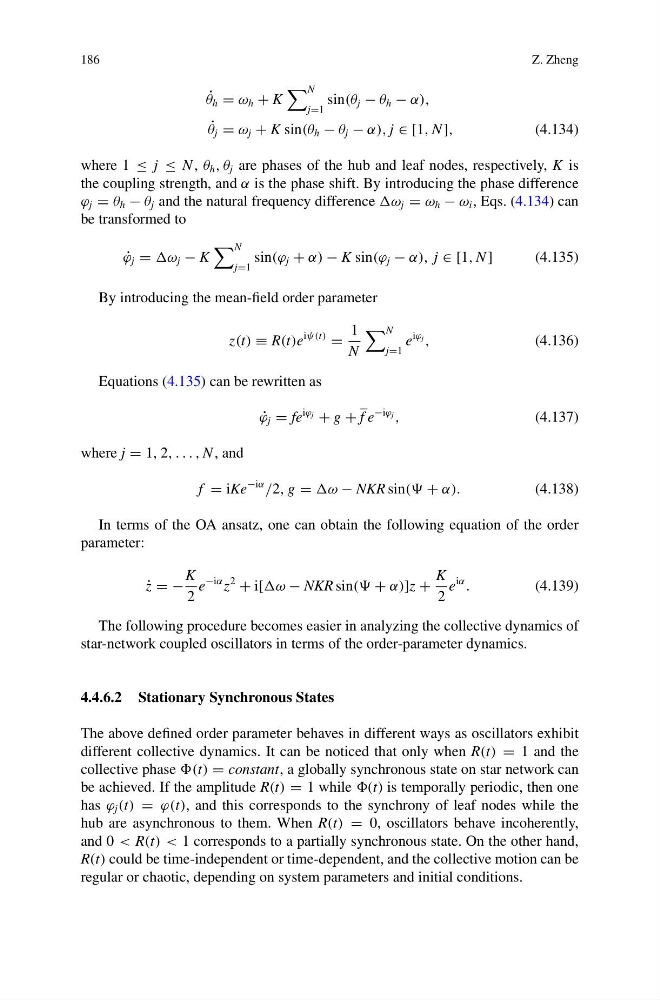
where 1 ≤ j ≤ N , θ h , θ j are phases of the hub and leaf nodes, respectively, K is
the coupling strength, and α is the phase shift. By introducing the phase difference
ϕ j = θ h − θ j and the natural frequency difference ω j = ω h − ω i , Eqs. (4.134) can
be transformed to
˙
ϕ j = ω j − K
N
j=1
sin(ϕ j + α) − K sin(ϕ j − α), j ∈ [1, N ]
(4.135)
By introducing the mean-field order parameter
z(t) ≡ R(t)e
iψ(t)
=
1
N
N
j=1
e
iϕ j ,
(4.136)
Equations (4.135) can be rewritten as
˙
ϕ j = fe
iϕ j + g + f e
−iϕ j ,
(4.137)
where j = 1, 2, . . . , N , and
f = iKe
−iα
/2, g = ω − NKR sin(( + α).
(4.138)
In terms of the OA ansatz, one can obtain the following equation of the order
parameter:
˙
z = −
K
2
e
−iα z
2
+ i[ω − NKR sin(( + α)]z +
K
2
e
iα
.
(4.139)
The following procedure becomes easier in analyzing the collective dynamics of
star-network coupled oscillators in terms of the order-parameter dynamics.
4.4.6.2 Stationary Synchronous States
The above defined order parameter behaves in different ways as oscillators exhibit
different collective dynamics. It can be noticed that only when R(t) = 1 and the
collective phase (t) = constant, a globally synchronous state on star network can
be achieved. If the amplitude R(t) = 1 while (t) is temporally periodic, then one
has ϕ j (t) = ϕ(t), and this corresponds to the synchrony of leaf nodes while the
hub are asynchronous to them. When R(t) = 0, oscillators behave incoherently,
and 0 < R(t) < 1 corresponds to a partially synchronous state. On the other hand,
R(t) could be time-independent or time-dependent, and the collective motion can be
regular or chaotic, depending on system parameters and initial conditions.
Z. Zheng
˙
θ h = ω h + K
N
j=1
sin(θ j − θ h − α),
˙
θ j = ω j + K sin(θ h − θ j − α), j ∈ [1, N ],
(4.134)
where 1 ≤ j ≤ N , θ h , θ j are phases of the hub and leaf nodes, respectively, K is
the coupling strength, and α is the phase shift. By introducing the phase difference
ϕ j = θ h − θ j and the natural frequency difference ω j = ω h − ω i , Eqs. (4.134) can
be transformed to
˙
ϕ j = ω j − K
N
j=1
sin(ϕ j + α) − K sin(ϕ j − α), j ∈ [1, N ]
(4.135)
By introducing the mean-field order parameter
z(t) ≡ R(t)e
iψ(t)
=
1
N
N
j=1
e
iϕ j ,
(4.136)
Equations (4.135) can be rewritten as
˙
ϕ j = fe
iϕ j + g + f e
−iϕ j ,
(4.137)
where j = 1, 2, . . . , N , and
f = iKe
−iα
/2, g = ω − NKR sin(( + α).
(4.138)
In terms of the OA ansatz, one can obtain the following equation of the order
parameter:
˙
z = −
K
2
e
−iα z
2
+ i[ω − NKR sin(( + α)]z +
K
2
e
iα
.
(4.139)
The following procedure becomes easier in analyzing the collective dynamics of
star-network coupled oscillators in terms of the order-parameter dynamics.
4.4.6.2 Stationary Synchronous States
The above defined order parameter behaves in different ways as oscillators exhibit
different collective dynamics. It can be noticed that only when R(t) = 1 and the
collective phase (t) = constant, a globally synchronous state on star network can
be achieved. If the amplitude R(t) = 1 while (t) is temporally periodic, then one
has ϕ j (t) = ϕ(t), and this corresponds to the synchrony of leaf nodes while the
hub are asynchronous to them. When R(t) = 0, oscillators behave incoherently,
and 0 < R(t) < 1 corresponds to a partially synchronous state. On the other hand,
R(t) could be time-independent or time-dependent, and the collective motion can be
regular or chaotic, depending on system parameters and initial conditions.