

4 An Introduction to Emergence Dynamics in Complex Systems
185
˙
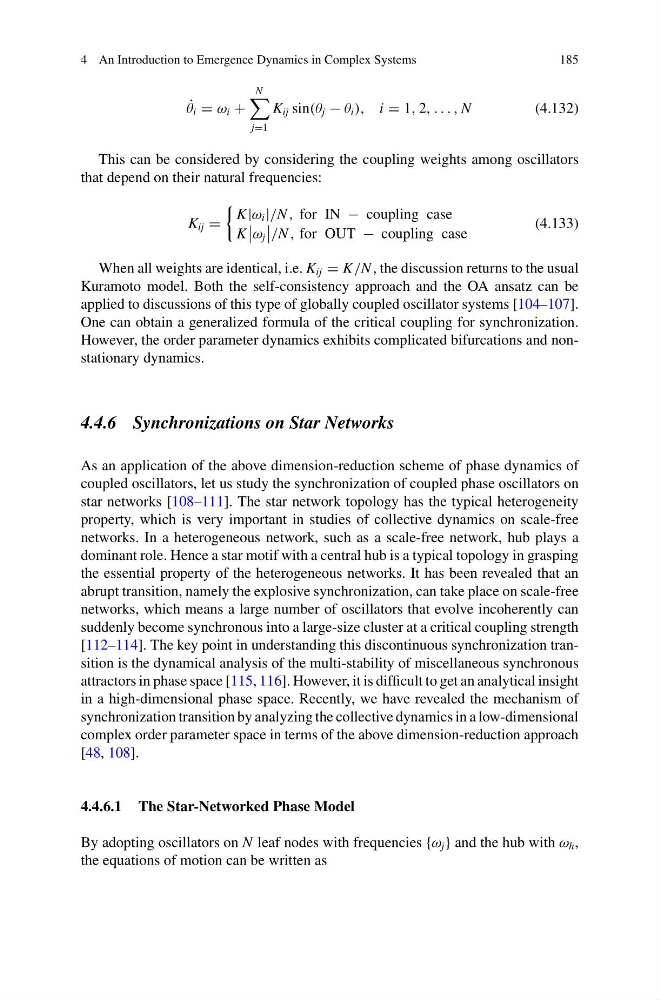
θ i = ω i +
N
j=1
K ij sin(θ j − θ i ), i = 1, 2, . . . , N
(4.132)
This can be considered by considering the coupling weights among oscillators
that depend on their natural frequencies:
K ij =
K|ω i |/N , for IN − coupling case
K
ω j
/N , for OUT − coupling case
(4.133)
When all weights are identical, i.e. K ij = K/N , the discussion returns to the usual
Kuramoto model. Both the self-consistency approach and the OA ansatz can be
applied to discussions of this type of globally coupled oscillator systems [104–107].
One can obtain a generalized formula of the critical coupling for synchronization.
However, the order parameter dynamics exhibits complicated bifurcations and nonstationary dynamics.
4.4.6 Synchronizations on Star Networks
As an application of the above dimension-reduction scheme of phase dynamics of
coupled oscillators, let us study the synchronization of coupled phase oscillators on
star networks [108–111]. The star network topology has the typical heterogeneity
property, which is very important in studies of collective dynamics on scale-free
networks. In a heterogeneous network, such as a scale-free network, hub plays a
dominant role. Hence a star motif with a central hub is a typical topology in grasping
the essential property of the heterogeneous networks. It has been revealed that an
abrupt transition, namely the explosive synchronization, can take place on scale-free
networks, which means a large number of oscillators that evolve incoherently can
suddenly become synchronous into a large-size cluster at a critical coupling strength
[112–114]. The key point in understanding this discontinuous synchronization transition is the dynamical analysis of the multi-stability of miscellaneous synchronous
attractors in phase space [115, 116]. However, it is difficult to get an analytical insight
in a high-dimensional phase space. Recently, we have revealed the mechanism of
synchronization transition by analyzing the collective dynamics in a low-dimensional
complex order parameter space in terms of the above dimension-reduction approach
[48, 108].
4.4.6.1 The Star-Networked Phase Model
By adopting oscillators on N leaf nodes with frequencies {ω j } and the hub with ω h ,
the equations of motion can be written as
185
˙
θ i = ω i +
N
j=1
K ij sin(θ j − θ i ), i = 1, 2, . . . , N
(4.132)
This can be considered by considering the coupling weights among oscillators
that depend on their natural frequencies:
K ij =
K|ω i |/N , for IN − coupling case
K
ω j
/N , for OUT − coupling case
(4.133)
When all weights are identical, i.e. K ij = K/N , the discussion returns to the usual
Kuramoto model. Both the self-consistency approach and the OA ansatz can be
applied to discussions of this type of globally coupled oscillator systems [104–107].
One can obtain a generalized formula of the critical coupling for synchronization.
However, the order parameter dynamics exhibits complicated bifurcations and nonstationary dynamics.
4.4.6 Synchronizations on Star Networks
As an application of the above dimension-reduction scheme of phase dynamics of
coupled oscillators, let us study the synchronization of coupled phase oscillators on
star networks [108–111]. The star network topology has the typical heterogeneity
property, which is very important in studies of collective dynamics on scale-free
networks. In a heterogeneous network, such as a scale-free network, hub plays a
dominant role. Hence a star motif with a central hub is a typical topology in grasping
the essential property of the heterogeneous networks. It has been revealed that an
abrupt transition, namely the explosive synchronization, can take place on scale-free
networks, which means a large number of oscillators that evolve incoherently can
suddenly become synchronous into a large-size cluster at a critical coupling strength
[112–114]. The key point in understanding this discontinuous synchronization transition is the dynamical analysis of the multi-stability of miscellaneous synchronous
attractors in phase space [115, 116]. However, it is difficult to get an analytical insight
in a high-dimensional phase space. Recently, we have revealed the mechanism of
synchronization transition by analyzing the collective dynamics in a low-dimensional
complex order parameter space in terms of the above dimension-reduction approach
[48, 108].
4.4.6.1 The Star-Networked Phase Model
By adopting oscillators on N leaf nodes with frequencies {ω j } and the hub with ω h ,
the equations of motion can be written as