

1 Introduction to Nonequilibrium Statistical Physics and Its Foundations
11
˙
x = v, m ˙
v = −αv +
N
i=1
F i ;
˙
x i = v i , m i ˙
v i = −F i +
N
j=1
j =i
F ji
(1.14)
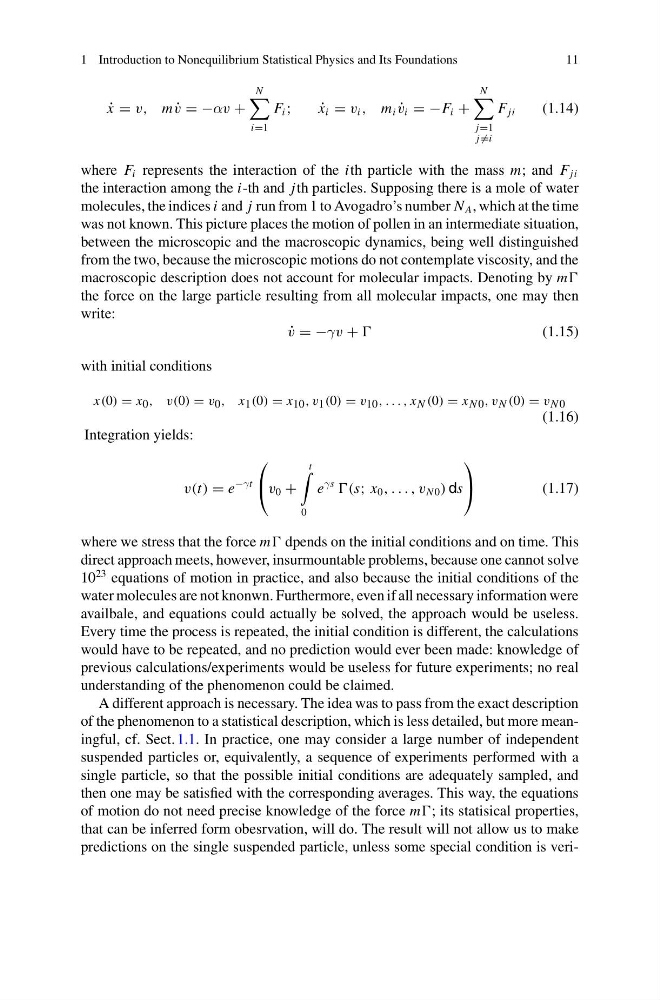
where F i represents the interaction of the ith particle with the mass m; and F ji
the interaction among the i-th and jth particles. Supposing there is a mole of water
molecules, the indices i and j run from 1 to Avogadro’s number N A , which at the time
was not known. This picture places the motion of pollen in an intermediate situation,
between the microscopic and the macroscopic dynamics, being well distinguished
from the two, because the microscopic motions do not contemplate viscosity, and the
macroscopic description does not account for molecular impacts. Denoting by m
the force on the large particle resulting from all molecular impacts, one may then
write:
˙
v = −γv +
(1.15)
with initial conditions
x(0) = x 0 , v(0) = v 0 , x 1 (0) = x 10 , v 1 (0) = v 10 , . . . , x N (0) = x N 0 , v N (0) = v N 0
(1.16)
Integration yields:
v(t) = e
−γt
⎛
⎝ v 0 +
t
0
e
γs
(s; x 0 , . . . , v N 0 ) ds
⎞
⎠
(1.17)
where we stress that the force m dpends on the initial conditions and on time. This
direct approach meets, however, insurmountable problems, because one cannot solve
10
23 equations of motion in practice, and also because the initial conditions of the
water molecules are not knonwn. Furthermore, even if all necessary information were
availbale, and equations could actually be solved, the approach would be useless.
Every time the process is repeated, the initial condition is different, the calculations
would have to be repeated, and no prediction would ever been made: knowledge of
previous calculations/experiments would be useless for future experiments; no real
understanding of the phenomenon could be claimed.
A different approach is necessary. The idea was to pass from the exact description
of the phenomenon to a statistical description, which is less detailed, but more meaningful, cf. Sect. 1.1. In practice, one may consider a large number of independent
suspended particles or, equivalently, a sequence of experiments performed with a
single particle, so that the possible initial conditions are adequately sampled, and
then one may be satisfied with the corresponding averages. This way, the equations
of motion do not need precise knowledge of the force m; its statisical properties,
that can be inferred form obesrvation, will do. The result will not allow us to make
predictions on the single suspended particle, unless some special condition is veri-
11
˙
x = v, m ˙
v = −αv +
N
i=1
F i ;
˙
x i = v i , m i ˙
v i = −F i +
N
j=1
j =i
F ji
(1.14)
where F i represents the interaction of the ith particle with the mass m; and F ji
the interaction among the i-th and jth particles. Supposing there is a mole of water
molecules, the indices i and j run from 1 to Avogadro’s number N A , which at the time
was not known. This picture places the motion of pollen in an intermediate situation,
between the microscopic and the macroscopic dynamics, being well distinguished
from the two, because the microscopic motions do not contemplate viscosity, and the
macroscopic description does not account for molecular impacts. Denoting by m
the force on the large particle resulting from all molecular impacts, one may then
write:
˙
v = −γv +
(1.15)
with initial conditions
x(0) = x 0 , v(0) = v 0 , x 1 (0) = x 10 , v 1 (0) = v 10 , . . . , x N (0) = x N 0 , v N (0) = v N 0
(1.16)
Integration yields:
v(t) = e
−γt
⎛
⎝ v 0 +
t
0
e
γs
(s; x 0 , . . . , v N 0 ) ds
⎞
⎠
(1.17)
where we stress that the force m dpends on the initial conditions and on time. This
direct approach meets, however, insurmountable problems, because one cannot solve
10
23 equations of motion in practice, and also because the initial conditions of the
water molecules are not knonwn. Furthermore, even if all necessary information were
availbale, and equations could actually be solved, the approach would be useless.
Every time the process is repeated, the initial condition is different, the calculations
would have to be repeated, and no prediction would ever been made: knowledge of
previous calculations/experiments would be useless for future experiments; no real
understanding of the phenomenon could be claimed.
A different approach is necessary. The idea was to pass from the exact description
of the phenomenon to a statistical description, which is less detailed, but more meaningful, cf. Sect. 1.1. In practice, one may consider a large number of independent
suspended particles or, equivalently, a sequence of experiments performed with a
single particle, so that the possible initial conditions are adequately sampled, and
then one may be satisfied with the corresponding averages. This way, the equations
of motion do not need precise knowledge of the force m; its statisical properties,
that can be inferred form obesrvation, will do. The result will not allow us to make
predictions on the single suspended particle, unless some special condition is veri-