

10
L. Rondoni
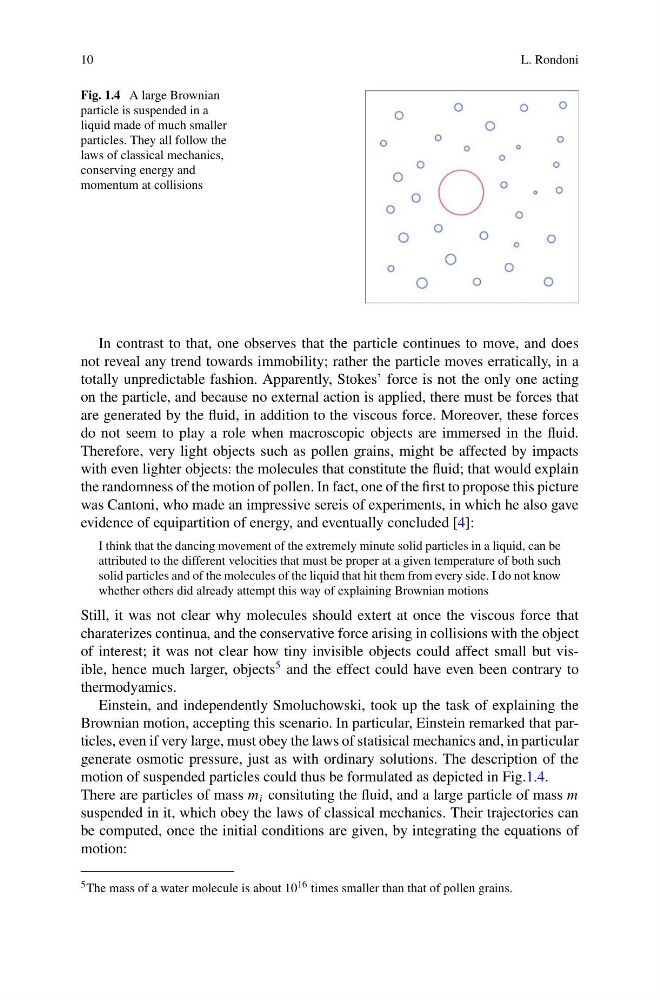
Fig. 1.4 A large Brownian
particle is suspended in a
liquid made of much smaller
particles. They all follow the
laws of classical mechanics,
conserving energy and
momentum at collisions
In contrast to that, one observes that the particle continues to move, and does
not reveal any trend towards immobility; rather the particle moves erratically, in a
totally unpredictable fashion. Apparently, Stokes’ force is not the only one acting
on the particle, and because no external action is applied, there must be forces that
are generated by the fluid, in addition to the viscous force. Moreover, these forces
do not seem to play a role when macroscopic objects are immersed in the fluid.
Therefore, very light objects such as pollen grains, might be affected by impacts
with even lighter objects: the molecules that constitute the fluid; that would explain
the randomness of the motion of pollen. In fact, one of the first to propose this picture
was Cantoni, who made an impressive sereis of experiments, in which he also gave
evidence of equipartition of energy, and eventually concluded [4]:
I think that the dancing movement of the extremely minute solid particles in a liquid, can be
attributed to the different velocities that must be proper at a given temperature of both such
solid particles and of the molecules of the liquid that hit them from every side. I do not know
whether others did already attempt this way of explaining Brownian motions
Still, it was not clear why molecules should extert at once the viscous force that
charaterizes continua, and the conservative force arising in collisions with the object
of interest; it was not clear how tiny invisible objects could affect small but visible, hence much larger, objects
5 and the effect could have even been contrary to
thermodyamics.
Einstein, and independently Smoluchowski, took up the task of explaining the
Brownian motion, accepting this scenario. In particular, Einstein remarked that particles, even if very large, must obey the laws of statisical mechanics and, in particular
generate osmotic pressure, just as with ordinary solutions. The description of the
motion of suspended particles could thus be formulated as depicted in Fig.1.4.
There are particles of mass m i consituting the fluid, and a large particle of mass m
suspended in it, which obey the laws of classical mechanics. Their trajectories can
be computed, once the initial conditions are given, by integrating the equations of
motion:
5 The mass of a water molecule is about 10 16 times smaller than that of pollen grains.
L. Rondoni
Fig. 1.4 A large Brownian
particle is suspended in a
liquid made of much smaller
particles. They all follow the
laws of classical mechanics,
conserving energy and
momentum at collisions
In contrast to that, one observes that the particle continues to move, and does
not reveal any trend towards immobility; rather the particle moves erratically, in a
totally unpredictable fashion. Apparently, Stokes’ force is not the only one acting
on the particle, and because no external action is applied, there must be forces that
are generated by the fluid, in addition to the viscous force. Moreover, these forces
do not seem to play a role when macroscopic objects are immersed in the fluid.
Therefore, very light objects such as pollen grains, might be affected by impacts
with even lighter objects: the molecules that constitute the fluid; that would explain
the randomness of the motion of pollen. In fact, one of the first to propose this picture
was Cantoni, who made an impressive sereis of experiments, in which he also gave
evidence of equipartition of energy, and eventually concluded [4]:
I think that the dancing movement of the extremely minute solid particles in a liquid, can be
attributed to the different velocities that must be proper at a given temperature of both such
solid particles and of the molecules of the liquid that hit them from every side. I do not know
whether others did already attempt this way of explaining Brownian motions
Still, it was not clear why molecules should extert at once the viscous force that
charaterizes continua, and the conservative force arising in collisions with the object
of interest; it was not clear how tiny invisible objects could affect small but visible, hence much larger, objects
5 and the effect could have even been contrary to
thermodyamics.
Einstein, and independently Smoluchowski, took up the task of explaining the
Brownian motion, accepting this scenario. In particular, Einstein remarked that particles, even if very large, must obey the laws of statisical mechanics and, in particular
generate osmotic pressure, just as with ordinary solutions. The description of the
motion of suspended particles could thus be formulated as depicted in Fig.1.4.
There are particles of mass m i consituting the fluid, and a large particle of mass m
suspended in it, which obey the laws of classical mechanics. Their trajectories can
be computed, once the initial conditions are given, by integrating the equations of
motion:
5 The mass of a water molecule is about 10 16 times smaller than that of pollen grains.