

1 Introduction to Nonequilibrium Statistical Physics and Its Foundations
9
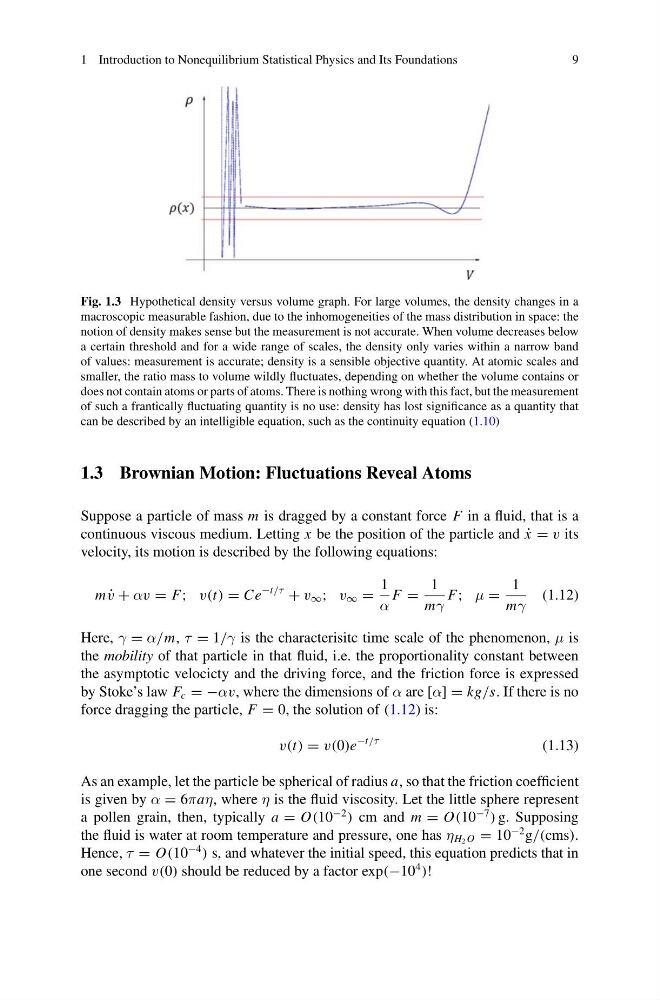
Fig. 1.3 Hypothetical density versus volume graph. For large volumes, the density changes in a
macroscopic measurable fashion, due to the inhomogeneities of the mass distribution in space: the
notion of density makes sense but the measurement is not accurate. When volume decreases below
a certain threshold and for a wide range of scales, the density only varies within a narrow band
of values: measurement is accurate; density is a sensible objective quantity. At atomic scales and
smaller, the ratio mass to volume wildly fluctuates, depending on whether the volume contains or
does not contain atoms or parts of atoms. There is nothing wrong with this fact, but the measurement
of such a frantically fluctuating quantity is no use: density has lost significance as a quantity that
can be described by an intelligible equation, such as the continuity equation (1.10)
1.3 Brownian Motion: Fluctuations Reveal Atoms
Suppose a particle of mass m is dragged by a constant force F in a fluid, that is a
continuous viscous medium. Letting x be the position of the particle and ˙
x = v its
velocity, its motion is described by the following equations:
m ˙
v + αv = F; v(t) = Ce
−t/τ
+ v ∞ ; v ∞ =
1
α
F =
1
mγ
F; μ =
1
mγ
(1.12)
Here, γ = α/m, τ = 1/γ is the characterisitc time scale of the phenomenon, μ is
the mobility of that particle in that fluid, i.e. the proportionality constant between
the asymptotic velocicty and the driving force, and the friction force is expressed
by Stoke’s law F c = −αv, where the dimensions of α are [α] = kg/s. If there is no
force dragging the particle, F = 0, the solution of (1.12) is:
v(t) = v(0)e
−t/τ
(1.13)
As an example, let the particle be spherical of radius a, so that the friction coefficient
is given by α = 6πaη, where η is the fluid viscosity. Let the little sphere represent
a pollen grain, then, typically a = O(10
−2
) cm and m = O(10
−7
) g. Supposing
the fluid is water at room temperature and pressure, one has η H 2 O = 10
−2 g/(cms).
Hence, τ = O(10
−4
) s, and whatever the initial speed, this equation predicts that in
one second v(0) should be reduced by a factor exp(−10
4
)!
9
Fig. 1.3 Hypothetical density versus volume graph. For large volumes, the density changes in a
macroscopic measurable fashion, due to the inhomogeneities of the mass distribution in space: the
notion of density makes sense but the measurement is not accurate. When volume decreases below
a certain threshold and for a wide range of scales, the density only varies within a narrow band
of values: measurement is accurate; density is a sensible objective quantity. At atomic scales and
smaller, the ratio mass to volume wildly fluctuates, depending on whether the volume contains or
does not contain atoms or parts of atoms. There is nothing wrong with this fact, but the measurement
of such a frantically fluctuating quantity is no use: density has lost significance as a quantity that
can be described by an intelligible equation, such as the continuity equation (1.10)
1.3 Brownian Motion: Fluctuations Reveal Atoms
Suppose a particle of mass m is dragged by a constant force F in a fluid, that is a
continuous viscous medium. Letting x be the position of the particle and ˙
x = v its
velocity, its motion is described by the following equations:
m ˙
v + αv = F; v(t) = Ce
−t/τ
+ v ∞ ; v ∞ =
1
α
F =
1
mγ
F; μ =
1
mγ
(1.12)
Here, γ = α/m, τ = 1/γ is the characterisitc time scale of the phenomenon, μ is
the mobility of that particle in that fluid, i.e. the proportionality constant between
the asymptotic velocicty and the driving force, and the friction force is expressed
by Stoke’s law F c = −αv, where the dimensions of α are [α] = kg/s. If there is no
force dragging the particle, F = 0, the solution of (1.12) is:
v(t) = v(0)e
−t/τ
(1.13)
As an example, let the particle be spherical of radius a, so that the friction coefficient
is given by α = 6πaη, where η is the fluid viscosity. Let the little sphere represent
a pollen grain, then, typically a = O(10
−2
) cm and m = O(10
−7
) g. Supposing
the fluid is water at room temperature and pressure, one has η H 2 O = 10
−2 g/(cms).
Hence, τ = O(10
−4
) s, and whatever the initial speed, this equation predicts that in
one second v(0) should be reduced by a factor exp(−10
4
)!