

8
L. Rondoni
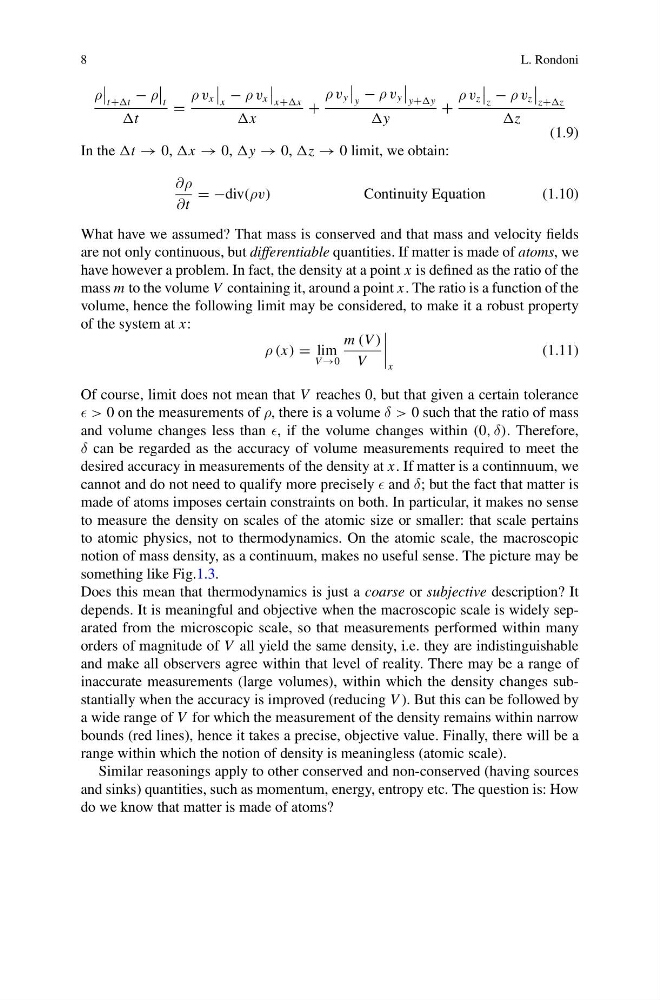
ρ
t+t
− ρ
t
t
=
ρ v x
x
− ρ v x
x+x
x
+
ρ v y
y
− ρ v y
y+y
y
+
ρ v z
z
− ρ v z
z+z
z
(1.9)
In the t → 0, x → 0, y → 0, z → 0 limit, we obtain:
∂ρ
∂t
= −div(ρv)
Continuity Equation
(1.10)
What have we assumed? That mass is conserved and that mass and velocity fields
are not only continuous, but differentiable quantities. If matter is made of atoms, we
have however a problem. In fact, the density at a point x is defined as the ratio of the
mass m to the volume V containing it, around a point x. The ratio is a function of the
volume, hence the following limit may be considered, to make it a robust property
of the system at x:
ρ (x) = lim
V →0
m (V )
V
x
(1.11)
Of course, limit does not mean that V reaches 0, but that given a certain tolerance
> 0 on the measurements of ρ, there is a volume δ > 0 such that the ratio of mass
and volume changes less than , if the volume changes within (0, δ). Therefore,
δ can be regarded as the accuracy of volume measurements required to meet the
desired accuracy in measurements of the density at x. If matter is a continnuum, we
cannot and do not need to qualify more precisely and δ; but the fact that matter is
made of atoms imposes certain constraints on both. In particular, it makes no sense
to measure the density on scales of the atomic size or smaller: that scale pertains
to atomic physics, not to thermodynamics. On the atomic scale, the macroscopic
notion of mass density, as a continuum, makes no useful sense. The picture may be
something like Fig.1.3.
Does this mean that thermodynamics is just a coarse or subjective description? It
depends. It is meaningful and objective when the macroscopic scale is widely separated from the microscopic scale, so that measurements performed within many
orders of magnitude of V all yield the same density, i.e. they are indistinguishable
and make all observers agree within that level of reality. There may be a range of
inaccurate measurements (large volumes), within which the density changes substantially when the accuracy is improved (reducing V ). But this can be followed by
a wide range of V for which the measurement of the density remains within narrow
bounds (red lines), hence it takes a precise, objective value. Finally, there will be a
range within which the notion of density is meaningless (atomic scale).
Similar reasonings apply to other conserved and non-conserved (having sources
and sinks) quantities, such as momentum, energy, entropy etc. The question is: How
do we know that matter is made of atoms?
L. Rondoni
ρ
t+t
− ρ
t
t
=
ρ v x
x
− ρ v x
x+x
x
+
ρ v y
y
− ρ v y
y+y
y
+
ρ v z
z
− ρ v z
z+z
z
(1.9)
In the t → 0, x → 0, y → 0, z → 0 limit, we obtain:
∂ρ
∂t
= −div(ρv)
Continuity Equation
(1.10)
What have we assumed? That mass is conserved and that mass and velocity fields
are not only continuous, but differentiable quantities. If matter is made of atoms, we
have however a problem. In fact, the density at a point x is defined as the ratio of the
mass m to the volume V containing it, around a point x. The ratio is a function of the
volume, hence the following limit may be considered, to make it a robust property
of the system at x:
ρ (x) = lim
V →0
m (V )
V
x
(1.11)
Of course, limit does not mean that V reaches 0, but that given a certain tolerance
> 0 on the measurements of ρ, there is a volume δ > 0 such that the ratio of mass
and volume changes less than , if the volume changes within (0, δ). Therefore,
δ can be regarded as the accuracy of volume measurements required to meet the
desired accuracy in measurements of the density at x. If matter is a continnuum, we
cannot and do not need to qualify more precisely and δ; but the fact that matter is
made of atoms imposes certain constraints on both. In particular, it makes no sense
to measure the density on scales of the atomic size or smaller: that scale pertains
to atomic physics, not to thermodynamics. On the atomic scale, the macroscopic
notion of mass density, as a continuum, makes no useful sense. The picture may be
something like Fig.1.3.
Does this mean that thermodynamics is just a coarse or subjective description? It
depends. It is meaningful and objective when the macroscopic scale is widely separated from the microscopic scale, so that measurements performed within many
orders of magnitude of V all yield the same density, i.e. they are indistinguishable
and make all observers agree within that level of reality. There may be a range of
inaccurate measurements (large volumes), within which the density changes substantially when the accuracy is improved (reducing V ). But this can be followed by
a wide range of V for which the measurement of the density remains within narrow
bounds (red lines), hence it takes a precise, objective value. Finally, there will be a
range within which the notion of density is meaningless (atomic scale).
Similar reasonings apply to other conserved and non-conserved (having sources
and sinks) quantities, such as momentum, energy, entropy etc. The question is: How
do we know that matter is made of atoms?