

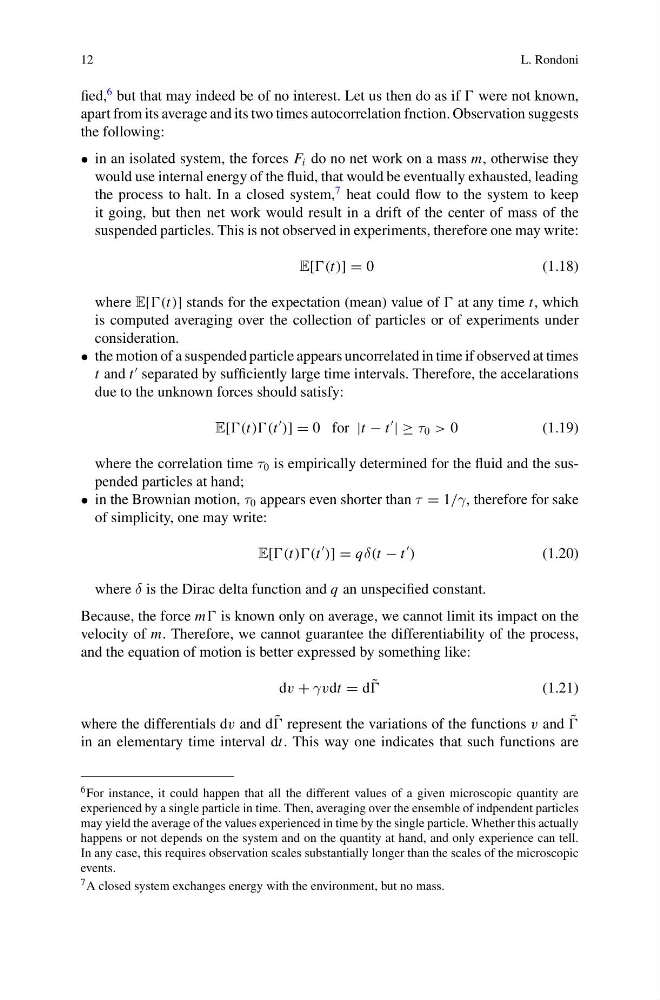
12
L. Rondoni
fied,
6 but that may indeed be of no interest. Let us then do as if were not known,
apart from its average and its two times autocorrelation fnction. Observation suggests
the following:
• in an isolated system, the forces F i do no net work on a mass m, otherwise they
would use internal energy of the fluid, that would be eventually exhausted, leading
the process to halt. In a closed system,
7 heat could flow to the system to keep
it going, but then net work would result in a drift of the center of mass of the
suspended particles. This is not observed in experiments, therefore one may write:
E[(t)] = 0
(1.18)
where E[(t)] stands for the expectation (mean) value of at any time t, which
is computed averaging over the collection of particles or of experiments under
consideration.
• the motion of a suspended particle appears uncorrelated in time if observed at times
t and t
separated by sufficiently large time intervals. Therefore, the accelarations
due to the unknown forces should satisfy:
E[(t))(t
)] = 0 for |t − t
| ≥ τ 0 > 0
(1.19)
where the correlation time τ 0 is empirically determined for the fluid and the suspended particles at hand;
• in the Brownian motion, τ 0 appears even shorter than τ = 1/γ, therefore for sake
of simplicity, one may write:
E[(t))(t
)] = qδ(t − t
)
(1.20)
where δ is the Dirac delta function and q an unspecified constant.
Because, the force m is known only on average, we cannot limit its impact on the
velocity of m. Therefore, we cannot guarantee the differentiability of the process,
and the equation of motion is better expressed by something like:
dv + γvdt = d ˜
(1.21)
where the differentials dv and d ˜
represent the variations of the functions v and ˜
in an elementary time interval dt. This way one indicates that such functions are
6 For instance, it could happen that all the different values of a given microscopic quantity are
experienced by a single particle in time. Then, averaging over the ensemble of indpendent particles
may yield the average of the values experienced in time by the single particle. Whether this actually
happens or not depends on the system and on the quantity at hand, and only experience can tell.
In any case, this requires observation scales substantially longer than the scales of the microscopic
events.
7 A closed system exchanges energy with the environment, but no mass.
L. Rondoni
fied,
6 but that may indeed be of no interest. Let us then do as if were not known,
apart from its average and its two times autocorrelation fnction. Observation suggests
the following:
• in an isolated system, the forces F i do no net work on a mass m, otherwise they
would use internal energy of the fluid, that would be eventually exhausted, leading
the process to halt. In a closed system,
7 heat could flow to the system to keep
it going, but then net work would result in a drift of the center of mass of the
suspended particles. This is not observed in experiments, therefore one may write:
E[(t)] = 0
(1.18)
where E[(t)] stands for the expectation (mean) value of at any time t, which
is computed averaging over the collection of particles or of experiments under
consideration.
• the motion of a suspended particle appears uncorrelated in time if observed at times
t and t
separated by sufficiently large time intervals. Therefore, the accelarations
due to the unknown forces should satisfy:
E[(t))(t
)] = 0 for |t − t
| ≥ τ 0 > 0
(1.19)
where the correlation time τ 0 is empirically determined for the fluid and the suspended particles at hand;
• in the Brownian motion, τ 0 appears even shorter than τ = 1/γ, therefore for sake
of simplicity, one may write:
E[(t))(t
)] = qδ(t − t
)
(1.20)
where δ is the Dirac delta function and q an unspecified constant.
Because, the force m is known only on average, we cannot limit its impact on the
velocity of m. Therefore, we cannot guarantee the differentiability of the process,
and the equation of motion is better expressed by something like:
dv + γvdt = d ˜
(1.21)
where the differentials dv and d ˜
represent the variations of the functions v and ˜
in an elementary time interval dt. This way one indicates that such functions are
6 For instance, it could happen that all the different values of a given microscopic quantity are
experienced by a single particle in time. Then, averaging over the ensemble of indpendent particles
may yield the average of the values experienced in time by the single particle. Whether this actually
happens or not depends on the system and on the quantity at hand, and only experience can tell.
In any case, this requires observation scales substantially longer than the scales of the microscopic
events.
7 A closed system exchanges energy with the environment, but no mass.