

174
Z. Zheng
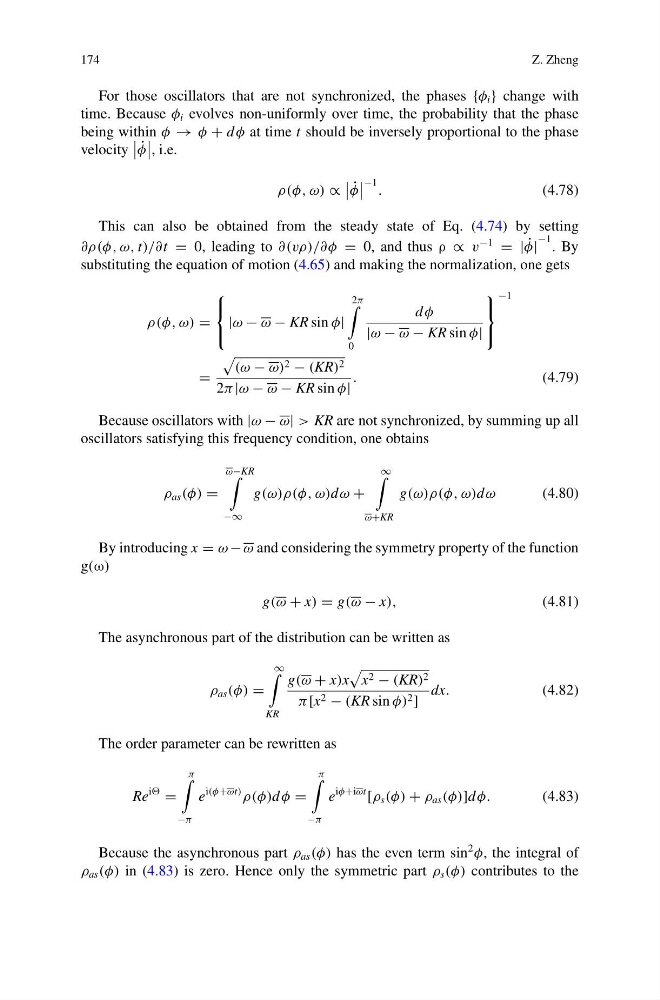
For those oscillators that are not synchronized, the phases {φ i } change with
time. Because φ i evolves non-uniformly over time, the probability that the phase
being within φ → φ + d φ at time t should be inversely proportional to the phase
velocity
˙
φ
, i.e.
ρ(φ, ω) ∝
˙
φ
−1 .
(4.78)
This can also be obtained from the steady state of Eq. (4.74) by setting
∂ρ(φ, ω, t)/∂t = 0, leading to ∂(vρ)/∂φ = 0, and thus ρ ∝ v
−1
= | ˙
φ|
−1 . By
substituting the equation of motion (4.65) and making the normalization, one gets
ρ(φ, ω) =
⎧
⎨
⎩
|ω − ω − KR sin φ|
2π
0
d φ
|ω − ω − KR sin φ|
⎫
⎬
⎭
−1
=
(ω − ω) 2 − (KR) 2
2π |ω − ω − KR sin φ|
.
(4.79)
Because oscillators with |ω − ω| > KR are not synchronized, by summing up all
oscillators satisfying this frequency condition, one obtains
ρ as (φ) =
ω−KR
−∞
g(ω)ρ(φ, ω)d ω +
∞
ω+KR
g(ω)ρ(φ, ω)d ω
(4.80)
By introducing x = ω − ω and considering the symmetry property of the function
g(ω)
g(ω + x) = g(ω − x),
(4.81)
The asynchronous part of the distribution can be written as
ρ as (φ) =
∞
KR
g(ω + x)x
x 2 − (KR) 2
π [x 2 − (KR sin φ) 2 ]
dx.
(4.82)
The order parameter can be rewritten as
Re
i
=
π
−π
e
i(φ+ωt)
ρ(φ)d φ =
π
−π
e
iφ+iωt
[ρ s (φ) + ρ as (φ)]d φ.
(4.83)
Because the asynchronous part ρ as (φ) has the even term sin
2
φ, the integral of
ρ as (φ) in (4.83) is zero. Hence only the symmetric part ρ s (φ) contributes to the
Z. Zheng
For those oscillators that are not synchronized, the phases {φ i } change with
time. Because φ i evolves non-uniformly over time, the probability that the phase
being within φ → φ + d φ at time t should be inversely proportional to the phase
velocity
˙
φ
, i.e.
ρ(φ, ω) ∝
˙
φ
−1 .
(4.78)
This can also be obtained from the steady state of Eq. (4.74) by setting
∂ρ(φ, ω, t)/∂t = 0, leading to ∂(vρ)/∂φ = 0, and thus ρ ∝ v
−1
= | ˙
φ|
−1 . By
substituting the equation of motion (4.65) and making the normalization, one gets
ρ(φ, ω) =
⎧
⎨
⎩
|ω − ω − KR sin φ|
2π
0
d φ
|ω − ω − KR sin φ|
⎫
⎬
⎭
−1
=
(ω − ω) 2 − (KR) 2
2π |ω − ω − KR sin φ|
.
(4.79)
Because oscillators with |ω − ω| > KR are not synchronized, by summing up all
oscillators satisfying this frequency condition, one obtains
ρ as (φ) =
ω−KR
−∞
g(ω)ρ(φ, ω)d ω +
∞
ω+KR
g(ω)ρ(φ, ω)d ω
(4.80)
By introducing x = ω − ω and considering the symmetry property of the function
g(ω)
g(ω + x) = g(ω − x),
(4.81)
The asynchronous part of the distribution can be written as
ρ as (φ) =
∞
KR
g(ω + x)x
x 2 − (KR) 2
π [x 2 − (KR sin φ) 2 ]
dx.
(4.82)
The order parameter can be rewritten as
Re
i
=
π
−π
e
i(φ+ωt)
ρ(φ)d φ =
π
−π
e
iφ+iωt
[ρ s (φ) + ρ as (φ)]d φ.
(4.83)
Because the asynchronous part ρ as (φ) has the even term sin
2
φ, the integral of
ρ as (φ) in (4.83) is zero. Hence only the symmetric part ρ s (φ) contributes to the