

168
Z. Zheng
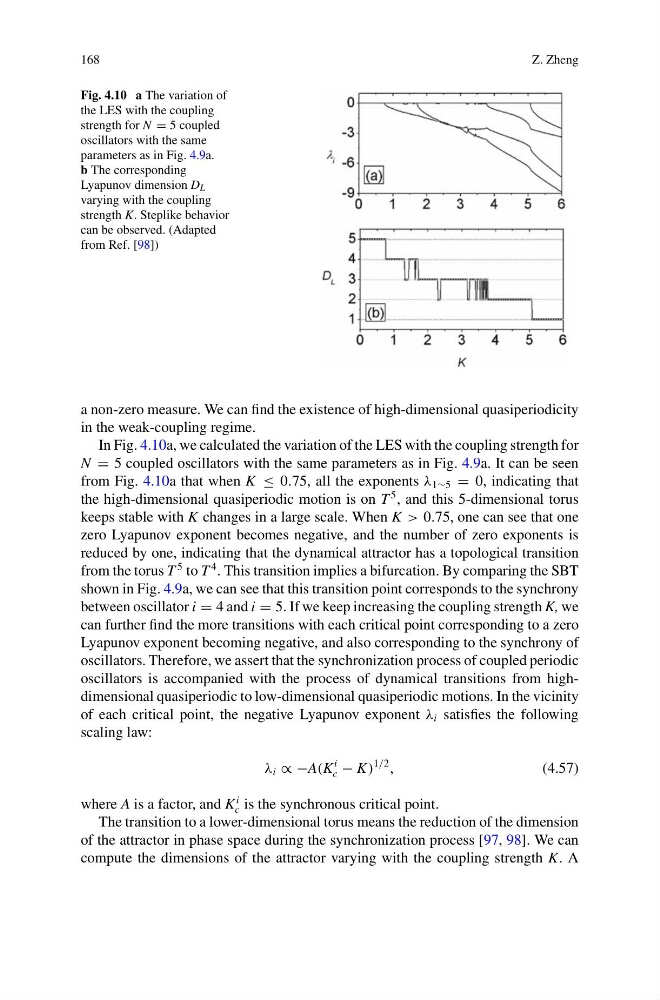
Fig. 4.10 a The variation of
the LES with the coupling
strength for N = 5 coupled
oscillators with the same
parameters as in Fig. 4.9a.
b The corresponding
Lyapunov dimension D L
varying with the coupling
strength K. Steplike behavior
can be observed. (Adapted
from Ref. [98])
a non-zero measure. We can find the existence of high-dimensional quasiperiodicity
in the weak-coupling regime.
In Fig. 4.10a, we calculated the variation of the LES with the coupling strength for
N = 5 coupled oscillators with the same parameters as in Fig. 4.9a. It can be seen
from Fig. 4.10a that when K ≤ 0.75, all the exponents λ 1∼5 = 0, indicating that
the high-dimensional quasiperiodic motion is on T
5 , and this 5-dimensional torus
keeps stable with K changes in a large scale. When K > 0.75, one can see that one
zero Lyapunov exponent becomes negative, and the number of zero exponents is
reduced by one, indicating that the dynamical attractor has a topological transition
from the torus T
5 to T
4 . This transition implies a bifurcation. By comparing the SBT
shown in Fig. 4.9a, we can see that this transition point corresponds to the synchrony
between oscillator i = 4 and i = 5. If we keep increasing the coupling strength K, we
can further find the more transitions with each critical point corresponding to a zero
Lyapunov exponent becoming negative, and also corresponding to the synchrony of
oscillators. Therefore, we assert that the synchronization process of coupled periodic
oscillators is accompanied with the process of dynamical transitions from highdimensional quasiperiodic to low-dimensional quasiperiodic motions. In the vicinity
of each critical point, the negative Lyapunov exponent λ i satisfies the following
scaling law:
λ i ∝ −A(K
i
c − K)
1/2
,
(4.57)
where A is a factor, and K
i
c is the synchronous critical point.
The transition to a lower-dimensional torus means the reduction of the dimension
of the attractor in phase space during the synchronization process [97, 98]. We can
compute the dimensions of the attractor varying with the coupling strength K. A
Z. Zheng
Fig. 4.10 a The variation of
the LES with the coupling
strength for N = 5 coupled
oscillators with the same
parameters as in Fig. 4.9a.
b The corresponding
Lyapunov dimension D L
varying with the coupling
strength K. Steplike behavior
can be observed. (Adapted
from Ref. [98])
a non-zero measure. We can find the existence of high-dimensional quasiperiodicity
in the weak-coupling regime.
In Fig. 4.10a, we calculated the variation of the LES with the coupling strength for
N = 5 coupled oscillators with the same parameters as in Fig. 4.9a. It can be seen
from Fig. 4.10a that when K ≤ 0.75, all the exponents λ 1∼5 = 0, indicating that
the high-dimensional quasiperiodic motion is on T
5 , and this 5-dimensional torus
keeps stable with K changes in a large scale. When K > 0.75, one can see that one
zero Lyapunov exponent becomes negative, and the number of zero exponents is
reduced by one, indicating that the dynamical attractor has a topological transition
from the torus T
5 to T
4 . This transition implies a bifurcation. By comparing the SBT
shown in Fig. 4.9a, we can see that this transition point corresponds to the synchrony
between oscillator i = 4 and i = 5. If we keep increasing the coupling strength K, we
can further find the more transitions with each critical point corresponding to a zero
Lyapunov exponent becoming negative, and also corresponding to the synchrony of
oscillators. Therefore, we assert that the synchronization process of coupled periodic
oscillators is accompanied with the process of dynamical transitions from highdimensional quasiperiodic to low-dimensional quasiperiodic motions. In the vicinity
of each critical point, the negative Lyapunov exponent λ i satisfies the following
scaling law:
λ i ∝ −A(K
i
c − K)
1/2
,
(4.57)
where A is a factor, and K
i
c is the synchronous critical point.
The transition to a lower-dimensional torus means the reduction of the dimension
of the attractor in phase space during the synchronization process [97, 98]. We can
compute the dimensions of the attractor varying with the coupling strength K. A