

4 An Introduction to Emergence Dynamics in Complex Systems
167
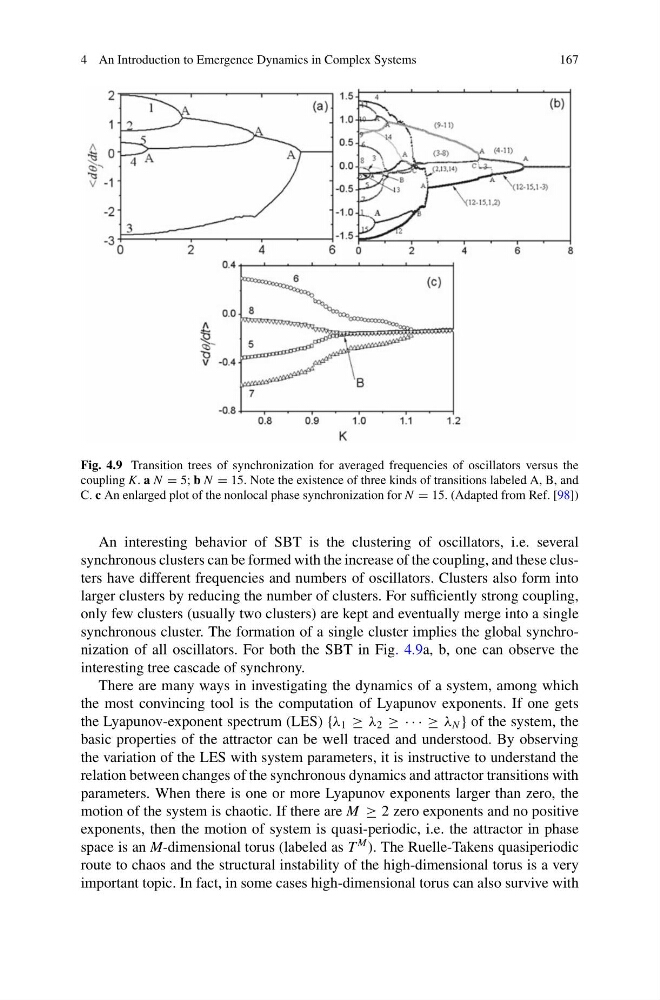
Fig. 4.9 Transition trees of synchronization for averaged frequencies of oscillators versus the
coupling K. a N = 5; b N = 15. Note the existence of three kinds of transitions labeled A, B, and
C. c An enlarged plot of the nonlocal phase synchronization for N = 15. (Adapted from Ref. [98])
An interesting behavior of SBT is the clustering of oscillators, i.e. several
synchronous clusters can be formed with the increase of the coupling, and these clusters have different frequencies and numbers of oscillators. Clusters also form into
larger clusters by reducing the number of clusters. For sufficiently strong coupling,
only few clusters (usually two clusters) are kept and eventually merge into a single
synchronous cluster. The formation of a single cluster implies the global synchronization of all oscillators. For both the SBT in Fig. 4.9a, b, one can observe the
interesting tree cascade of synchrony.
There are many ways in investigating the dynamics of a system, among which
the most convincing tool is the computation of Lyapunov exponents. If one gets
the Lyapunov-exponent spectrum (LES) {λ 1 ≥ λ 2 ≥ · · · ≥ λ N } of the system, the
basic properties of the attractor can be well traced and understood. By observing
the variation of the LES with system parameters, it is instructive to understand the
relation between changes of the synchronous dynamics and attractor transitions with
parameters. When there is one or more Lyapunov exponents larger than zero, the
motion of the system is chaotic. If there are M ≥ 2 zero exponents and no positive
exponents, then the motion of system is quasi-periodic, i.e. the attractor in phase
space is an M-dimensional torus (labeled as T
M ). The Ruelle-Takens quasiperiodic
route to chaos and the structural instability of the high-dimensional torus is a very
important topic. In fact, in some cases high-dimensional torus can also survive with
167
Fig. 4.9 Transition trees of synchronization for averaged frequencies of oscillators versus the
coupling K. a N = 5; b N = 15. Note the existence of three kinds of transitions labeled A, B, and
C. c An enlarged plot of the nonlocal phase synchronization for N = 15. (Adapted from Ref. [98])
An interesting behavior of SBT is the clustering of oscillators, i.e. several
synchronous clusters can be formed with the increase of the coupling, and these clusters have different frequencies and numbers of oscillators. Clusters also form into
larger clusters by reducing the number of clusters. For sufficiently strong coupling,
only few clusters (usually two clusters) are kept and eventually merge into a single
synchronous cluster. The formation of a single cluster implies the global synchronization of all oscillators. For both the SBT in Fig. 4.9a, b, one can observe the
interesting tree cascade of synchrony.
There are many ways in investigating the dynamics of a system, among which
the most convincing tool is the computation of Lyapunov exponents. If one gets
the Lyapunov-exponent spectrum (LES) {λ 1 ≥ λ 2 ≥ · · · ≥ λ N } of the system, the
basic properties of the attractor can be well traced and understood. By observing
the variation of the LES with system parameters, it is instructive to understand the
relation between changes of the synchronous dynamics and attractor transitions with
parameters. When there is one or more Lyapunov exponents larger than zero, the
motion of the system is chaotic. If there are M ≥ 2 zero exponents and no positive
exponents, then the motion of system is quasi-periodic, i.e. the attractor in phase
space is an M-dimensional torus (labeled as T
M ). The Ruelle-Takens quasiperiodic
route to chaos and the structural instability of the high-dimensional torus is a very
important topic. In fact, in some cases high-dimensional torus can also survive with