

4 An Introduction to Emergence Dynamics in Complex Systems
157
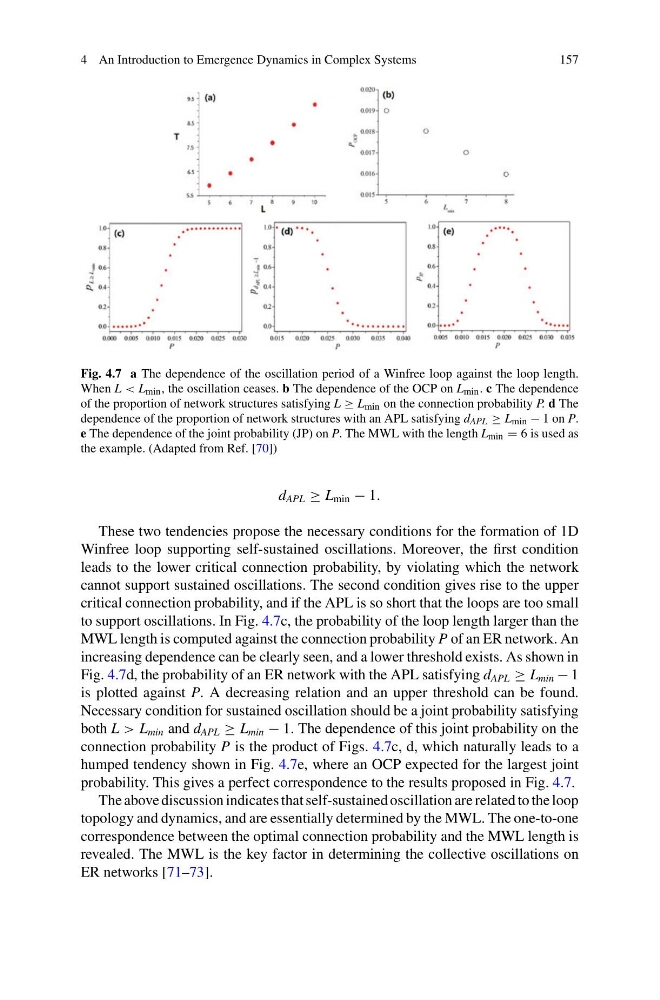
Fig. 4.7 a The dependence of the oscillation period of a Winfree loop against the loop length.
When L < L min , the oscillation ceases. b The dependence of the OCP on L min . c The dependence
of the proportion of network structures satisfying L ≥ L min on the connection probability P. d The
dependence of the proportion of network structures with an APL satisfying d APL ≥ L min − 1 on P.
e The dependence of the joint probability (JP) on P. The MWL with the length L min = 6 is used as
the example. (Adapted from Ref. [70])
d APL ≥ L min − 1.
These two tendencies propose the necessary conditions for the formation of 1D
Winfree loop supporting self-sustained oscillations. Moreover, the first condition
leads to the lower critical connection probability, by violating which the network
cannot support sustained oscillations. The second condition gives rise to the upper
critical connection probability, and if the APL is so short that the loops are too small
to support oscillations. In Fig. 4.7c, the probability of the loop length larger than the
MWL length is computed against the connection probability P of an ER network. An
increasing dependence can be clearly seen, and a lower threshold exists. As shown in
Fig. 4.7d, the probability of an ER network with the APL satisfying d APL ≥ L min − 1
is plotted against P. A decreasing relation and an upper threshold can be found.
Necessary condition for sustained oscillation should be a joint probability satisfying
both L > L min and d APL ≥ L min − 1. The dependence of this joint probability on the
connection probability P is the product of Figs. 4.7c, d, which naturally leads to a
humped tendency shown in Fig. 4.7e, where an OCP expected for the largest joint
probability. This gives a perfect correspondence to the results proposed in Fig. 4.7.
The above discussion indicates that self-sustained oscillation are related to the loop
topology and dynamics, and are essentially determined by the MWL. The one-to-one
correspondence between the optimal connection probability and the MWL length is
revealed. The MWL is the key factor in determining the collective oscillations on
ER networks [71–73].
157
Fig. 4.7 a The dependence of the oscillation period of a Winfree loop against the loop length.
When L < L min , the oscillation ceases. b The dependence of the OCP on L min . c The dependence
of the proportion of network structures satisfying L ≥ L min on the connection probability P. d The
dependence of the proportion of network structures with an APL satisfying d APL ≥ L min − 1 on P.
e The dependence of the joint probability (JP) on P. The MWL with the length L min = 6 is used as
the example. (Adapted from Ref. [70])
d APL ≥ L min − 1.
These two tendencies propose the necessary conditions for the formation of 1D
Winfree loop supporting self-sustained oscillations. Moreover, the first condition
leads to the lower critical connection probability, by violating which the network
cannot support sustained oscillations. The second condition gives rise to the upper
critical connection probability, and if the APL is so short that the loops are too small
to support oscillations. In Fig. 4.7c, the probability of the loop length larger than the
MWL length is computed against the connection probability P of an ER network. An
increasing dependence can be clearly seen, and a lower threshold exists. As shown in
Fig. 4.7d, the probability of an ER network with the APL satisfying d APL ≥ L min − 1
is plotted against P. A decreasing relation and an upper threshold can be found.
Necessary condition for sustained oscillation should be a joint probability satisfying
both L > L min and d APL ≥ L min − 1. The dependence of this joint probability on the
connection probability P is the product of Figs. 4.7c, d, which naturally leads to a
humped tendency shown in Fig. 4.7e, where an OCP expected for the largest joint
probability. This gives a perfect correspondence to the results proposed in Fig. 4.7.
The above discussion indicates that self-sustained oscillation are related to the loop
topology and dynamics, and are essentially determined by the MWL. The one-to-one
correspondence between the optimal connection probability and the MWL length is
revealed. The MWL is the key factor in determining the collective oscillations on
ER networks [71–73].