

158
Z. Zheng
4.3.5 Sustained Oscillation in Gene Regulatory Networks
4.3.5.1 Gene Regulatory Networks (GRNs)
Gene regulatory networks (GRNs), as a kind of biochemical regulatory networks in
systems biology, can be well described by coupled differential equations (ODEs) and
have been extensively explored in recent years. The ODEs describing biochemical
regulation processes are strongly nonlinear and often have many degrees of freedom.
We are concerned with the common features and network structures of GRNs.
Different from the above excitable networks, positive feedback loops (PFLs) and
negative feedback loops (NFLs) have been identified in various biochemical regulatory networks and found to be important control modes in GRNs [46, 50–53]. Selfsustained oscillation, bi-rhythmicity, bursting oscillation and even chaotic oscillations are expected for these objects. Moreover, oscillations may occur in GRNs with
a small number of units. The study of sustained oscillations in small GRNs is of
great importance in understanding the mechanism of gene regulation processes in
very large-scale GRNs. Network motifs as subgraphs can appear in some biological
networks, and they are suggested to be elementary building blocks that carry out
some key functions in the network. It is our motivation to unveil the relation between
network structures and the existence of oscillatory behaviors in GRNs.
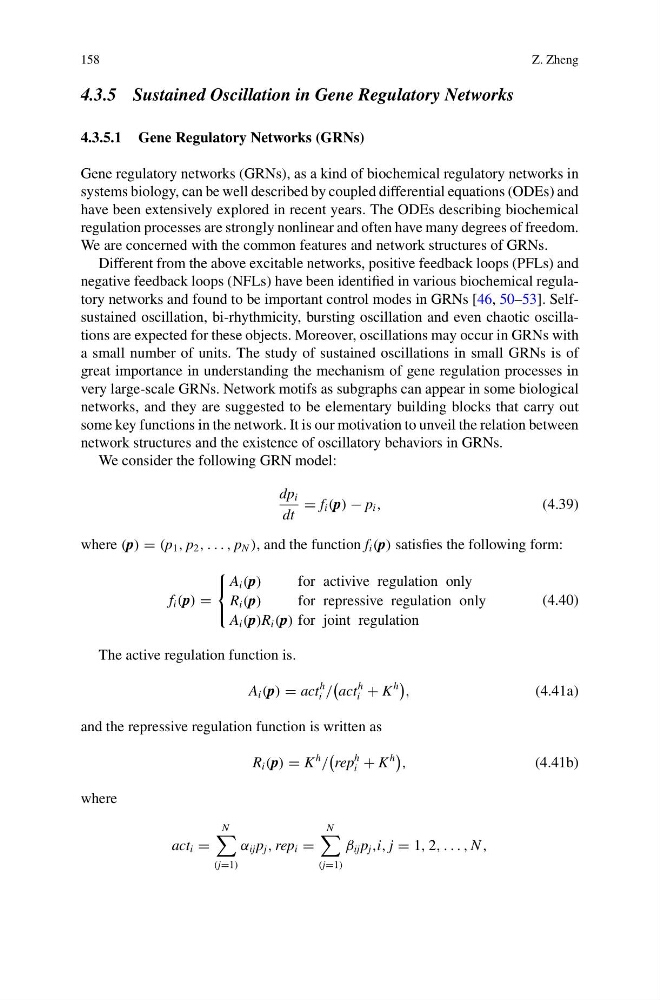
We consider the following GRN model:
dp i
dt
= f i (p) − p i ,
(4.39)
where (p) = (p 1 , p 2 , . . . , p N ), and the function f i (p) satisfies the following form:
f i (p) =
⎧
⎨
⎩
A i (p)
for activive regulation only
R i (p)
for repressive regulation only
A i (p)R i (p) for joint regulation
(4.40)
The active regulation function is.
A i (p) = act
h
i /
act
h
i + K
h
,
(4.41a)
and the repressive regulation function is written as
R i (p) = K
h
/
rep
h
i + K
h
,
(4.41b)
where
act i =
N
(j=1)
α ij p j , rep i =
N
(j=1)
β ij p j ,i, j = 1, 2, . . . , N ,
Z. Zheng
4.3.5 Sustained Oscillation in Gene Regulatory Networks
4.3.5.1 Gene Regulatory Networks (GRNs)
Gene regulatory networks (GRNs), as a kind of biochemical regulatory networks in
systems biology, can be well described by coupled differential equations (ODEs) and
have been extensively explored in recent years. The ODEs describing biochemical
regulation processes are strongly nonlinear and often have many degrees of freedom.
We are concerned with the common features and network structures of GRNs.
Different from the above excitable networks, positive feedback loops (PFLs) and
negative feedback loops (NFLs) have been identified in various biochemical regulatory networks and found to be important control modes in GRNs [46, 50–53]. Selfsustained oscillation, bi-rhythmicity, bursting oscillation and even chaotic oscillations are expected for these objects. Moreover, oscillations may occur in GRNs with
a small number of units. The study of sustained oscillations in small GRNs is of
great importance in understanding the mechanism of gene regulation processes in
very large-scale GRNs. Network motifs as subgraphs can appear in some biological
networks, and they are suggested to be elementary building blocks that carry out
some key functions in the network. It is our motivation to unveil the relation between
network structures and the existence of oscillatory behaviors in GRNs.
We consider the following GRN model:
dp i
dt
= f i (p) − p i ,
(4.39)
where (p) = (p 1 , p 2 , . . . , p N ), and the function f i (p) satisfies the following form:
f i (p) =
⎧
⎨
⎩
A i (p)
for activive regulation only
R i (p)
for repressive regulation only
A i (p)R i (p) for joint regulation
(4.40)
The active regulation function is.
A i (p) = act
h
i /
act
h
i + K
h
,
(4.41a)
and the repressive regulation function is written as
R i (p) = K
h
/
rep
h
i + K
h
,
(4.41b)
where
act i =
N
(j=1)
α ij p j , rep i =
N
(j=1)
β ij p j ,i, j = 1, 2, . . . , N ,