

156
Z. Zheng
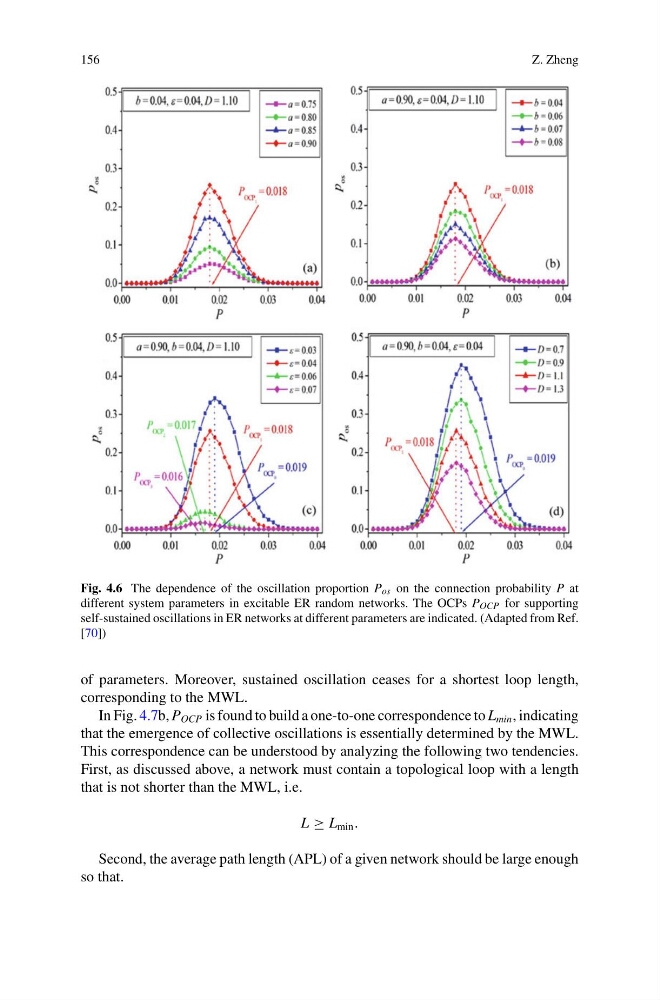
Fig. 4.6 The dependence of the oscillation proportion P os on the connection probability P at
different system parameters in excitable ER random networks. The OCPs P OCP for supporting
self-sustained oscillations in ER networks at different parameters are indicated. (Adapted from Ref.
[70])
of parameters. Moreover, sustained oscillation ceases for a shortest loop length,
corresponding to the MWL.
In Fig. 4.7b, P OCP is found to build a one-to-one correspondence to L min , indicating
that the emergence of collective oscillations is essentially determined by the MWL.
This correspondence can be understood by analyzing the following two tendencies.
First, as discussed above, a network must contain a topological loop with a length
that is not shorter than the MWL, i.e.
L ≥ L min .
Second, the average path length (APL) of a given network should be large enough
so that.
Z. Zheng
Fig. 4.6 The dependence of the oscillation proportion P os on the connection probability P at
different system parameters in excitable ER random networks. The OCPs P OCP for supporting
self-sustained oscillations in ER networks at different parameters are indicated. (Adapted from Ref.
[70])
of parameters. Moreover, sustained oscillation ceases for a shortest loop length,
corresponding to the MWL.
In Fig. 4.7b, P OCP is found to build a one-to-one correspondence to L min , indicating
that the emergence of collective oscillations is essentially determined by the MWL.
This correspondence can be understood by analyzing the following two tendencies.
First, as discussed above, a network must contain a topological loop with a length
that is not shorter than the MWL, i.e.
L ≥ L min .
Second, the average path length (APL) of a given network should be large enough
so that.